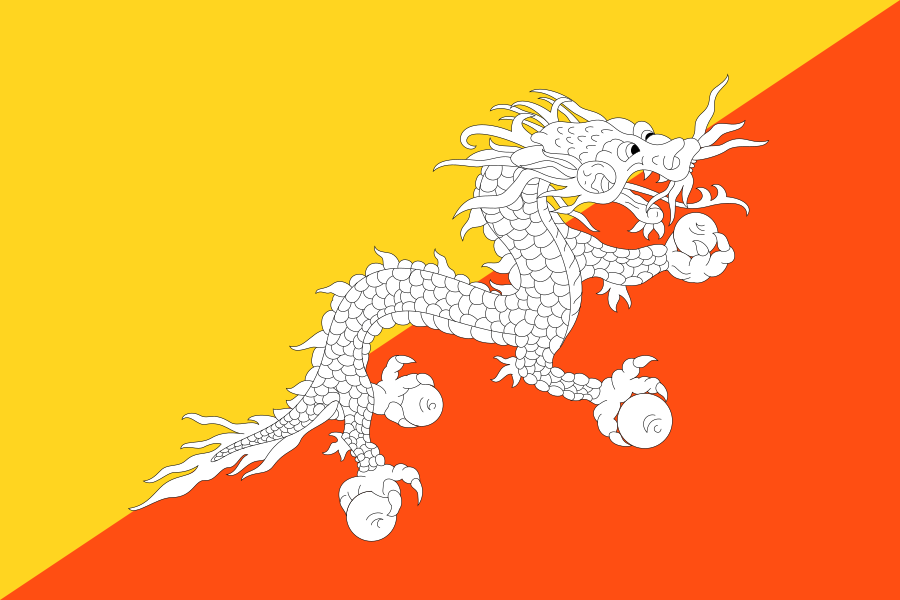
Bhutan’s national flag combines yellow and orange diagonal halves with a white dragon across their boundary. Its height is two thirds of its length. The displayed dragon faces the fly and holds four jewels.
Specification
Article 1(5) of the Constitution identifies the First Schedule as the authority for the national flag. That schedule describes the yellow upper half, orange lower half, and white dragon across their division. Section 2 of the 1972 rules prescribes the 2:3 hoist-to-fly ratio at every size.
Meaning in the Constitution
Yellow represents secular tradition and the King; orange represents spiritual tradition, including the Kagyu and Nyingma Buddhist traditions. The dragon evokes the Kingdom’s name. Its white color signifies the people’s pure thoughts and loyalty across ethnic and linguistic differences.
Specimen colors
The SVG uses the following screen values. Neither cited legal text supplies numeric color standards; these values are artwork approximations, not physical production specifications.
Specimen only / #FFD520Specimen only / #FF4E12Specimen only / #FFFFFFConstruction notes
With the hoist at left, the specimen divides a 900 × 600 rectangle from (0,600) to (900,0), producing equal triangular areas: yellow above and toward the hoist, orange below and toward the fly. These coordinates describe the SVG, not a legislated construction grid.
The rules place the dragon across the color boundary but provide no coordinate drawing for its outline, claws, jewels, or internal detail. This Commons-derived rendering uses white paths and black detailing. Its field and ratio match the legal description; its particular dragon drawing is illustrative. Preserve the complete artwork when scaling. For manufacture, obtain an approved model rather than treating this specimen as an official master. Asset provenance and geometry →
Historical record
The Centre for Bhutan Studies’ 2002 account places the first national flag at the 1949 Indo-Bhutan Treaty signing. Earlier forms differed in proportions, dragon color, and placement. It dates the replacement of the lower red field by orange to 1968–69; 1969 is commonly listed for the current form. No precise adoption day is established here.
The National Assembly endorsed the flag rules in Resolution 28 of its 36th session on 8 June 1972. The 2008 Constitution subsequently included the flag’s description. BT-NAT-1972 is this catalogue’s editorial identifier anchored to the rules year, not a government code or a claim that the design originated in 1972. Earlier designs are not represented by this specimen.
Use and display
The rules address state celebrations, government premises, schools, diplomatic use, and designated mourning. They prescribe daytime display at government premises and prohibit inverted or damaged flags. Vehicle entitlement and ceremonial handling have separate provisions; consult the full rules for those contexts.
Source trail
Constitution of the Kingdom of Bhutan, 2008: Article 1(5) and First Schedule, printed page 62 (FAOLEX copy) ↗ — legal identity, colors, and symbolism.
Office of the Attorney General: National Flag Rules of Bhutan, 1972 ↗ — endorsement date, sections 1–2 on description and ratio, sections 3–8 on use.
Dorji Penjore and Sonam Kinga, Centre for Bhutan Studies (2002): The Origin and Description of the National Flag and National Anthem of the Kingdom of Bhutan, pages 4–13 ↗ — author-hosted copy; historical development and field orientation.
FOTW: Bhutan ↗ — conventional 1969 dating.
Specimen source, contributor history, public-domain declarations, and local checksum →
Sources checked 6 September 2026. Unresolved: an exact adoption day for the orange-field design, a definitive dragon production drawing, and authoritative numeric physical color specifications.
Frequently Asked Questions
When did Bhutan’s current flag originate, and why does the record code contain 1972?
The Centre for Bhutan Studies’ historical account dates the change from a red lower field to orange to 1968–69. The current form is conventionally dated to 1969, as recorded by Flags of the World; an exact adoption day is not established by the evidence cited here. Separately, the National Assembly endorsed the flag rules on 8 June 1972, in Resolution 28 of its 36th session. This catalogue’s editorial identifier, BT-NAT-1972, refers to that rules year. It is not a government code and does not date the design’s origin to 1972.
Flag terminology
The hoist is the edge where a flag attaches to its pole or support; the fly is the opposite, free edge. In a hoist:fly ratio, the measurements describe the flag’s height and length: 2:3 means two units high for every three units long. Section 2 of Bhutan’s 1972 flag rules specifies this ratio.
With the attachment edge shown at the left, yellow upper-hoist describes the yellow field above the diagonal and toward that edge; orange lower-fly describes the orange field below the diagonal and toward the free edge. The specimen’s coordinates describe its artwork, while the 2:3 ratio is an official specification. Its dragon drawing and screen colors remain illustrative rather than certified production specifications.