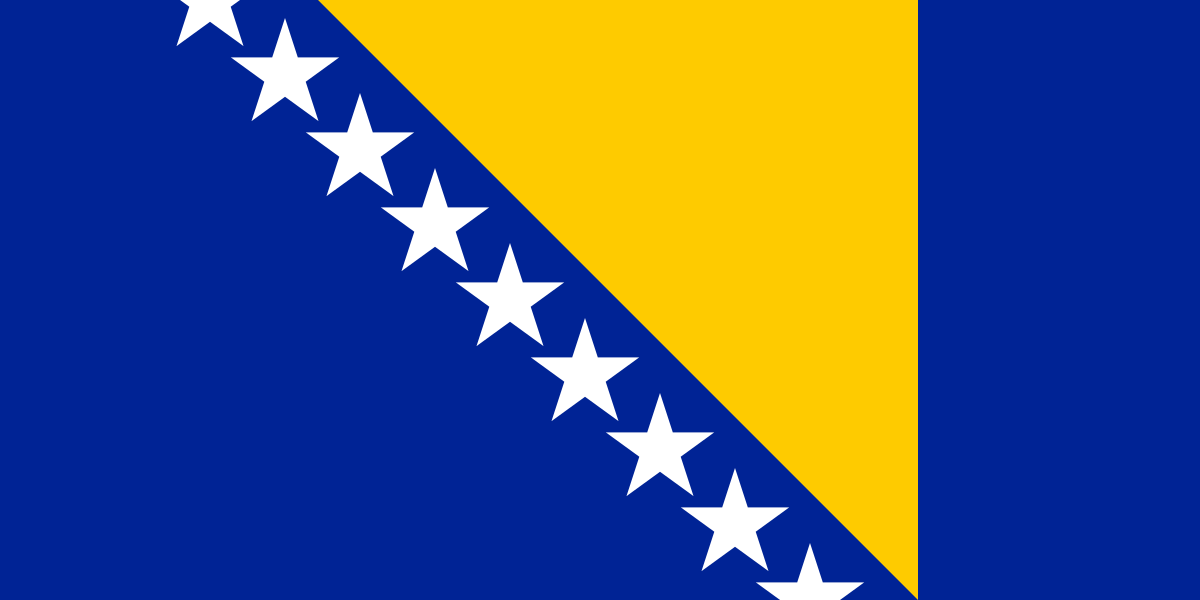
Bosnia and Herzegovina’s current national flag is blue with a yellow right triangle and a diagonal row of white stars. Its hoist-to-fly ratio is 1:2. The design took effect on 4 February 1998. Adoption decision ↗
Specification
The 1998 law’s Article 3 places the yellow triangle to the right of center, with white five-pointed stars following its left side between the upper and lower edges. Article 4 incorporates the technical annex. The English transcription’s “length and width” wording accompanies 1:2; the published construction establishes the intended short hoist and twice-long fly. Law transcription ↗
Colors
The adoption decision explicitly directs that blue and yellow match the Council of Europe flag. It supplies no numeric color codes. Heimer’s construction account reports Reflex Blue and Pantone 116; FOTW also records differing Olympic and naval-manual palettes. Those later references do not establish one mandatory HEX conversion or textile tolerance.
Specimen screen colors
#002395 / SVG fill#FECB00 / SVG fill#FFFFFF / SVG fillThese are retained display values from the source vector. They are screen approximations, not official physical production standards.
Construction notes
Heimer reports a 2000 × 1000 construction: the triangle’s equal legs each measure 1000, its upper-left vertex is 530 from the hoist, and the fly margin is 470. Stars occupy circles of diameter 190, with the terminal circle centers on the top and bottom edges. The star-to-triangle distance is not specified. FAME: construction account ↗
Our SVG uses a 16 × 8 viewBox. Triangle vertices (4.24,0), (12.24,0) and (12.24,8) reproduce those proportions. The retrieved vector’s stars were too large for the reported circle diameter; their outline was replaced with regular five-pointed stars of radius 0.76, giving diameter 1.52, or 19% of the hoist. Nine instances have centers (2.8+n,n), for n=0 through 8. Clipping leaves seven complete stars and two partial stars.
The retained diagonal offset is an editorial reference choice. Engene’s construction notes likewise identify missing star-position dimensions in the OHR model. The original annex was not retrieved, so this adapted specimen is not a certified production master. Asset measurements and rights →
Symbols and use
OHR’s contemporary explanation associates the triangle with the three constituent peoples, yellow with the sun and hope, and blue and stars with Europe. Its 5 February briefing, transcribed by FOTW, explains the clipped terminal stars as a continuing rather than finite sequence. These are attributed explanations, not extra construction rules. OHR Bulletin 65 ↗ · Briefing transcription ↗
The law provides for display on state institutions, diplomatic premises, border crossings, official presidential transport and occasions when the country is represented internationally. FOTW classifies it for civil, state and military use on land. This entry covers the national design and does not supply a separate ensign or manufacturing standard.
Historical record
Following Parliament’s 3 February deliberations, High Representative Carlos Westendorp selected the triangle-and-stars design on 4 February 1998 and brought the law into effect immediately, changing the proposed colors to those of the Council of Europe. OHR records its raising at the Presidency that day, at the United Nations on 6 February and at the Nagano Winter Olympics on 7 February. These hoistings are distinct from the adoption date. OHR Bulletin 66 ↗
Parliament’s catalogue lists a June 2016 unofficial consolidated text of the flag law. Its download and the Ministry of Justice’s 2001 law endpoint were unavailable during review; no separate parliamentary enactment or proclamation day is inferred here. The current design is corroborated by the national entry in FOTW. This record’s use period begins with the 1998 decision.
Source trail
Reviewed 14 September 2026. The adoption decision was read directly; the law and construction were checked through the identified vexillological transcriptions and accounts. The original technical annex remains uninspected.
- OHR: decision of 4 February 1998 ↗ — immediate commencement and Council of Europe color reference.
- OHR Bulletin 65 ↗ — contemporary symbolism; Bulletin 66 ↗ — first hoistings and use.
- Flags of the World: flag law ↗ — 1998 legal text transcription.
- Željko Heimer, FAME: national flag and construction ↗ — dimensions and missing star offset.
- Flags of the World: Bosnia and Herzegovina ↗ — current classification, Engene’s reconstruction notes, color-reference differences and OHR briefing.
- Parliament: consolidated-law catalogue entry ↗ — indexed title available; full text inaccessible during review.
- Ministry of Justice: 2001 law PDF ↗ — unavailable during review.
- Local asset register → — source SVG, public-domain basis, modifications and checksum.