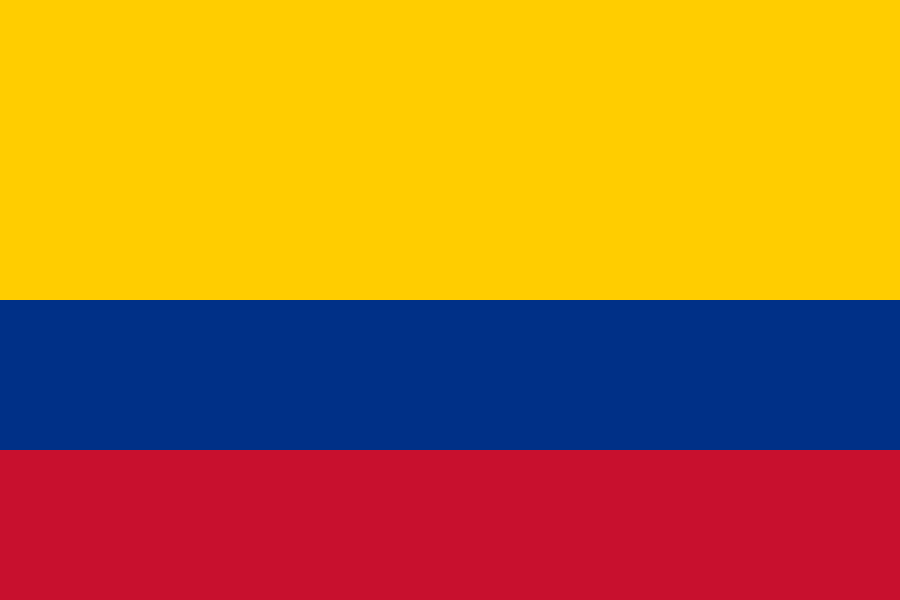
Colombia’s current plain national flag has three horizontal bands: yellow occupies the upper half, blue the next quarter, and red the bottom quarter. The usual reference format is 2:3, without an emblem.
Specification
Law 12 of 1984, articles 1–2, recognizes the flag as a national symbol and prescribes the color order and unequal band heights. Article 2 does not specify the overall hoist-to-fly ratio. Flags of the World, citing the Album des pavillons, records 2:3; this entry uses that reference format without treating it as a dimension stated in the 1984 law.
Colors and specimen
The law names yellow, blue, and red. The following values are the actual fills in the transcribed Commons SVG source code.
SVG #FFCD00 / screen approximationSVG #003087 / screen approximationSVG #C8102E / screen approximationThe Commons page’s RGB annotations do not agree with its displayed HEX code. Flags of the World also documents differing reference color approximations. No independently verified current textile standard, Pantone equivalence, or manufacturing tolerance is asserted here; screen fills are not production specifications.
Construction notes
For hoist H, the legal bands have heights H/2, H/4, and H/4. For the reference 2:3 rectangle, choose fly 3H/2. These coordinates express the cited relationships rather than a separate official construction sheet.
The specimen’s 900 × 600 viewBox contains three overlapping rectangular paths: red to y=600, blue to y=450, and yellow to y=300. Their visible heights are 300, 150, and 150 units across the full 900-unit fly. No border, lettering, or emblem is present. ViewBox and accessible metadata were added; the source-code paths and fills were retained.
Historical record
Archivo de Bogotá dates the present arrangement to the decree of 26 November 1861, sanctioned by Tomás Cipriano de Mosquera. Its transcription of article 2 specifies horizontal yellow, blue, and red bands with the yellow twice the height of each other band.
The archive traces earlier adoption of the colors through 1819 and 1834. Those antecedents are historical designs, not interchangeable specimens of the present arrangement. The date recorded here identifies the 1861 arrangement, not the first use of these colors. Law 12 of 1984 restated the bands; it did not introduce a new tricolor design.
Symbols and interpretation
The Foreign Ministry’s explanation associates yellow with the land’s abundance and with sovereignty, harmony, and justice; blue with Colombia’s seas and connections to other peoples; and red with life, love, strength, and progress. This is an official educational interpretation, not a colorimetric or construction rule.
Usage and status
Foreign Ministry Circular 36 of 2021 confirms that ordinary national institutions and diplomatic and consular missions use the plain three-band flag. It cites Decree 1687 of 1986 and Decree 1967 of 1991; the latter reserves the version with the coat of arms for the President and armed forces. That armorial variant is outside this specimen’s scope.
Decree 1967 of 1991, articles 4–6, addresses adequate illumination, keeping the flag clear of the ground, and preserving its original form. This record identifies the plain national flag; specialized maritime and service flags require their own specifications.
Source trail
Checked 13 September 2026. Spanish descriptions are paraphrased in English.
- Función Pública / Law 12 of 1984 — articles 1–2 and enactment date.
- Archivo de Bogotá / El tricolor nacional — 1861 decree transcription and historical chronology.
- Cancillería / Circular 36 of 2021 — plain flag in institutional and diplomatic use.
- Cancillería / Decree 1967 of 1991 — display and armorial-use distinctions.
- Cancillería / Símbolos patrios — national identity and educational color meanings.
- Flags of the World / Colombia — 2:3 reference format and differing color approximations.
- Wikimedia Commons / reviewed file-page revision — displayed SVG source code, contributor history, and public-domain declarations; local asset review.
