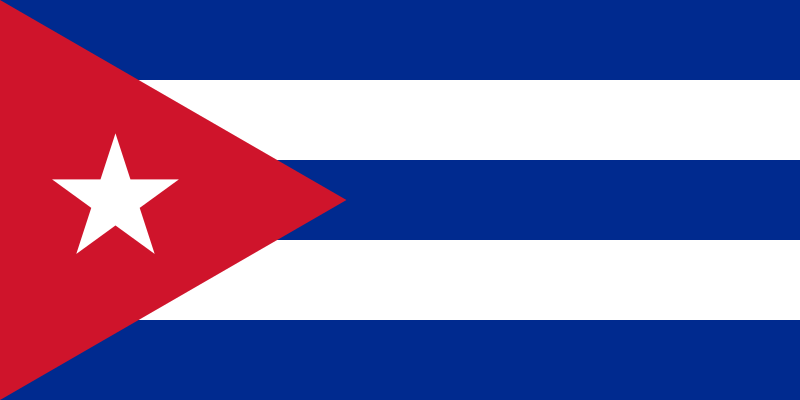
Cuba’s current national flag has five equal horizontal stripes, three deep blue alternating with two white, and a red equilateral triangle at the hoist bearing a white five-pointed star. The flag is twice as long as it is high. The star’s outer-tip circle has a diameter of one-third of the hoist.
Specification
Article 2 of the 2019 Constitution names the flag of the lone star among Cuba’s national symbols. Law 128/2019, articles 5–7, calls it the Bandera Nacional and prescribes its layout: five equal alternating stripes, blue at both outer edges, a red equilateral triangle whose vertical side fills the hoist, and a centered white star with one point upward.
Colors
The law names azul turquí (deep blue), white and red. The inspected SVG uses #002A8F, #FFFFFF and #CF142B, respectively. These are inherited screen fills, not legally prescribed HEX values or certified textile matches.
Flags of the World’s color discussion reports differing recommendations from national-symbol guidance, Olympic manuals and editions of the Album des Pavillons. Such purpose-specific recommendations do not establish one universal manufacturing standard. No Pantone value is promoted here as a requirement of Law 128/2019.
Construction notes
Take the top-left corner as (0,0), with hoist H and fly 2H. Stripe boundaries fall at H/5, 2H/5, 3H/5 and 4H/5. Elementary geometry gives the triangle’s flyward vertex as (√3H/2, H/2) and its center as (√3H/6, H/2). Place the star’s outer tips on a circle of radius H/6 about that center, with the upper tip vertically above it. These coordinates are derived from article 7, rather than additional dimensions quoted from the law.
The local SVG has viewBox 0 0 800 400, 80-unit stripes, triangle apex (346.410162, 200), and star center (115.470054, 200), with outer radius 66.666667. The retrieved Commons-derived vector used a roughly 60-unit star radius. Its triangle and star paths were recalculated locally; the field paths and colors were retained. Coordinates are rounded to nine decimal places. Flags of the World also records a 3/10-hoist star in Album 2000, contrasting it with the one-third value in Flaggenbuch 1939. Article 7 resolves the choice for this current record: use one-third.
The star is rendered as a filled regular pentagram. Article 7 specifies the five points, circle, center and orientation without a separate numerical inner radius. Annex II is legally part of the specification, but its construction drawing was not independently inspected here. The specimen is an editorial geometric reference, not a certified copy of that drawing or a production pattern.
Article 9 prefers polyamide fabric but permits other suitable materials. Article 10 sets sizes for particular settings and also allows other sizes according to the display space; the ratio above does not replace those contextual requirements.
Symbols
Article 6 supplies the statutory interpretation: the star represents a free, independent and sovereign republic and Cuban unity; the triangle expresses liberty, equality and fraternity, with red recalling blood shed in the struggle. White signifies purity of ideals and virtue. Blue represents patriotic aspirations and the island’s administrative divisions when the flag was designed. These are the law’s present-day meanings, rather than proof of every original designer’s intention.
Historical record
Flags of the World records the flag being raised by Narciso López at Cárdenas on 19 May 1850. That early use precedes national adoption; it does not establish that today’s exact shades and geometry were used in the original textile.
Article 5 explicitly records adoption at the Assembly of Guáimaro on 11 April 1869. The Flags of the World country record instead headlines 20 May 1902, the start of republican national use. The two dates describe different milestones; this catalogue uses the adoption date stated in the law.
Law 128 was approved on 13 July 2019 and published in Gaceta Oficial No. 71 on 19 September 2019. Its final provisions set commencement 180 days after publication and replace Law 42/1983 and its 1988 regulation. This is a later specification and usage framework, not a new adoption of the flag. The displayed specimen represents the current legal design and is not a reconstruction of an early textile.
Usage and status
The national flag serves civil and institutional representation, including use aboard Cuban vessels. Law 128 applies in Cuba, on Cuban vessels and aircraft, and in protected Cuban missions abroad. Articles 12–15 require respectful, prominent placement; when flown with other national flags, it has a separate staff of equal height and is raised and lowered with them.
Article 22 places the triangle at the viewer’s left in horizontal ceremonial display, with the star upright. In vertical display, the triangle’s base is at the top and the formerly upper star point faces the viewer’s right. This is a clockwise quarter-turn of the horizontal specimen.
Source trail
Reviewed 14 September 2026. English descriptions are editorial paraphrases of Spanish legal texts.
- 2019 Constitution / official gazette copy hosted by UN ECLAC — printed page 70, article 2: entity and constitutional flag name.
- Law 128/2019 / legislative text reproduced by vLex — articles 4–15: adoption, symbolism, geometry, materials, dimensions and usage.
- Gaceta Oficial No. 71, 19 September 2019 / mirrored text — article 22, special provision four and final provisions; the government-hosted PDF could not be retrieved during this review. Annex II drawing remains unverified.
- Flags of the World / Cuba — republican-use date, use classification and differing color recommendations; historical material is distinguished from current law.
- country-flags / retrieved Commons-derived SVG · repository provenance · Commons history and public-domain declarations — source artwork and rights; see local modifications and geometry review.


National flags → · Related record: Chile’s distinct lone-star construction →