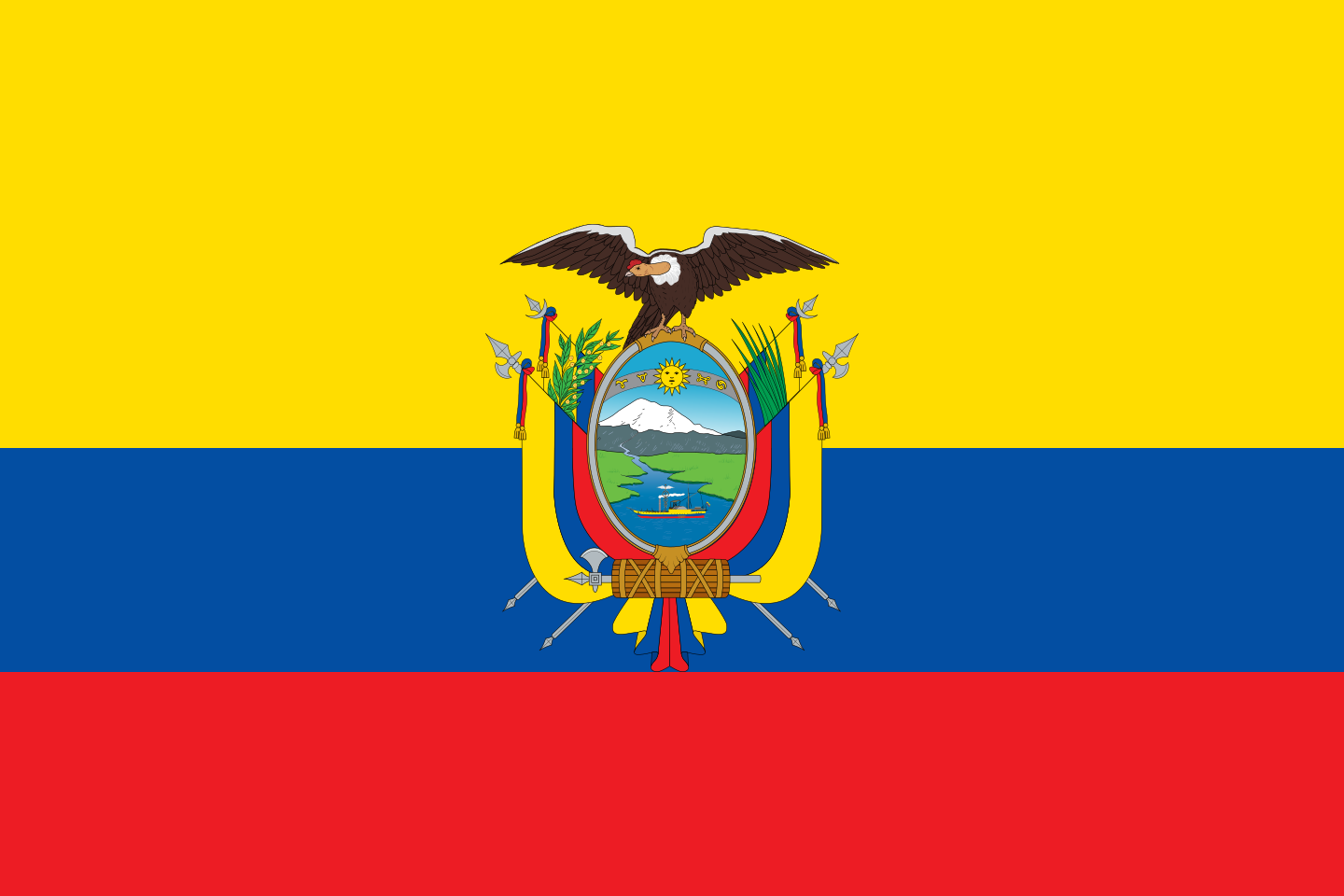
Ecuador’s current armorial national flag has yellow across its upper half, blue across the next quarter and red across the bottom quarter, with the national arms in the center over yellow and blue. The specimen follows the 2:3 format in the Presidency’s November 2009 guidance.
Specification
Constitution, article 2, recognizes the legally established flag, arms and anthem as national symbols. The 1900 decree, articles 2–3 (transcription), specifies horizontal yellow, blue and red, yellow twice the height of either other band, and central arms over yellow and blue for the listed state uses. It does not give an overall rectangle ratio.
The Presidency’s Instructivo, November 2009, section 1.2, gives 2.20 m × 1.47 m and an explicit 3:2 length-to-height relationship. The example is rounded; the specimen follows the stated proportion. This official guidance survives here in a Flags of the World mirror; it is not presented as a newly enacted flag law.
Colors and specimen
The statutory color names are yellow, blue and red. The principal fills below are read directly from the SVG.
SVG #FFDD00 / screen approximationSVG #034EA2 / screen approximationSVG #ED1C24 / screen approximationThe arms contain additional fills and gradients. Flags of the World records differing Album and Olympic color schedules. None is adopted here as an Ecuadorian textile standard; no verified Pantone, RAL, physical tolerance or screen-to-fabric equivalence is asserted.
Construction notes
For hoist H, use fly 3H/2 and band heights H/2, H/4 and H/4. These are coordinate expressions of the cited relationships. The 1440 × 960 specimen has a red full-field rectangle, blue overlay to y=720 and yellow overlay to y=480, leaving visible bands 480, 240 and 240 units high.
The arms group is centered horizontally and spans approximately the middle half of the hoist, extending from yellow into blue. Its detailed paths, gradients and internal mirrored components are source artwork, not a claim of exact legal symmetry or an independently verified heraldic construction grid. The SVG’s viewBox and accessible metadata were added locally; artwork was retained. No calculator substitutes for an official manufacturing schedule.
Historical record
The National Assembly’s historical account dates restoration of the yellow-blue-red tricolor to 26 September 1860 under Gabriel García Moreno, after fifteen years of a different flag. It identifies the congressional decree of 31 October 1900 as the later official regulation of the unequal bands. The Assembly’s arms account also dates congressional adoption of the arms to 31 October 1900.
The decree transcription ends with a 7 November 1900 executive order, while its heading mentions 5 December promulgation and its page description gives 7 November publication. Other official commemorative accounts give 5 November. The original gazette issue has not been independently inspected: these are not collapsed into one falsely precise adoption date. This catalogue uses the congressional date and year for the armorial framework.
Flags of the World preserves older 1:2 reports alongside the later 2:3 guidance. No original statute establishing 1:2 was verified. November 2009 is the date of the inspected guidance, not a proven first-ever use of 2:3. Earlier proportions and earlier arms drawings are not interchangeable with this specimen.
Symbols and interpretation
The Instructivo, section 2.1, describes an oval shield with a sun and zodiac signs Aries through Cancer, Chimborazo, the Guayas river and a steamship with a caduceus mast. Surrounding national flags and branches support the composition beneath a spread-winged condor. It connects the caduceus with navigation and commerce, the branches with peace, and the zodiac sequence with historic events in March–June. These explanations describe the emblem; they do not specify digital colors.
Usage and status
The 2009 guidance describes a fabric Bandera Nacional with arms on both faces for fixed flagpoles at public, private, civil, military and police institutions. It separately describes a velvet ceremonial Pabellón Nacional and an escorted Estandarte. This specimen shows the rectangular flag without institutional lettering.
The 1900 decree distinguished armorial state and military uses from a plain tricolor for merchant vessels and private persons (article 6), and a municipal star variant (article 4). These are separate usage forms. The later guidance’s broader armorial use does not itself demonstrate repeal of those provisions; this entry does not certify contemporary maritime protocol or substitute the plain form for the displayed arms-bearing flag.
Source trail
Checked 14 September 2026. Spanish descriptions are paraphrased in English.
- Ministry of Defence / Constitution, article 2 — constitutional status.
- 1900 legislative decree / Wikisource transcription — articles 1–6, congressional and executive dates; original gazette not inspected.
- Presidency / Instructivo de uso de los Símbolos Patrios, November 2009 — sections 1.1–1.3 and 2.1; archived by Flags of the World.
- National Assembly / 26 de Septiembre de 1860 — tricolor restoration and 1900 chronology.
- National Assembly / Día del Escudo Nacional — congressional adoption of arms.
- Flags of the World / Ecuador — conflicting ratio, usage and color reports.
- Commons / Flag of Ecuador.svg — contributors, CC0 rights and file history; local specimen audit.
