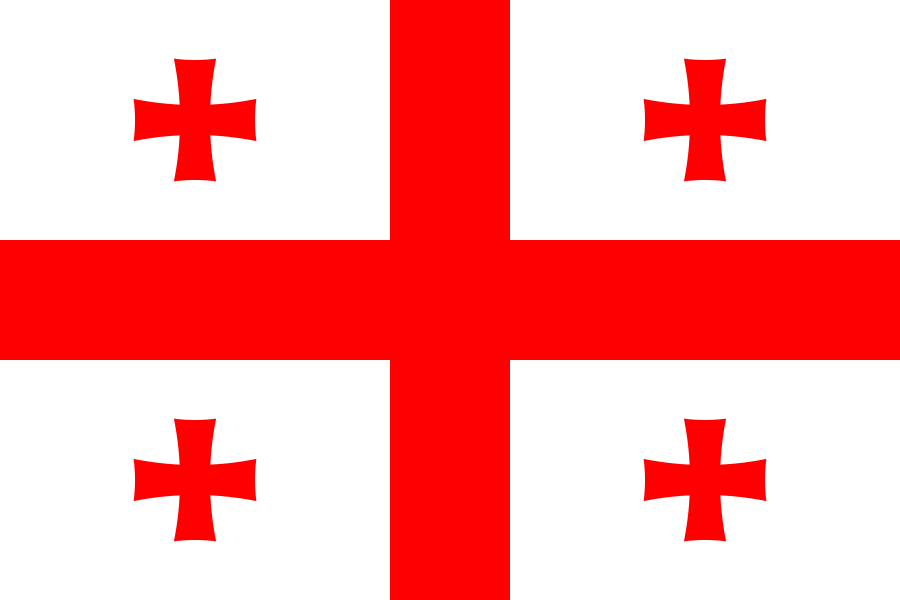
Georgia’s national flag is white with one large red cross reaching the edges and four smaller red crosses, one in each quarter. Its hoist-to-fly ratio is 2:3. Parliament adopted the five-cross flag on 14 January 2004.
Specification
Organic Law No 3724-Iს, article 2, defines the white rectangle, central red cross and four same-colored Bolnur-Katskhuri crosses. Annexes 1–2 prescribe the image and dimensions. The English translation calls the quarters “squares”; the specimen’s quarters are rectangular.
Colors and symbols
The statutory color names are white and red. The SVG uses #FFFFFF and #FF0000, retained from its source as screen values. No textile, Pantone or RAL match is certified here. Secondary references report differing reds: FOTW’s color survey includes Olympic and naval-publication palettes; these are not interchangeable legal standards. The legal description names the crosses but assigns no color symbolism or individual designer.
Construction notes
The local vector uses a 300 × 200 canvas, 40-unit central cross limbs, and small-cross centers at (65,40), (235,40), (65,160) and (235,160). These are specimen coordinates, not physical dimensions or manufacturing tolerances.
MapGrid’s analysis of the 2018 annex identifies incompatible small-cross measurements. This specimen follows its arc-based interpretation: radii 104 and 54, with centers offset 109 and 74 units from each small-cross center. The resulting outer span is approximately 40.920 units and inner span 10.253, rather than the labelled 40 and 10. It cannot satisfy both sets simultaneously.
.svg)
The Commons-derived source used radius 55 and slightly offset cross placements; those were changed locally. The interpretation matches the cited arc construction, not every dimension of the legal drawing. The official annex remains the production authority. Its image could not be independently inspected during this review; numerical detail was cross-checked through the linked construction analysis. Physical manufacture requires clarification of the conflicting dimensions and applicable material/color requirements.
Historical record
David Chkheidze’s 2017 International Congress of Vexillology paper dates parliamentary adoption to 14 January 2004 and Presidential Decree 31 to 25 January. It relates the design to a flag over Tbilisi in the 1367 Pizzigano chart; that precedent is not evidence of continuous use of today’s exact vector geometry.
The former flag law is a historical source, not current authority; its English closing date reads 2014, conflicting with the documented 2004 adoption. The 2018 organic law consolidated the state symbols. FOTW records its commencement on 16 December 2018 and explains the end-arc radius revision from 0.56 to 0.54. This entry represents the current construction interpretation; older drawings should not be substituted without identifying their date.
Use and display
The current Georgian usage law, articles 2–8, establishes Flag Day, protects the design and proportions, and requires permanent display at specified government buildings, diplomatic premises, educational institutions and Georgian-registered maritime vessels. Damaged or faded flags must not be used. Under the 6 February 2025 amendment to article 5, manufacturing procedures are set by government resolution. The available English translation predates that change.
Source trail
Legislative Herald: 2018 organic law ↗ — legal name and description; Georgian text and annexes ↗.
Legislative Herald: latest consolidated usage law ↗ — current display and manufacturing-rule authority.
Heraldry department: law and annexes ↗ — official alternative copy.
Flag Institute: Chkheidze, The flags of contemporary Georgia ↗ — adoption and historical reference.
FOTW: Georgia ↗ — ratio, construction chronology and differing color references.
MapGrid: construction analysis ↗ — explicit numerical inconsistency; local asset register — source SVG, rights and alterations. Sources checked 14 September 2026.