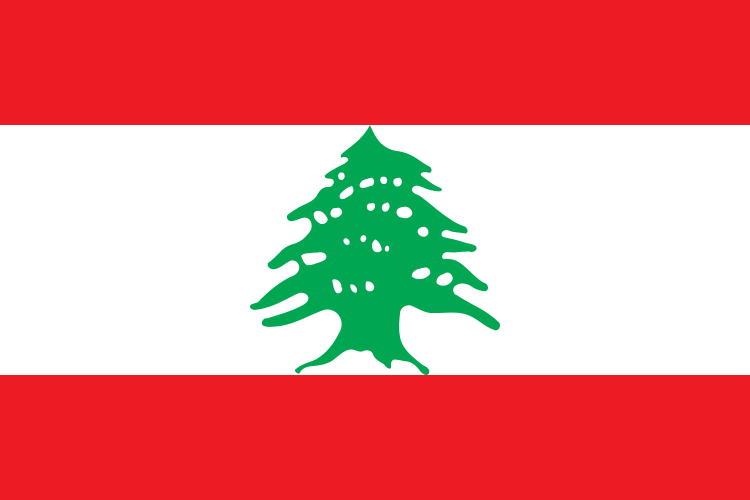
Lebanon’s current national flag has red bands above and below a white band bearing a green cedar. The white band occupies half the height. The constitutional description dates to 7 December 1943; the familiar 2:3 rectangle is a customary format rather than a ratio stated in Article 5.
Specification
The Presidency’s Arabic text of Article 5 names the Lebanese flag and requires horizontal red, white and red sections. White equals the two red sections together. A green cedar stands centrally, with its tip meeting the upper red section and its base meeting the lower one. The article also relates the cedar’s size to one third of the white section; it supplies no measured outline or definition of that size relationship.
Display colors
The constitutional colors are red, white and green. No numerical color system is prescribed in the cited article. These values describe this SVG only; they are not certified fabric, ink, Pantone or RAL specifications.
HEX #ED1C24 / specimen screen valueHEX #FFFFFF / specimen screen valueHEX #00A651 / specimen screen valueConstruction notes
The specimen uses a 750 × 500 viewBox. Its red bands are each 125 units high, with 250 units of white between them. Equal outer bands and the 2:3 rectangle follow the customary construction documented by Flags of the World; the constitution expressly fixes the combined red-to-white relationship.
The source cedar’s curved outline has been retained and slightly rescaled and positioned so its bounds span x = 250–500 and y = 125–375. This implements the common reading of the one-third clause as a cedar envelope one third of the fly, reaching both red bands. It is an editorial interpretation, not a claim that the green silhouette covers exactly one third of the white area. The original outline is asymmetric; no new symmetry, branch count or official master drawing is asserted.
The Constitutional Council’s English rendering describes the cedar as occupying one third of the white stripe, while the Arabic uses a size relationship without a construction diagram. Neither text resolves an exact area-versus-width measurement. The specimen therefore illustrates the customary design with checked band geometry and edge contact, rather than serving as an official manufacturing standard. Its trunk and branches are green, in keeping with the constitutional color of the cedar.
Historical record
The present design belongs to Lebanon’s independence in 1943. The Presidency dates the amendment to Article 5 to 7 December 1943, which is the constitutional adoption date used here. The Lebanese Army’s historical account places a raising at Bshamoun on 21 November 1943, before parliamentary approval in December. These are separate events, not competing dates for the same legal act.
The Army’s December 2019 account describes the current flag as the official symbol of the Lebanese state and identifies 21 November as Flag Day. In its explanation of symbolism, red recalls the blood of those who died for the country, white evokes mountain snow, purity and peace, and the evergreen cedar signifies endurance and immortality. These are the Army’s explanatory meanings, not additional construction rules in Article 5.
This record covers the current constitutional design. The older mandate-era design belongs to a different period and is not an alternative specimen for current use.
Source trail
Presidency of the Lebanese Republic: Constitution, Article 5 (Arabic) ↗ — legal description and amendment date.
Constitutional Council: fundamental provisions, Article 5 (English) ↗ — official English rendering; compare the cedar-size wording.
Lebanese Army: “A flag’s story,” December 2019 ↗ — national status, Flag Day and attributed symbolism.
Lebanese Army: historical flags account ↗ — Bshamoun raising and subsequent parliamentary approval.
Flags of the World: Lebanon ↗ — customary 2:3 ratio, 1:2:1 bands and construction discussion; a secondary vexillological reference, not legislation.
Specimen source, rights and geometry audit. Sources reviewed 14 September 2026.