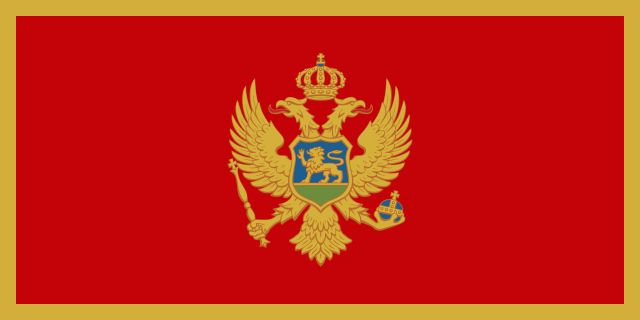
Montenegro’s current flag is red, bordered in gold, with the state arms in the center. Article 4 of the Constitution confirms this identity. The border is part of the flag’s surface. Constitution, Article 4 ↗ · Flag standard, Article 4 ↗
Specification
Article 5 of the state-symbols law gives length:width 2:1, arms height two-thirds of flag height, coincident flag and arms centers, and border width one-twentieth of the shorter side. Law, Article 5 ↗
The crowned golden double-headed eagle holds a sceptre in its heraldic right claw (viewer’s left) and a blue, gold-mounted orb in its left. Its breast shield carries a golden lion passant above green ground against blue. The crown, sceptre and orb bear crosses. Law, Article 4 ↗
Color specification
The flag decision, Article 2, prescribes CMYK red and light gold; it refers the arms colors to the separate arms decision. That decision supplies five process-color values. These are graphic specifications, not screen conversions.
| Element / color | Official CMYK (%) | Local SVG screen fill |
|---|---|---|
| Red field | 0 / 100 / 100 / 0 | #C40308 |
| Light gold / border and arms | 10 / 30 / 90 / 0 | #D3AE3B border; #D4AF3A arms |
| Blue in arms | 100 / 60 / 20 / 0 | #1D5E91 |
| Green in arms | 70 / 30 / 100 / 0 | #6D8C3E |
| Dark gold in arms | 10 / 65 / 100 / 0 | #B96B29 |
Flag decision ↗ · Arms decision, Article 2 ↗. The SVG also uses #C52126 for red details. Its two light-gold fills and secondary red are inherited rendering choices, not separate official colors. No official HEX, RGB, Pantone or RAL equivalence is asserted. Preserve the distinction between this screen specimen and physical production specifications.
Construction notes
For a horizontal frame of height H, use fly 2H, border H/20 and centered arms of height 2H/3. At 640 × 320 units, these become a 16-unit border, center (320,160), and arms height 213⅓ units. Centering that height leaves 53⅓ units above and below. These values are arithmetic consequences of Article 5, not additional official dimensions.
The downloaded vector uses a full gold background path and a red inset beginning at (16,16), measuring 608 × 288. Its original arms measured approximately 206.44 units high, centered around (319.32,160.63). This local adaptation groups the unchanged emblem paths, scales them uniformly by approximately 1.03338442 and translates their measured bounding-box center to (320,160). The rendered specimen and path structure were inspected; no external images or scripts are embedded. Asset audit →
The legal text does not define a Bézier-coordinate grid or a numerical emblem width. Bounding-box centering is this specimen’s implementation of the centering instruction. The government PDF contains horizontal and vertical construction illustrations, but their graphical detail could not be independently inspected in this review. Exact contour agreement with that master remains unverified. Use the official standard for manufacture; do not derive textile tolerances or a vertical layout by rotating this horizontal SVG.
Symbols and usage
The law identifies the flag as an expression of affiliation to Montenegro. It requires permanent display at specified public institutions, provides for holidays, diplomatic premises and polling places, and prescribes half-mast display during government-declared mourning. Aircraft and vessels follow separate rules. Law, Articles 2 and 15–17 ↗
No individual designer or separate popular meaning for each color is established by the inspected legal texts. The detailed display and material rules have their own Ministry of Culture source ↗; this record does not certify a fabric composition.
Historical record
Flags of the World reports parliamentary adoption on 12 July 2004. The government-hosted consolidation also dates Gazette 47/04 to 12 July, while the Gazette’s online register gives publication as 13 July. The law ties commencement to publication, so that one-day discrepancy is retained here rather than silently resolved. Adoption account ↗ · Consolidation ↗ · Gazette register ↗
The flag-standard decision explicitly records the government session of 16 September 2004 and publication in Gazette 58/04 on 17 September, with commencement on publication. This primary document takes precedence over the tentative 15 September date in Flags of the World. Decision, preamble and Article 7 ↗
The flag predates Montenegro’s declaration of independence on 3 June 2006. Early July–September 2004 specimens with fringe in place of the integral border, described by Flags of the World, are transitional renditions and are not interchangeable with the standardized flag shown here. Historical and transitional-use account ↗
Source trail
Reviewed 14 September 2026. Legal descriptions are paraphrased in English; government-hosted consolidations are identified by their publication dates.
- Government: Constitution of Montenegro ↗ — Articles 1 and 4, entity and national symbols.
- Government: state-symbols law, 2022 consolidation ↗ — amendments through 2019; Articles 2, 4–5, 15–17 and 32.
- Government: flag standard, Gazette 58/04 ↗ — dated 16 September 2004; text verified, illustration detail not independently inspected.
- Government: arms standard, consolidated through 2008 ↗ — Article 2 CMYK values.
- Official Gazette: original law register ↗ — publication-date discrepancy noted above.
- Flags of the World: Montenegro ↗ — July adoption, independence and transitional manufacture; tentative September date superseded here by the primary decision.
- Retrieved Commons-derived SVG ↗ · repository rights declaration ↗ · Commons rights and contributor history ↗ — adaptation and checksum in the local asset record →.

