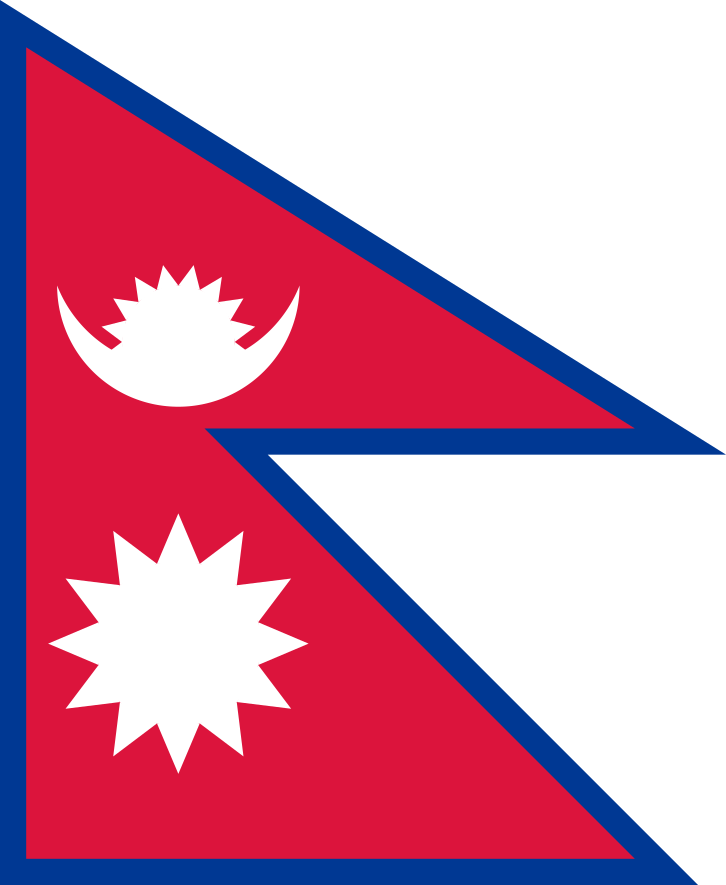
Nepal has the only non-quadrilateral sovereign-state flag. Two crimson pennants share a dark blue border and carry white emblems of the moon and sun.
Specification
The flag cannot be fully specified by a simple rectangular ratio. Schedule 1 of Nepal’s Constitution provides a geometric compass-and-straightedge style construction, beginning with the lower pennant and deriving every subsequent point.
Display colors
HEX #DC143C / display referenceHEX #003893 / display referenceConstruction notes
A production drawing should follow the constitutional sequence, not scale a casual outline. The apparent ratio is a consequence of that construction. The upper emblem is a crescent moon with points; the lower is a twelve-rayed sun.
Historical record
Earlier forms used separate pennants and included facial details in the celestial emblems. The modern construction and simplified white devices were standardized with the 1962 constitution and retained by the 2015 constitution.
Source trail
Nepal Law Commission: Constitution of Nepal, Article 8 and Schedule 1 ↗
The miniature on this page is a simplified display rendering; the constitutional construction remains authoritative.
Flag description
Two joined crimson pennants share a dark blue border. The upper pennant carries a white moon emblem; the lower carries a white twelve-rayed sun. The displayed specimen is a simplified rendering, not a production drawing.
Using the ratio and display colors
Hoist means the flag’s height along the edge attached to the pole; fly means its horizontal extent away from that edge. The approximate hoist:fly value listed here is 1.219:1. This rounded description of overall proportions cannot specify the pennant outlines, border or emblems and does not replace the constitutional geometric construction referenced in Article 8 and Schedule 1.
The listed HEX values, #DC143C for crimson and #003893 for blue, are screen display references. They are not presented as official physical manufacturing specifications for fabric, dyes or printing. This page cites no customary manufacturing color standard. For a production drawing, follow the constitutional construction rather than enlarging the simplified specimen or relying on the approximate ratio alone.
Source coverage and historical uncertainties
The source trail identifies the Nepal Law Commission’s Constitution of Nepal, Article 8 and Schedule 1, as the reference for the flag’s description and geometric construction. The link leads to a constitution collection rather than a specific passage, limiting direct checking of individual claims.
This page cites no supporting passages for the historical claims about separate pennants, facial details in earlier emblems or the exact standardization date of 16 December 1962. Standardization under the 1962 constitution and retention in the 2015 constitution are distinct historical claims. These accounts remain unconfirmed by claim-specific citations on this page.
Frequently Asked Questions
What is the flag’s shape?
It consists of two joined crimson pennants with a dark blue border. Its double-pennant outline is not a rectangle.
Where are the moon and sun?
The white moon emblem is in the upper pennant, and the white twelve-rayed sun is in the lower pennant. The displayed specimen is a simplified rendering.
Why is a rectangular ratio insufficient for drawing the flag?
The approximate hoist:fly value of 1.219:1 describes overall proportions only. It does not determine the pennant outlines, border or emblems. Production drawings should follow the constitutional geometric sequence.
Are the listed HEX values official manufacturing colors?
The record presents #DC143C and #003893 as display references, not official manufacturing colors. These screen values do not establish physical specifications for fabric, dyes or printing. This page cites no customary manufacturing color standard.