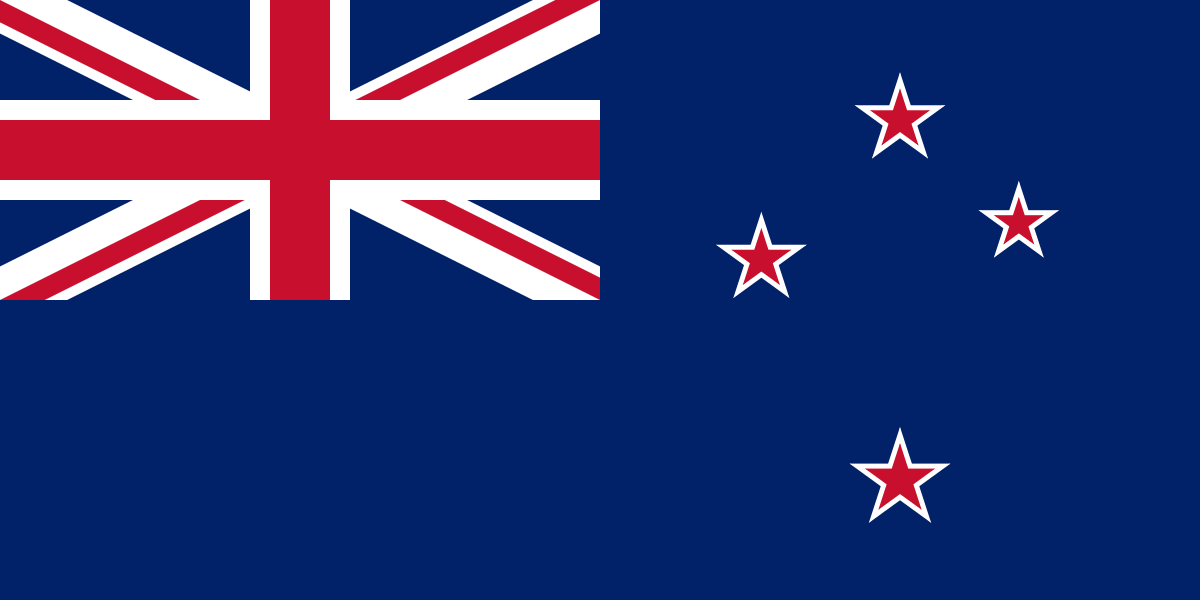
New Zealand’s current national flag is a blue ensign with the Union Jack and four white-edged red stars representing the Southern Cross. National adoption dates to 1902; its maritime predecessor dates to 1869.
Specification
Section 5 of the Flags, Emblems, and Names Protection Act 1981 names the New Zealand Flag by reference to the illustration in Schedule 1. It represents the Realm, Government, and people of New Zealand. This statutory identification is distinct from the detailed Gazette construction and Ministry color guidance.
Official reproduction colors
PANTONE 280C / Ministry digital approximation #02216EPANTONE 186C / Ministry digital approximation #C91235PANTONE white / screen swatch #FFFFFFManatū Taonga’s guidance supplies these references. The specimen retains its source’s #012169 blue and #C8102E red. Screen equivalents vary; neither set replaces physical color matching.
Construction notes
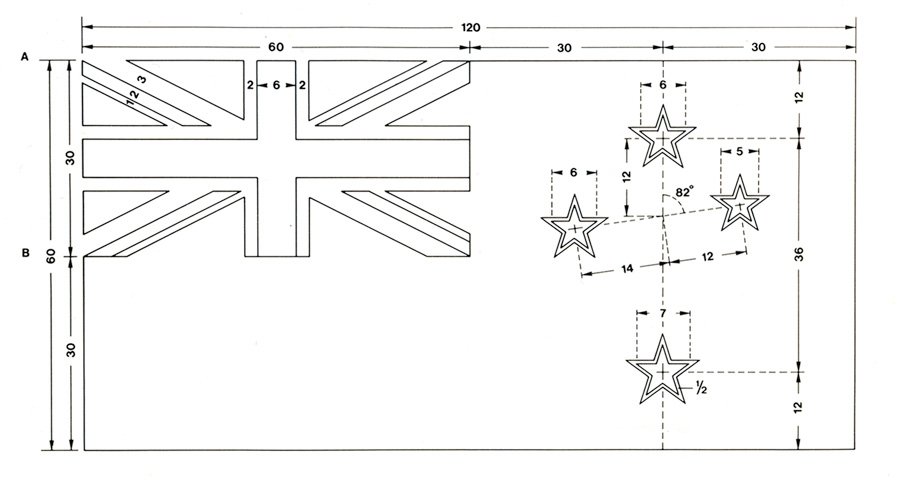
Using hoist H, the long axis lies at three quarters of the fly. Upper and lower star centers are H/5 from their respective edges. The short axis rises toward the fly, at 82° to vertical, crossing 12H/60 below the upper star.
| Star | Red width across points | Center placement |
|---|---|---|
| Upper | 6H/60 | Long axis |
| Lower | 7H/60 | 36H/60 below upper |
| Hoist-side | 6H/60 | 14H/60 along short axis from intersection |
| Fly-side | 5H/60 | 12H/60 along short axis from intersection |
White borders are H/120. Consult the Ministry construction drawing alongside its Gazette transcription.
Specimen precision
The inspected SVG uses a 1200 × 600 viewBox and a 600 × 300 canton. Its red star widths are 60, 70, 60, and 50 units respectively. The two lateral centers differ from the derived construction by less than 0.001 unit. Rounded star paths and white-star scaling approximate the prescribed 5-unit border. These are properties of this display asset, not official manufacturing tolerances; the specimen is not a certified production master.
Symbols and use
The Southern Cross locates New Zealand in the South Pacific; the Union Jack records the flag’s British ensign heritage. The Ministry attributes the 1869 design to Albert Hastings Markham.
Section 5 authorizes general national use on land and appropriate international use overseas. At sea it identifies New Zealand Government ships and other ships authorized under the Ship Registration Act 1992. Separate maritime ensigns have their own uses. For display practice, consult the Ministry’s display rules.
Historical record
The four-star ensign for colonial government ships was proclaimed on 23 October 1869. It spread into land use before acquiring national legal status. This earlier use should not be read as the adoption date of the national record shown here.
The New Zealand Ensign Act 1901 received King Edward VII’s approval on 24 March 1902. Publication of the Governor’s proclamation followed on 12 June; the 27 June Gazette notice then detailed changes to star sizes and positions. These are separate milestones, which explains the different 1902 dates in reference works. Subsequent shipping legislation carried the flag provisions forward; the 1981 Act provides the present statutory identification. NZHistory documents this sequence.
Source trail
New Zealand Legislation: Flags, Emblems, and Names Protection Act 1981, section 5 and Schedule 1 ↗ — current name, represented entity, statutory illustration, and use.
Manatū Taonga: New Zealand flag ↗ — technical description, Gazette transcription, designer, and official reproduction colors.
NZHistory: New Zealand ensign proclaimed, 23 October 1869 ↗ — maritime origin.
NZHistory: The NZ flag ↗ — 1902 approval, proclamation, construction changes, and later legislation.
Wikimedia Commons: source artwork and public-domain declaration ↗ · Retrieved SVG ↗ — Commons-derived artwork; vector contributors credited on Commons include Zscout370 and Hugh Jass. Local checksum and geometry review are retained in the asset register.


Related records
Flag construction terminology
The hoist is the edge nearest the flagpole; the fly is the edge away from it. The canton is the upper hoist quarter. In the construction notes, H denotes the flag’s height, measured along the hoist. A proportion of 1:2 (hoist : fly) means the flag is twice as wide as it is tall.