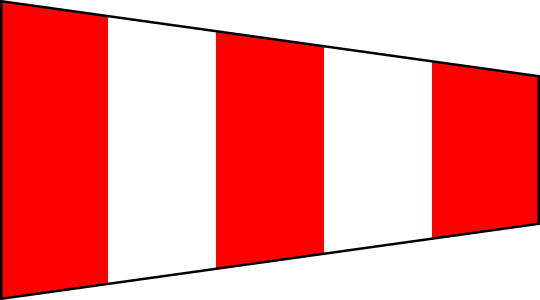

Quick answer
The answering pennant acknowledges flag signals: the receiver raises it partway (at the dip) when a hoist is seen, then fully (close up) when understood. Official instructions.
| Aspect | Finding |
|---|---|
| Official procedural reference | NGA Publication 102, International Code of Signals, 1969 edition, revised 2020. |
| Exact proportions and geometry | No dimensioned construction standard was verified for this proposal. |
| Physical colours | No authoritative colourimetric or textile specification was verified. |
| Common manufacture | No manufacturer’s dimensions are treated here as an international standard. |
| Screen approximation or editorial reconstruction | Neither a digital palette nor reconstructed artwork is supplied. |
Uses in signaling
When the sender lowers a hoist, the receiver returns the pennant to the dip; it rises again when the next hoist is understood. If the signal cannot be distinguished, it stays at the dip.
The sender displays it alone after the final hoist to mark completion. Between numeral pennants it represents a decimal point. A warship communicating with a merchant vessel keeps the Code pennant conspicuously displayed during the signal.
Construction notes
This record does not provide a production pattern. Exact taper, band widths, ratio and colour values should not be inferred from an illustration. Manufacturing dimensions, screen approximations and editorial reconstructions require their own documented basis.
Historical context
IMCO adopted the revised Code in 1965; the 1969 edition became effective on 1 April 1969. These are Code milestones, not verified dates for the pennant’s first introduction. This record uses NGA’s 2020 revision.