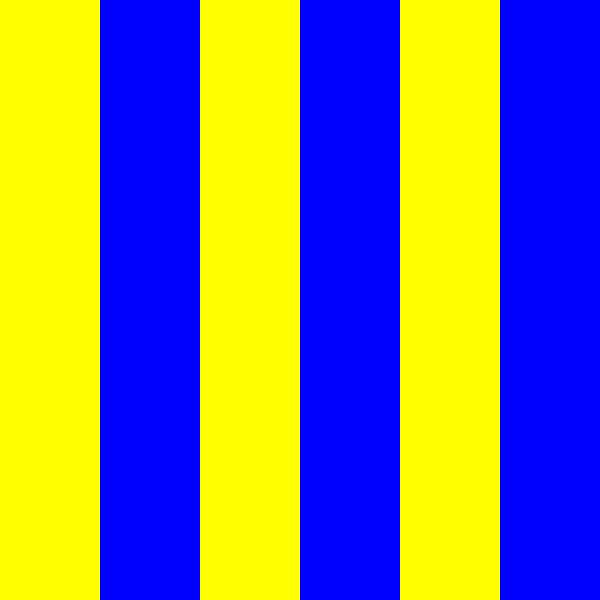

Quick answer
Golf represents G. As a single-letter signal it means “I require a pilot.” For fishing vessels operating close together on the fishing grounds, it instead indicates that nets are being hauled. That qualification matters; it is not a general alternative meaning for every fishing vessel. See Publication 102, page 22.
| Feature | Description | Evidence status |
|---|---|---|
| Pattern | Six vertical stripes alternating yellow and blue: yellow, blue, yellow, blue, yellow, blue. | Described in the National Park Service reference illustration; identification evidence, not a dimensional manufacturing standard. |
| Stripe widths | The National Park Service describes six equal-sized strips. | Reference depiction; no manufacturing tolerance verified. |
| Overall proportions | The National Park Service specimen is described as square. | A specimen proportion, not evidence of a universal mandatory ratio. |
| Colours | Yellow and blue. | No authoritative textile colour coordinates, Pantone values or digital colour values verified. |
| Manufacture | No common commercial dimensions or construction tolerances established in this review. | Supplier dimensions require their own evidence. |
Construction notes
The National Park Service reference description supports the stripe count, sequence and equal-width depiction. It does not establish a universal production specification. A drawing made from that description should be labelled an editorial reconstruction; selected screen colours should be labelled approximations. Do not derive exact colour values, dimensions or tolerances by measuring an illustration.
History and continuing reference use
The revised International Code was adopted in 1965; its 1969 edition took effect on 1 April 1969. These are Code milestones, not established dates for the first appearance of Golf’s striped design. The consulted United States edition is revised 2003. See its preface.
Golf also appears in the New Zealand Nautical Almanac 2025–26, supporting its treatment here as a continuing signal-code entry rather than a retired historical flag.
Read the complete signal
G followed by four or five numerals denotes longitude, rather than the standalone pilot request. Publication 102 also marks G with an asterisk: use by sound is subject to the collision-prevention regulations. See pages 22–23.