
Quick answer
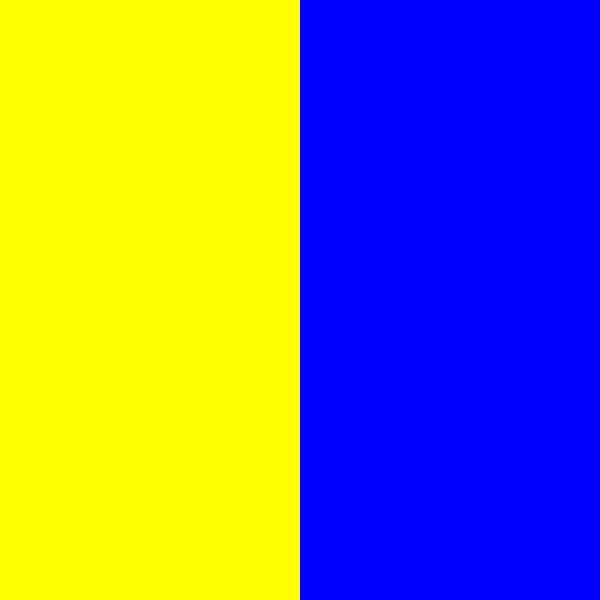
Kilo represents K. Its single-letter signal means “I wish to communicate with you.” The flag has yellow and blue vertical divisions. See NGA Publication 102, single-letter signals.
| Item | Description |
|---|---|
| Letter and spelling word | K — Kilo |
| Colours and arrangement | Yellow and blue, divided vertically. |
| Official meaning | A request to communicate with the receiving station. |
| Overall proportions | No exact official ratio established here; do not derive a mandatory ratio from the reference chart. |
| Colour specifications | No verified Pantone, RGB, HEX or textile colour values supplied. |
| Manufacture | No verified universal dimensions, fabric requirements or sewing tolerances supplied. |
Construction and colour evidence
The LINZ signal chart supports identification by yellow and blue vertical divisions. It is not treated here as a dimensioned manufacturing drawing. Exact panel dimensions, overall proportions and colour tolerances require a separate applicable specification.
Official signal identity, common manufacture, screen approximation and editorial reconstruction are distinct. No common manufacturing ratio is asserted here. Any digital colour selection would be a screen approximation unless supported by a colour standard; any newly drawn construction would need to be labelled as an editorial reconstruction.
Kilo with a numeral
K followed by one numeral specifies a communication method using the Code’s complements table. This is distinct from K alone. Consult Publication 102, single-letter signals with complements and Chapter 2, Section 10.
Historical context
The revised Code was adopted by IMCO in 1965; its 1969 edition became effective on 1 April 1969. These are Code milestones, not evidence of Kilo’s original design date. The NGA preface documents this chronology. No first-adoption date for the flag’s artwork is established here.