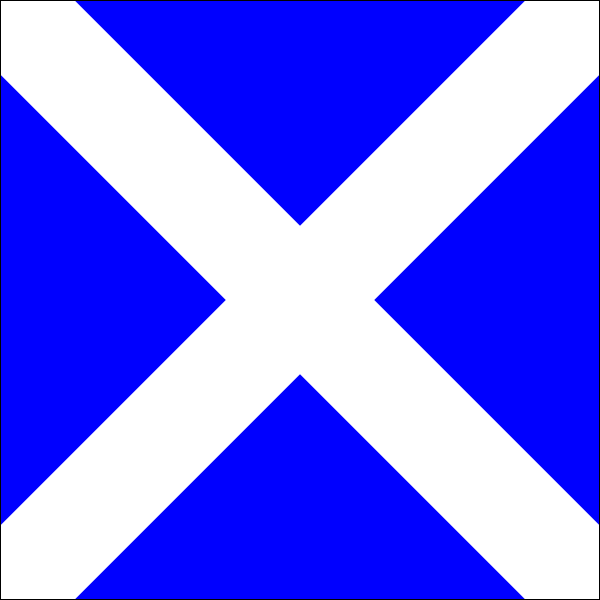

Quick answer
Mike represents M: a blue flag with a white saltire (diagonal cross). Flown as a single-letter signal, it means: “My vessel is stopped and making no way through the water.” Official code, single-letter signals.
| Feature | Description |
|---|---|
| Letter and spelling word | M — Mike |
| Design | White saltire on a blue field |
| Official identification evidence | International Flags and Pennants plate in U.S. Publication 102 |
| Manufacturing proportions | No mandatory hoist-to-fly ratio established here; do not derive one by measuring the reference illustration. |
| Saltire dimensions | No verified numerical width, construction grid or manufacturing tolerance supplied. |
| Colours | Blue and white; no verified textile colour standard or official digital colour values supplied. |
Construction and reproduction
The official identification plate supports the colour arrangement, but this record does not establish a dimensioned manufacturing specification. No common commercial ratio is asserted without supporting evidence. Any chosen drawing dimensions would be an editorial reconstruction; screen colours would be approximations rather than certified fabric colours.
History and current status
The revised Code was adopted by IMCO in 1965. The U.S. 1969 edition became effective on 1 April 1969, according to its preface. These are code milestones, not verified dates for the first appearance of Mike’s design.
IMO’s publication overview states that the 2005 edition incorporated amendments through December 2000 and that the later presentation introduces only minor editorial improvements and a new cover. IMO considers both editions equally valid.
Mike and Lima
Mike reports the signalling vessel’s condition. Lima instead directs the receiving vessel to stop immediately. The distinction appears in the official single-letter signal table.