
Quick answer
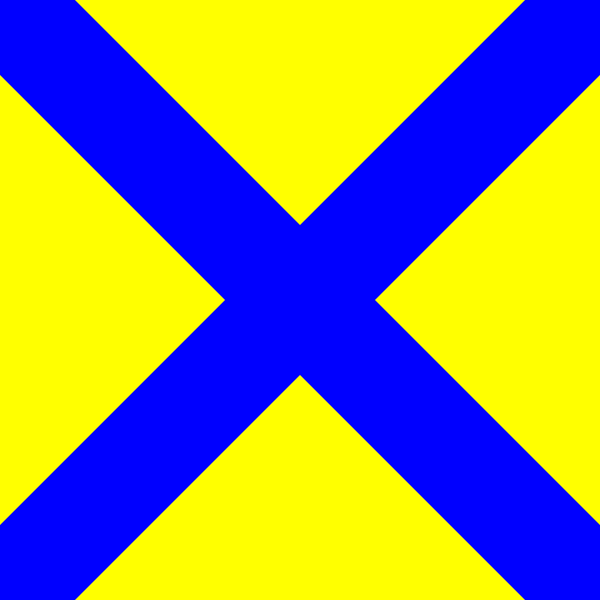
Numeral pennant Five represents 5 in International Code flag signaling. It has yellow toward the hoist and blue toward the tapered fly. Numbers are transmitted using numeral pennants; interpretation depends on the complete signal. See Publication 102 and the government reproduction of the signal chart.
| Feature | Description |
|---|---|
| Signal | Numeral 5 |
| Form | Tapered numeral pennant |
| Colour arrangement | Yellow hoist portion and blue fly portion |
| Exact proportions | No manufacturing ratio asserted |
| Colour standards | No verified textile, Pantone, RGB or hexadecimal specification supplied |
| Construction geometry | No dimensioned cutting pattern or exact division position established |
Construction and rendering limits
The government chart reproduction supports identification by colour placement. It is not treated here as a dimensioned manufacturing drawing. No exact ratio, taper angle or colour-boundary measurement is inferred from its artwork.
An official signal illustration, a manufacturer’s product dimensions, screen colour approximations and an editorial reconstruction are different kinds of evidence. No manufacturing standard or calibrated colour reference has been verified for this record. Any future reconstruction should identify its chosen dimensions and screen colours as editorial choices unless supported by a specification.
Historical context and present status
The consulted U.S. Publication 102 identifies itself as the 1969 edition, revised in 2003, of the Code adopted by the Inter-Governmental Maritime Consultative Organization’s Fourth Assembly in 1965. These dates describe the Code and publication, not a verified first-adoption date for this individual pennant. See the publication title page.
The National Park Service describes the international signal code as still existing at sea and includes number pennants in its Signal Flags Activity. This record therefore treats Five as a current signal, rather than a historical-only flag.
Related numeral pennants
Compare Numeral Pennant Four and Numeral Pennant One.
Sources
- Publication 102: official signal chart, title page and instructions for signaling numbers.
- U.S. Copyright Office: reproduction of the International Code chart, page 6; used for visual identification only.
- National Park Service: present-day educational account of international signal flags and numeral pennants.