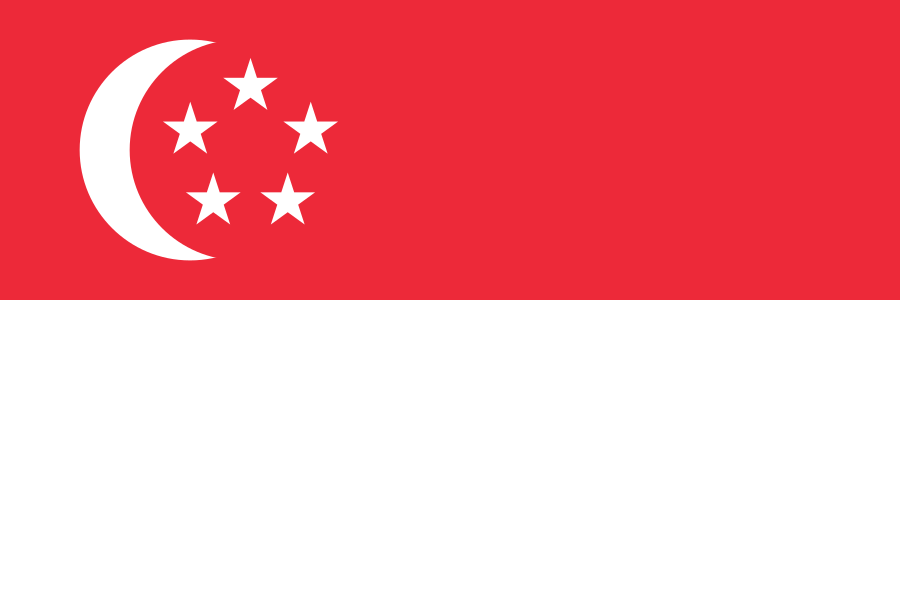
Singapore’s current national flag has equal red and white horizontal halves in a 2:3 rectangle. A white crescent and five white stars occupy the upper hoist. Introduced in 1959, the design became the independent republic’s national flag in 1965.
Specification
Section 3 and the First Schedule, Part 1, of the National Symbols Act 2022 establish the flag’s name, design and meaning. The schedule specifies red above white, equal horizontal sections, and a white crescent beside five white stars in a circular arrangement in the canton. Its width-to-length ratio is 2:3, expressed here as hoist:fly.
Colors and meaning
Pantone 032 / NHB guidance; #ED2939 is the specimen’s screen value onlyPantone White / NHB guidance; #FFFFFF is the specimen’s screen value onlyThe National Heritage Board (NHB) supplies these Pantone references. No coating suffix or universal RGB conversion is asserted here. Screen swatches do not replace physical color matching.
The Act associates red with fellowship and equality, white with enduring purity and virtue, and the crescent with a rising young nation. The stars express democracy, peace, progress, justice and equality.
Construction notes
Divide a three-unit-long, two-unit-high rectangle horizontally at half its height. Keep the crescent and five-pointed stars within the upper hoist; the crescent opens toward the fly. The statutory text gives no numerical radii or coordinates for the emblem.
The local SVG has a 0 0 54 36 viewBox, an 18-unit red band and two equal-radius circles forming the crescent. A star path and rotated internal copies produce five stars. These coordinates belong to the selected Commons-derived vector, not a dimensional schedule transcribed by this archive.
Parliamentary paper Misc. (New Series) 2 of 1959 is the archival construction source identified by Commons. Its scan could not be inspected here. Commons revised the star-circle radius in February 2026; this specimen preserves the mirrored 2021 rendering. Consequently, detailed emblem coordinates remain unverified against the archival sheet. The checked ratio, equal fields and emblem arrangement agree with the statutory description; obtain current official artwork for manufacture.
Historical record
NHB dates Legislative Assembly endorsement to 18 November 1959 and the public unveiling to 3 December 1959, during Yusof Ishak’s installation as Head of State. It records official national adoption at independence in 1965. These are distinct milestones, rather than competing dates for one event. The record year identifies the design’s introduction.
The Ministry of Culture, Community & Youth’s commencement announcement confirms that the 2022 Act and 2023 Regulations replaced the earlier legislative framework on 1 August 2023. This was a change in the governing framework, not a new flag design.
Use and display
The flag serves national and public ceremonial use. The National Symbols Regulations 2023 govern display and respectful treatment. Regulations 6–8 address outdoor display, vehicles and vessels, and precedence. When displayed flat, the crescent and stars belong at the spectator’s upper left. Ordinary outdoor display requires a flagpole and night illumination; the National Day period, 1 July–30 September, has specific exceptions. Vessel use has separate conditions: this record does not treat the national flag as an interchangeable maritime ensign.
Source trail
- National Symbols Act 2022, section 3 and First Schedule, Part 1 — legal identity, description, ratio and symbolism; inspected through the Gazette Act scan, printed page 10.
- Government Gazette S 536/2023 — original Regulations, especially regulations 6–8; the consolidated text is linked above.
- NHB: National Flag — historical milestones, Pantone guidance and display summary.
- MCCY, 31 July 2023 — commencement and replacement of the earlier framework.
- Commons specimen history and public-domain declaration — compare the selected SVG mirror and local inspection record.


Sources checked 6 September 2026. Detailed archival construction remains the stated verification limit.
Reading the flag specification
The hoist is the edge beside the flagpole; the fly is the opposite edge. The canton is the upper area beside the flagpole, where Singapore’s crescent and stars appear. The ratio 2:3 (hoist:fly) means two units high by three units long. The equal horizontal bands each occupy half the flag’s height, with red above white.
| Evidence | What it specifies or shows | Limits |
|---|---|---|
| National Symbols Act 2022, section 3 and First Schedule, Part 1 | Equal horizontal sections, red above white; a white crescent beside five white stars arranged in a circle in the canton; width:length of 2:3. | The statutory text gives no numerical radii or coordinates for the emblem. |
| National Heritage Board color guidance | Red: Pantone 032. White: Pantone White. | No coating suffix or universal RGB conversion is asserted. Screen swatches do not replace physical color matching. |
| Selected SVG: screen colors | Red: #ED2939. White: #FFFFFF. | These are the selected specimen’s screen values, not a universal conversion of the NHB Pantone guidance. |
| Selected SVG: specimen geometry | A 0 0 54 36 viewBox, equal 18-unit bands, two equal-radius circles forming the crescent, and five stars made from a star path and rotated internal copies. | The specimen preserves the mirrored 2021 geometry and does not include Commons’ February 2026 star-circle-radius revision. Detailed emblem dimensions remain unverified against the archival construction sheet, whose scan was not inspected in the imported record. This reference rendering is not a certified manufacturing pattern; obtain current official artwork for manufacture. |