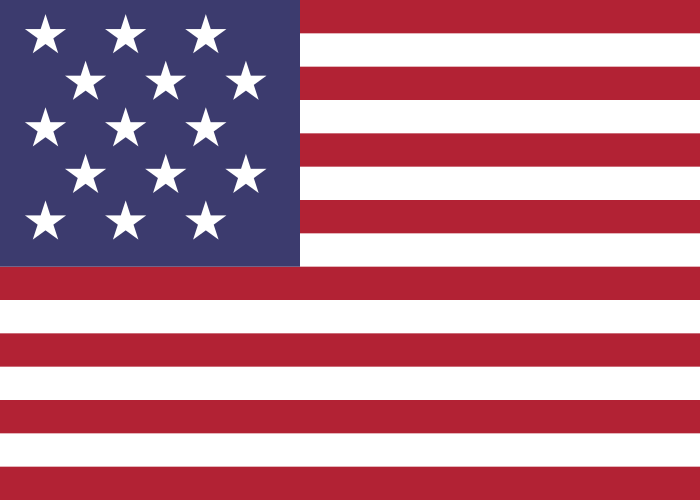
The second United States flag law added two stars and two stripes for Vermont and Kentucky. It was the country’s only official design period with more than thirteen stripes.
Specification boundaries
The act approved on 13 January 1794 required fifteen alternating stripes and fifteen stars from 1 May 1795. It did not prescribe the flag’s proportions, the union dimensions, or the arrangement and orientation of the stars.
The surviving banner
Mary Pickersgill made the best-known 15-star example for Fort McHenry in 1813. Its stars were arranged in five staggered rows of three, and its original dimensions were approximately 30 by 42 feet. That artifact inspired Francis Scott Key in September 1814.
Return to thirteen stripes
The flag act of 4 April 1818 restored thirteen stripes and established a star for every state, with new stars taking effect on the Fourth of July after admission. The change superseded the 15-stripe form on 4 July 1818.
Source trail
Smithsonian Institution: principal flag acts and star-count periods ↗
National Museum of American History: visual description of the Star-Spangled Banner ↗
The design and the surviving artifact
The Star-Spangled Banner is a particular surviving example of the United States flag with 15 stars and 15 stripes. Its five staggered rows of three stars and approximately 30-by-42-foot original dimensions describe that artifact, not requirements for all flags of the period. The 1794 act prescribed the counts but did not prescribe proportions or star arrangement; an individual flag’s construction does not establish a universal manufacturing specification.
The reconstruction displayed on this page is illustrative. Its geometry and screen colors should not be treated as a prescribed manufacturing specification or an authoritative color standard.
| Date | Event | Meaning |
|---|---|---|
| 13 January 1794 | Act approved | Legislation required 15 stars and 15 stripes from a later effective date. |
| 1 May 1795 | 1794 act took effect | The official 15-star, 15-stripe period began. |
| 4 April 1818 | Replacement act approved | Legislation restored 13 stripes and established a star for each state, with the change taking effect in July. |
| 4 July 1818 | 15-star, 15-stripe form superseded | The replacement requirements took effect; 3 July 1818 was the last day of the preceding official period. |
Which source supports which claims?
The Smithsonian flag-facts source supports the legislation dates, required star-and-stripe counts and official periods. Approval dates and effective dates describe different events.
The National Museum of American History’s visual description supports details of the surviving Star-Spangled Banner, including its star arrangement and original dimensions. Those artifact details do not establish requirements for every flag of the period or certify this page’s reconstruction as a manufacturing or color standard.