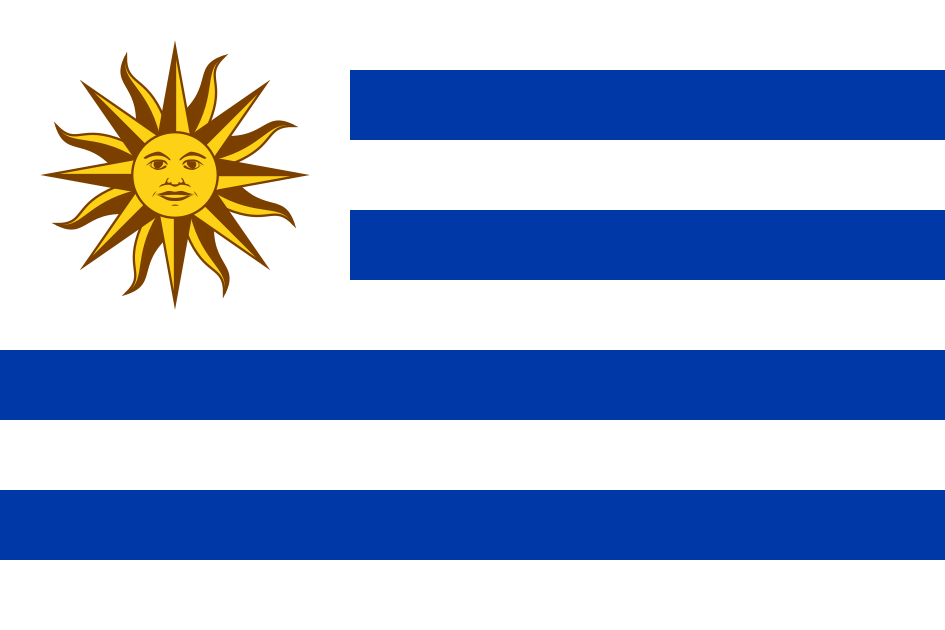
Uruguay’s current national flag has four blue stripes alternating with five white stripes and a golden, faced sun in a white square at the upper hoist. Its hoist-to-fly ratio is 2:3. The nine-stripe arrangement dates to 1830; the displayed sun follows later practice.
Specification
Article 6 of the decree of 18 February 1952 specifies white, blue and a gold sun with sixteen rays. The square canton ends immediately above the sixth stripe; the sun diameter is 11/15 of that square.
Colors
The Interior Ministry resolution of 21 August 1996, published on 29 August, explicitly rejects celeste or azul celeste in place of blue in official and private reproductions. This resolves the apparent conflict with sky-blue wording in early historical descriptions. It supplies no numerical color coordinates.
The inspected specimen uses #0038A8 blue, #FFFFFF white, #FCD116 yellow for gold, and #7B3F00 brown details. These SVG fills are screen approximations, not legal HEX values, textile matches, or a substitute for the official pattern.
Construction notes
With hoist H, the fly is 3H/2. Equal stripes give a canton side of 5H/9. Centering the sun in the square places it 5H/18 from the top and hoist. The specimen interprets the prescribed diameter as including the rays.
The SVG viewBox is -5 -5 945 630. Stripes are 70 units high; the canton extends from (−5,−5) to (345,345), a 350-unit square. Its center is (170,170). The downloaded sun’s nominal straight-tip diameter was 254.134 units; the statutory target at this size is 256.667. A local uniform scale and translation bring the nominal diameter and face center to those targets. Rounded source ray coordinates retain small differences; stroke thickness extends beyond path centerlines.
The artwork has eight straight and eight wavy rays. Their curves and facial details remain the Commons rendering. Article 6 does not give a separate face-disc diameter or mathematical ray contours; article 4 requires fidelity to the pattern held by the Museo Histórico Nacional. That pattern has not been inspected here. The local adjustment is an editorial reference reconstruction, not a manufacturing certification.
Historical record and symbols
The decree’s appended laws date creation of the earlier flag to 16 December 1828 and reduction to four blue stripes to 12 July 1830. The superseded nine-blue-stripe flag is not the specimen shown here.
ANEP’s Uruguay Educa account connects the nine total stripes with the nine original departments. It dates the use of the familiar alternating straight and wavy sun rays to 1930, contrasting earlier straight-ray renderings. Thus an 1830 arrangement date does not establish that this exact modern sun drawing was used then. The device is commonly called the Sun of May; no additional legally prescribed symbolic meaning is assigned here.
Usage and status
The 1952 decree recognizes the Pabellón Nacional as a national symbol. Articles 3–4 condition private use on authorization and faithful reproduction; article 10 leaves military and diplomatic protocol to the responsible ministries. The 1996 resolution reaffirms the official design for printed reproductions. This record describes the current national flag rather than a separate service standard.
Source trail
Reviewed 13 September 2026. English descriptions are editorial paraphrases of Spanish sources.
- Parliament library / Símbolos Nacionales, decree of 18 February 1952 — articles 3–6 and 10; printed pages 6–10; appended 1828 and 1830 laws.
- IMPO / Interior Ministry resolution, 21 August 1996 — current blue clarification and reproduction requirements.
- ANEP / evolution of the flag’s design — departments and changing sun depiction.
- Wikimedia Commons / artwork, contributors and public-domain declarations — local provenance and geometry review.

National flags → · Related record: Argentina’s distinct 32-rayed sun →