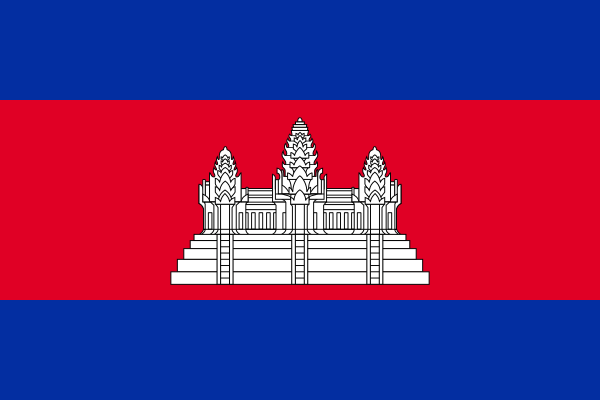
Cambodia’s current national flag has blue, red and blue horizontal bands, with the red band occupying half the height. A white image of Angkor Wat stands in the middle. The Cambodian embassy’s protocol specification gives a hoist-to-fly ratio of 2:3. The design dates to 1948 and returned in 1993.
Specification
Article 6 of the Constitution establishes the national flag by reference to Annex I. It does not provide a numerical construction formula in the article itself. The Royal Embassy’s note to ASEAN, 10 November 2015, supplies the practical description: three horizontal bands, equal blue outer bands, a red middle band twice their height, and a white three-towered Angkor Wat in the red area. Its width-to-length wording corresponds to a 2:3 hoist-to-fly rectangle.
These numerical proportions are diplomatic protocol guidance. They are not presented here as measurements transcribed from the constitutional annex. The specimen follows that guidance; the 16:25 version found in some digital collections is not used as the construction standard for this entry.
Colors and reproduction
The named colors are blue, red and white. This specimen retains black architectural linework from its source vector. Its screen fills are blue #032EA1, red #E00025, white #FFFFFF and black #000000; these are asset values, not certified textile specifications. No physical color tolerances or manufacturing standard were verified for this record.
Temple outlines remain a source distinction: Flags of the World reports both black-line diplomatic artwork and red-line constitutional illustrations. The local black-line temple is a documented reference rendering, not a claim that every contour or stroke is legally prescribed. A currently accessible, authoritative vector master was not obtained.
Construction notes
For a 600-unit fly and 400-unit hoist, draw blue across the field, then red from y=100 to y=300. This gives two 100-unit blue bands around a 200-unit red band. Place the white temple within the central band, with its taller central tower between two lower towers.
The retrieved Commons-derived SVG had a 625 × 400 frame. The local adaptation reduces the field width to 600 and moves the entire temple 12.5 units left, preserving its paths, scale and vertical position. The resulting viewBox is 0 0 600 400. The outer towers use a mirrored vector component; that is an artwork technique, not a verified legal symmetry requirement. Temple dimensions, margins, steps and stroke widths remain source-artwork choices. This is a reference specimen, not a sewing pattern or certified production master.
Meaning and use
The flag represents Cambodia in national and diplomatic display; the embassy note specifically supplies it for ASEAN protocol. That note explains red as courage and bravery, blue as territory, and white as purity. These are attributed embassy explanations rather than a symbolism clause in Article 6. Angkor Wat is the named architectural emblem.
Historical record
The blue–red–blue arrangement with Angkor Wat was introduced in 1948 and used until 1970. Its current period begins in 1993. These separated periods should not be read as continuous use or as proof that historical and current temple drawings are identical.
The Constitution was adopted by the Constituent Assembly on 21 September 1993, as recorded in the government’s English text. Its promulgation followed on 24 September, documented in the Cambodian Center for Human Rights chronology. Constitutional adoption, promulgation and the earlier return of a flag to use are distinct events.
Date and specification limits
The FOTW country account gives 29 October 1948 and 24 September 1993; its historical chronology instead gives 20 October 1948 and 30 June 1993. Without the original flag adoption instruments, this record uses the corroborated years rather than assigning an unqualified exact day. Article 6 was checked in the government transcription; the Constitutional Council annex and Foreign Ministry image endpoint could not be retrieved. The embassy note is linked directly below; its wording was checked through FOTW’s attributed transcription because the scanned PDF did not yield readable content during review.
Source trail
- Royal Government, Press and Quick Reaction Unit: Constitution of the Kingdom of Cambodia, English text published 25 January 2017: Articles 1 and 6 and the closing adoption statement. Constitutional Council edition (access unavailable during review).
- Royal Embassy of Cambodia, Jakarta: note No. 1304/REC-JKT/2015, 10 November 2015, hosted by ASEAN: proportions, bands, temple and color explanations; reviewed through the attributed transcription in the following reference.
- Flags of the World: Cambodia: embassy-note transcription, outline variants and restoration account. Historical chronology: differing exact adoption and restoration dates.
- Cambodian Center for Human Rights: chronology of constitutional amendments: 21 September adoption and 24 September 1993 promulgation.
- Retrieved Commons-derived SVG and repository provenance and public-domain statement. Related Commons asset history and rights. Local modifications and asset record.


Related records: Thailand · Vietnam · National flags.