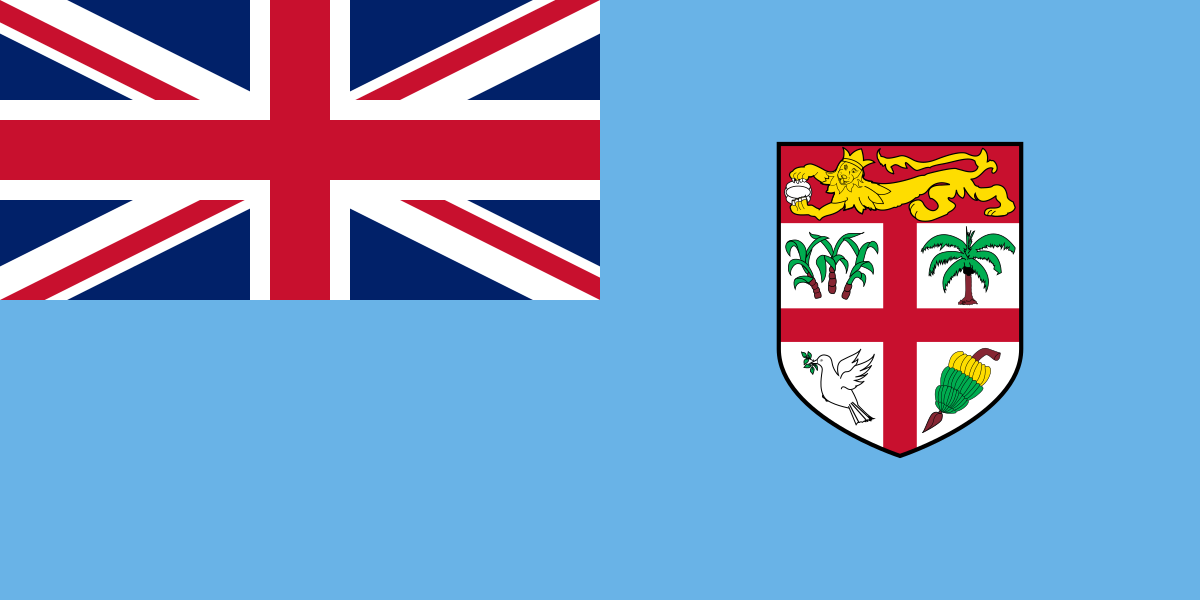
Fiji’s current national flag has a light-blue field, the Union Jack in the upper hoist quarter, and the shield from the national arms in the fly. It was first raised on Independence Day, 10 October 1970; reference proportions are 1:2.
Specification
The Ministry of Foreign Affairs describes the shield as centered in the outer half. A gold lion holding a cocoa pod occupies its red upper band. Below, a red cross divides a white field into quarters containing sugarcane, a coconut palm, a dove and bananas. The flag uses the shield alone, rather than the complete achievement of arms.
Legal description and its limits
The National Flag Protection Act 2015, assented to on 31 August 2015, anticipated a new flag declared by Gazette notice under section 4. Section 1 requires a separate commencement notice; section 17 permits later dimensional rules. The Act itself supplies no drawing or measurements. A commencement notice, replacement declaration and binding construction schedule were not verified in this research. Its enactment is therefore not treated as adoption or specification of the 1970 design.
Colors
Government guidance identifies light blue and the recognizable colors of the Union Jack and shield, but the consulted pages do not prescribe numerical color standards. Flags of the World records differing blue recommendations: the London 2012 Olympic manual uses PMS 2915, while the French naval reference uses Pantone 298C for the light blue. These references serve different reproduction contexts and do not establish one binding Fijian textile shade.
#69B3E7 / inspected SVG only#012169 / inspected SVG only#C8102E / inspected SVG onlyThe artwork also uses white #FFFFFF, yellow #FEDD00, green #00AD50, dark red-brown #862633 and black #000000. These are file values, not certified Pantone conversions or physical production standards.
Construction notes
Flags of the World documents 1:2 proportions. The specimen follows that ratio and the official descriptive arrangement. With hoist H, its fly is 2H and its canton is H wide by H/2 high. No precise shield size, cross width or heraldic drawing tolerance is asserted as law.
| Part | Measured construction | Authority level |
|---|---|---|
| Canvas | viewBox 0 0 1200 600 | Matches 1:2 reference ratio |
| Canton | 600 × 300, upper left | Matches upper hoist quarter |
| Shield outline path | x = 778.8–1021.2; y = 143.94–455.94, excluding stroke | Source illustrator’s dimensions |
| Shield placement | Horizontal axis x = 900; bounding-box midpoint y = 299.94 | Approximately centered in fly half |
The Union Jack retains its offset diagonal red stripes. The shield contains asymmetric heraldic figures; its artwork must not be replaced with a mirrored half. Paths and colors are retained from the source SVG. Only accessible metadata was added. This is a reference specimen, not a certified production master.
Symbols and use
The Ministry connects the lion with Fiji’s historical relationship with the United Kingdom. The embassy describes the dove as a peace emblem. The crop devices depict sugarcane, coconuts and bananas. The designer interview reproduced by Flags of the World explains the pale-blue field as representing the sea.
This record covers the national flag used to represent Fiji. Separate civil, government and naval ensigns have distinct fields and functions; they should not be substituted for this light-blue national design. Flags of the World provides separate records for those maritime flags.
Historical record
The Fiji Embassy in Japan dates first use to 10 October 1970 and credits the competition jointly to Robi Wilcock and Mrs Murray MacKenzie. The latter is identified as Tessa Mackenzie in the designer interview reproduced by Flags of the World. No separate original proclamation date was established here.
A later replacement project did not supersede this flag. On 18 August 2016, The Fiji Times reported the Prime Minister’s decision to retain it. Current official diplomatic pages continue to identify the same design as Fiji’s national flag.
Source trail
Fiji Embassy in Japan: National Emblems ↗ — official usage name, first raising, competition attribution and shield devices.
Ministry of Foreign Affairs: Fiji High Commission, New Zealand, History ↗ — current official description and shield position.
Parliament of Fiji: National Flag Protection Act 2015 ↗ — sections 1, 3, 4 and 17; conditional legislative framework, not a construction drawing.
Flags of the World: Fiji ↗ — 1:2 ratio, adoption, color-reference differences, designer interview and links to separate ensigns.
The Fiji Times, 18 August 2016: Fiji will retain flag ↗ — contemporary reporting of the retention decision.
Wikimedia Commons: artwork history and public-domain declaration ↗ · Retrieved Commons-derived SVG ↗ · Local provenance, rights and checksum →

