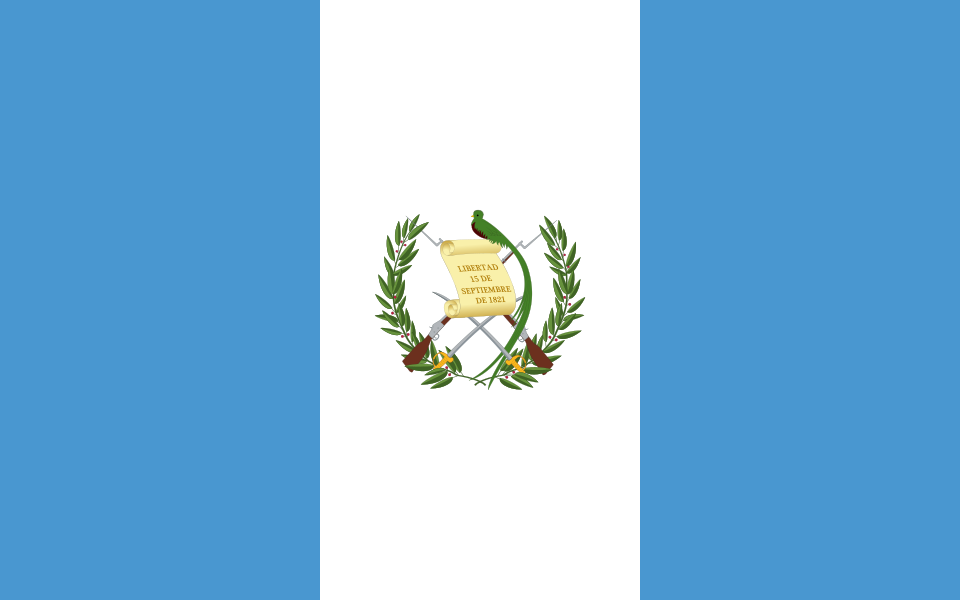
Guatemala’s national flag has three equal vertical bands, blue, white and blue, in a rectangle five units high and eight long. The white band contains the national arms: a quetzal above an independence inscription, crossed rifles and swords, and laurel branches. This record depicts the current flag with arms.
Specification
Decree 104-97, articles 1–2, sets the 5:8 rectangle, equal bands and centered arms. Article 1 calls the flag simply Bandera. The statute’s reference to the golden rule does not replace its explicit 5:8 dimensions with an irrational golden-ratio rectangle.
| Element | Legal description | Reference specimen |
|---|---|---|
| Blue | ISCC–NBS 177 | #4997D0 screen fill |
| White | ISCC–NBS 263 | #FFFFFF screen fill |
| Arms | Centered; occupy two-thirds of the white band | Conventional vector rendering; see scale note |
These color-system identifiers are the legal references. The SVG fills are not certified equivalents. Published Pantone approximations differ, so no Pantone, RAL or textile tolerance is adopted here.
Symbols
Articles 4–6 describe period Remington rifles with triangular bayonets, crossed at a right angle; fruiting laurel branches crossed below without a tie; a rolled parchment; and a naturally colored quetzal facing heraldic right, toward the viewer’s left. The parchment bears four lines: LIBERTAD / 15 DE / SEPTIEMBRE / DE 1821. Its date commemorates independence, not flag adoption.
Construction notes
The inspected SVG uses a 960 × 600 viewBox. A full blue rectangle is overlaid by white from x=320 to x=640, giving three bands of 320 units each. The emblem lies centrally within the white band; its overall width is approximately two-thirds of that band. Its asymmetric bird, foliage and lettering should not be replaced by a mirrored geometric emblem.
The law’s two-thirds clause does not identify a measurement axis or define a bounding box. This specimen follows the conventional width interpretation; it is not proof of the exact official emblem scale or contours. Article 16 provides for a Ministry of Culture and Sports model for authorized manufacturers. That model was not obtained. Use it for physical production rather than treating this screen drawing as a sewing pattern.
Paths, gradients and local references were inspected and rendered. The lettering is outlined; there are no fonts, raster images, scripts or external resource loads. Artwork geometry and colors were retained, with accessible metadata added.
Historical record
Congress dates the blue-white-blue flag to Decree 12 of 17 August 1871. The arms followed under Decree 33 on 18 November. The 1968 regulation standardized proportions, colors and emblem details, taking effect on 15 September. Thus 1871 identifies the enduring design family, not an unchanged digital drawing.
Congress’s register dates Decree 104-97 to 28 October 1997. The cultural-information catalogue places that date in a combined publication/commencement field, but article 19 instead specifies commencement thirty days after official publication. This record uses 28 October only as the issue date. FOTW’s varying 1997 dates are not treated as replacement dates for the flag’s 1871 origin.
Meaning and use
Article 3 associates white with purity, peace, integrity, firmness and light; blue with strength, justice, truth and loyalty. The sword represents justice and sovereignty, laurel victory, the parchment remembrance of the nation’s birth, and the quetzal liberty.
Articles 8 and 11 cover daily display at state offices and educational establishments, voluntary private display, and representation abroad. The latter requires the arms in the displays it regulates. Article 17 assigns 17 August as Flag Day.
The 1968 regulation explicitly described a merchant flag without arms. The 1997 law’s naming clause still mentions flags with or without arms, while its design and official-display provisions require the emblem. References differ on the plain flag’s later status; it must not be substituted for the current armorial specimen shown here.
Source trail
Reviewed 15 September 2026. Spanish legal descriptions are paraphrased in English. Official catalogue summaries were accessible through search; the Congress document endpoint did not deliver the full text during review. Article-level checks therefore used the reproduced statutory text below, cross-checked against the official summaries and specialist references.
- Congress / Decree 104-97 catalogue and decree register — identity and issue date.
- Ministry of Culture and Sports / legal catalogue — ratio, bands, status and Flag Day; date-field limitation noted above.
- Congress / 150 years of the flag — 17 August 1871 origin.
- Reproduction of Decree 104-97, articles 1–19 — consulted transcription of the legislation, not an authenticated legal master.
- International Organization of Protocol / Guatemala — statutory descriptions and link to a Gazette copy.
- Flags of the World / Guatemala — 1968 regulation, historical dates, conflicting color equivalents and discussion of plain-flag use.
- country-flags / source SVG — Commons-derived specimen; rights and inspection record.

Related records: Costa Rica · Mexico · National flags.