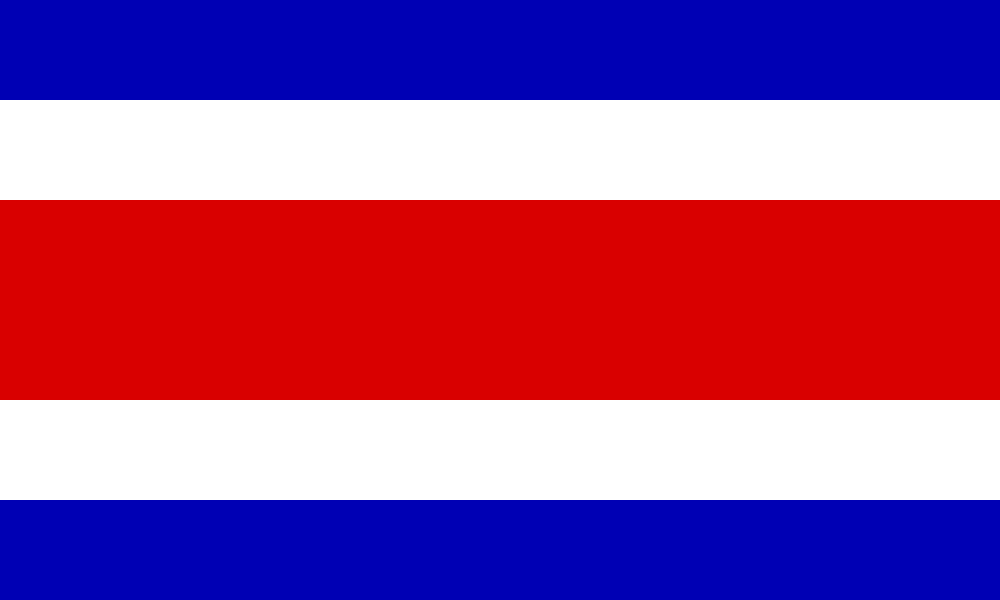
Costa Rica’s plain national flag has blue, white, red, white and blue horizontal bands. The red middle band is double the height of each other band. The rectangle is three units high and five long. The national pavilion, or pabellón nacional, adds the arms and has separate ceremonial rules.
Specification
Law 10178, articles 1–2, prescribes the five bands and a 2 m fly by 1.20 m hoist, with proportional scaling. It prefers silk. The following are the law’s named references, not conversions from the specimen.
| Color | Legal reference | Scope |
|---|---|---|
| Blue | Pantone Reflex Blue | No C/U suffix stated |
| White | White | No numbered color reference |
| Red | Pantone 485C | Printed “panthone 485C” in the Gazette |
Screen specimen
The local SVG retains the fills of the MIT-licensed flag-icons source. These are editorial screen approximations, not verified matches to the law’s physical color references.
#0000B4 / source SVG fill#FFFFFF / source SVG fill#D90000 / source SVG fillNo textile tolerances, measurement conditions, RAL equivalences or certified screen-to-Pantone conversion were verified. The missing blue suffix is preserved rather than supplied from a secondary illustration.
Construction notes
Expressing the specified proportions on a 1000 × 600 viewBox gives horizontal boundaries at y=100, 200, 400 and 500. Visible band heights are 100, 100, 200, 100 and 100; all span the full fly. The blue full-field path is overlaid by white from y=100 to 500 and red from y=200 to 400.
The retrieved flag-icons source was a 640 × 480 icon with nonuniform outer bands. Its three-path construction was retained, but coordinates were replaced with the statutory geometry. This is an explicitly adapted reference drawing, not an official downloadable master or a sewing pattern. There are no arms, borders, scripts, external resources or embedded raster images.
Historical record
The National Archives’ bicentenary catalogue dates the national tricolor to 29 September 1848 during José María Castro Madriz’s presidency. It attributes its creation to Pacífica Fernández Oreamuno and associates her choice of colors with admiration for France. That is an archival attribution, not a designer credit established by the current flag law.
The Ministry of Education records the pavilion’s first ceremonial raising on 12 November 1848 in San José’s Plaza Mayor, now Parque Central. Its transcription of the original design includes arms. Accordingly, 1848 here dates the enduring band arrangement, not proof that the present plain specimen was the armorial flag raised that day. Earlier designs and successive versions of the arms are distinct historical specimens.
Law 10178 was promulgated on 25 April 2022 and took effect with publication on 11 May. It replaced the 1906 law and later listed amendments; this is a new statutory framework for an established tricolor.
Meaning and use
Articles 1–2 associate blue with the sky, white with peace and red with those who died for freedom. Articles 3–6 cover public buildings and respectful private display, including permanent patriotic display. They prohibit added lettering and contact with the ground.
Articles 12–17 distinguish the armorial pavilion and its restricted ceremonial use, with a special 12 November observance. The plain flag shown here must not substitute for an illustration of that pavilion.
Source trail
Reviewed 14 September 2026. Spanish sources are paraphrased in English.
- Imprenta Nacional / La Gaceta 86, 11 May 2022, Law 10178 — enacted text, articles 1–8, 12–17 and 23, commencement and promulgation.
- Archivo Nacional / bicentenary exhibition catalogue, “La bandera y el escudo” — 1848 decree, attribution and historical distinction.
- Ministry of Education / Día del Pabellón Nacional, 12 November 2020 — first raising and original armorial description. Its older usage context is superseded by the 2022 law for this entry.
- flag-icons / retrieved SVG and MIT licence — inspected source paths; local geometry adaptation recorded in the asset register.

Related records: Colombia · Thailand · National flags.