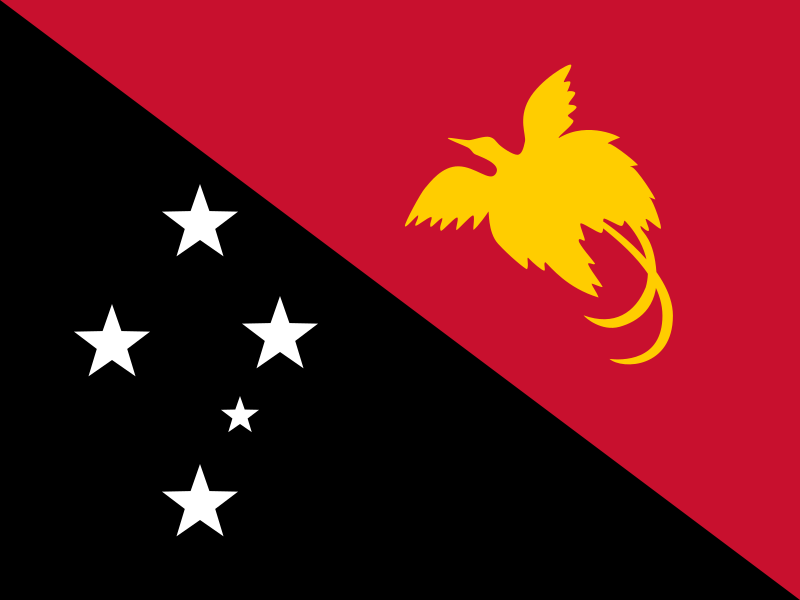
Papua New Guinea’s national flag has a yellow bird of paradise on a red upper triangle and five white Southern Cross stars on a black lower triangle. Its hoist-to-fly ratio is 3:4. Adopted in 1971, it predates independence in 1975.
Specification
Section 1 of the National Identity Act identifies the flag through Schedules 1 and 2. Section 3 of the Constitution preserves the pre-independence national symbols pending legislation. The PNG Embassy’s description confirms the current design and a four-to-three length-to-height proportion.
Color references
The schedule names scarlet (Collies 305), mid-yellow (Collies 537), black (Collies 309), and white; scarlet is overprinted on mid-yellow. These physical references are distinct from the SVG’s screen fills below. No authoritative conversion from Collies to HEX, RGB or Pantone was established.
Specimen only / #C8102ESpecimen only / #FFCD00Specimen only / #000000Specimen only / #FFFFFFConstruction notes
The following star coordinates follow the consolidated Schedule 1 transcription. Units are hundredths of fly length, measured rightward and downward from the upper hoist. Large stars have outer/inner diameters 10/4; Epsilon has 5/2.
| Star | Across | Down |
|---|---|---|
| Alpha | 25 | 63 |
| Beta | 14 | 43 |
| Gamma | 25 | 28 |
| Delta | 35 | 42 |
| Epsilon | 30 | 52 |
The bird’s reference circle has diameter 34.5 and center (67,24). Consult Table 1 in the linked transcription for wing, plume and tail landmarks. The circle and tabulated landmarks do not coincide exactly; do not infer a perfectly circular construction or manufacturing tolerance.
Inspected specimen
The SVG has a 768 × 576 viewBox and 800 × 600 intrinsic dimensions, both 3:4. A black rectangle and red triangle meet along (0,0)–(768,576). Its star group is scaled by 0.768 from a 1000-unit fly: Gamma is centered at (250,280), with the other centers at (140,430), (250,630), (350,420), and (300,520). Outer and inner radii are 50 and 20 before scaling; Epsilon is half-size. Rounded path coordinates match the schedule to display precision.
The preserved Commons bird path is a recognizable reference silhouette, not a traced statutory plate. It does not reproduce every Table 1 landmark exactly: for example, its upper wing reaches approximately y=75 in the viewBox, whereas the tabulated 7/100 fly is y=53.76. Its field and star geometry match the cited schedule, but the complete asset must not be used as an official production master. Obtain an approved bird drawing and physical color samples for manufacture. Asset provenance and checksum →
Symbols and use
The Embassy explains the soaring kumul, or bird of paradise, as an expression of emerging nationhood. Its plumes have ceremonial importance. The Southern Cross links the country with the skies and nations of the South Pacific; red, black and yellow are traditional local colors.
Section 5 of the Act provides for government purposes and customary national-flag occasions. Sections 2–4 separately address other flags and ensigns, authorizations, and rules of use. This record identifies the national flag; it does not substitute for a separate maritime ensign or a protocol authorization.
Historical record
Committee member Geoff Littler recalled receiving schoolgirl Susan Karike’s design at Yule Island on 12 February 1971. His account dates the House’s acceptance of the committee report to 4 March. Those selection milestones precede legal introduction: the Australian administration’s report to the United Nations records proclamation on 1 July 1971. Independence followed on 16 September 1975.
FOTW distinguishes the original 96-part schedule from the consolidated 100-part construction, attributing revision to a 1972 amendment commencing 29 March 1973. The linked amendment and commencement originals could not be retrieved here; that exact revision date remains secondary-source evidence. Earlier geometry is not interchangeable with this specimen.
PG-NAT-1971 is an editorial catalogue identifier anchored to adoption, not an official government code or a claim that every present construction detail dates to 1971.
Source trail
Ombudsman Commission: Constitution, preamble and section 3 ↗ — state identity, independence date and continuity of national symbols.
PNG Buai: National Identity Act 1971, Part I ↗ — explicitly non-official republication of the PacLII consolidation to 2000; statutory name and usage provisions.
FOTW: Papua New Guinea, construction and amendment notes ↗ — legal schedule transcription, Collies references and comparison of versions. Underlying PacLII Act ↗ — inaccessible during this check; not independently inspected.
PNG Embassy to the Americas: flag description ↗ — design, ratio and symbolism. Its sentence placing stars on a “yellow part” is an apparent wording error; its black-field description and displayed flag resolve the context.
United Nations: Australian report on New Guinea, T/1742 ↗ — contemporary record of the 1 July 1971 proclamation.
PNG Association: Geoff Littler, The Papua New Guinea Crest and Flag ↗ — participant’s account of Karike’s design and committee selection.
Wikimedia Commons: vector contributors, revision history and public-domain declaration ↗ · Local asset register →

Unresolved: independently verified commencement of the revised construction, reconciliation of bird landmarks with the reference circle, an approved vector bird master, and modern physical equivalents for the Collies colors.