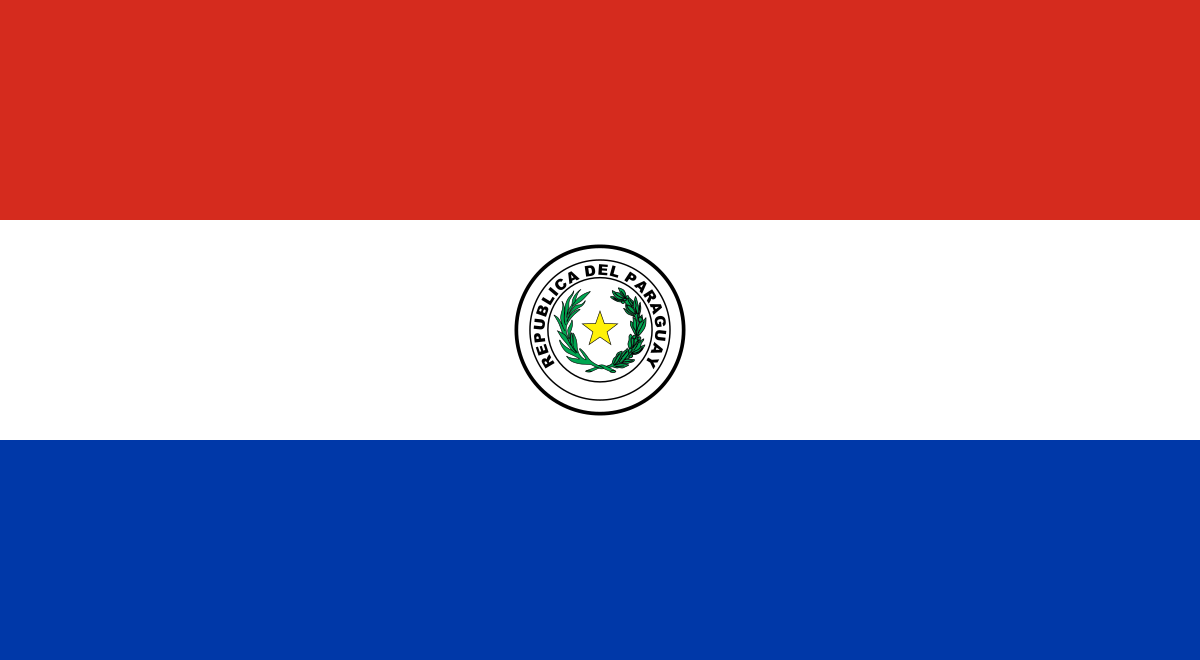
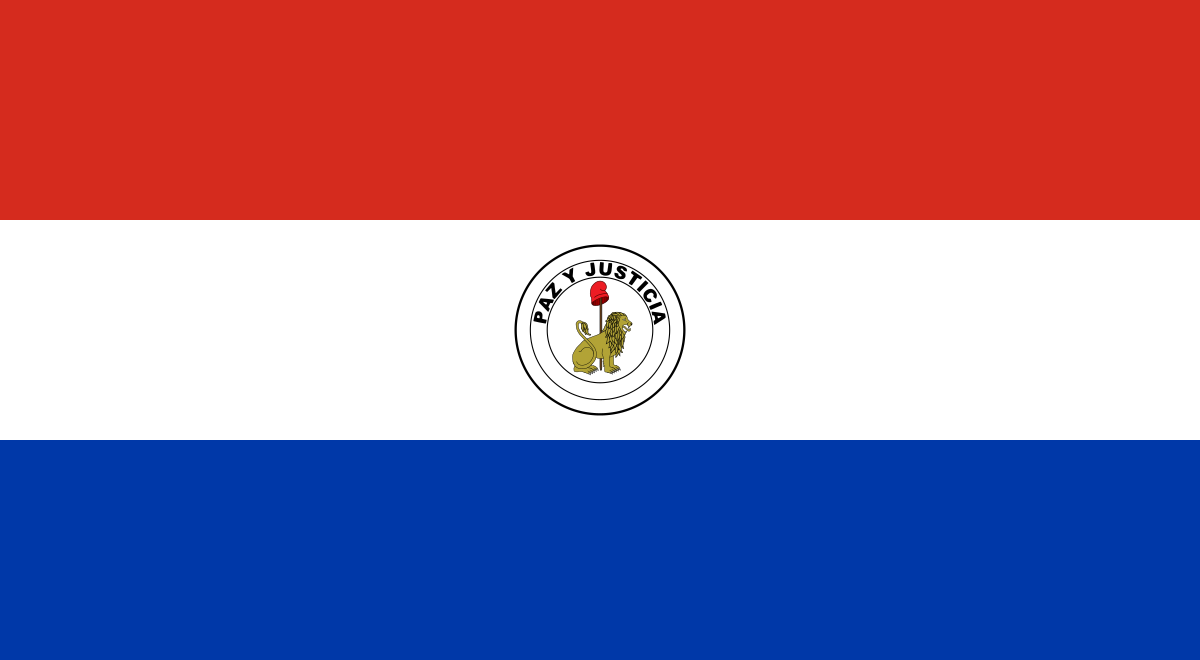
Paraguay’s current national flag has equal horizontal red, white and blue bands and a different emblem on each face. The front has a yellow star with palm and olive branches; the reverse has a lion beneath a red liberty cap and the words Paz y Justicia. The decree’s approximate proportion corresponds to a hoist-to-fly ratio of 11:20.
Specification
Decree 11,400 of 15 July 2013, articles 1–2, implements the national-symbol framework of Constitution article 139 and reproduces the flag description in the congressional resolution of 25 November 1842. The Pabellón combines the tricolor with its two central emblems, one on each face of the white band. A plain decorative tricolor is not the complete specimen documented here.
Article 5 says that the longer-to-shorter-side proportion should be as close as possible to 1:0.55. This yields 11:20 in hoist-to-fly notation, while retaining the law’s qualification. It does not prescribe an exact manufacturing tolerance. Article 4 makes physical size dependent on use, support and display space.
Two national emblems
Article 6 specifies black inscriptions on an uncolored ring. On the front, a central yellow five-pointed star lies between palm and olive branches intertwined at their base, beneath República del Paraguay. On the reverse, Paz y Justicia means “Peace and Justice.” A seated, roaring lion faces the observer’s right, with a raised, waving tail. Behind it, a vertical pike carries the red Phrygian cap, explicitly identified as a symbol of liberty.
Colors and lettering
Article 5 describes the band colors as red, white and blue, calling red and blue primary colors without admixture. The annex’s numerical palette concerns the emblems; it does not establish a blue band value. The following entries are transcribed from the annex’s color grid (PDF page 13), not inferred from the faded scan.
| Emblem element | Pantone in annex | RGB in annex |
|---|---|---|
| Red cap | 485 C | 237, 28, 36 |
| Yellow star | Yellow C | 255, 241, 8 |
| Green branches | 355 C | 0, 166, 81 |
| Brown pike | 478 C | 136, 83, 33 |
| Ochre lion | 4505 C | 178, 163, 54 |
| Black lettering | Black C | 0, 0, 0 |
The annex also supplies offset CMYK values and specifies Arial Black lettering (PDF page 15). These are separate reproduction systems, not a claim that a screen reproduces a textile or spot-color sample. The specimens retain band fills #D52B1E, #FFFFFF and #0038A8 as screen approximations. Their principal emblem fills have been locally aligned with the annex’s RGB entries; minor shading details remain source artwork. No additional legal meaning is assigned here to individual band colors.
Construction notes
For a reference drawing with hoist H, set the fly to 20H/11, divide the hoist into thirds and place each emblem at (10H/11, H/2). Both SVGs have a 0 0 1200 660 viewBox; band boundaries lie at y=220 and y=440, and the emblems are centered approximately at (600,330). The reverse field paths retain a negligible source-coordinate offset of less than 0.00002 unit at the left edge.
The circular emblems are about 170 units across including their outer strokes, approximately 0.26H. This is the illustrator’s scale: the cited decree does not state an emblem-diameter-to-hoist fraction. Article 6 describes the inscription ring width as one twelfth of the emblem circle and the reverse inscription as spanning a centered upper arc of 135 degrees. The scan does not turn those words into a fully dimensioned production drawing; no additional radius, letter spacing or contour tolerance is asserted here.
The rendered specimens were compared with the annex’s two-face drawing (PDF page 9). Bands, placement, devices and orientation agree in principal arrangement. Lettering is outlined, so no font download is required. Rounded circles, letter paths, leaf contours, lion details and stroke weights remain the Commons contributors’ rendering, not a certified tracing. Use the decree and annex for production review; this record is a visual reference.
Historical record and use
The 2013 decree assigns 15 August 1812 as the first hoisting date for educational and commemorative purposes and the origin of the definitive colors (article 3). That statutory commemoration is distinct from the 25 November 1842 resolution describing the two emblems and from the current 2013 artwork rules. The displayed specimens represent the current specification, not an exact flag from 1812 or 1842.
Articles 16–17 required replacement of nonconforming symbols within 90 days of gazette publication and repealed the 1926 and 1957 decrees. Earlier emblem renderings are therefore not interchangeable with the current specimen. The catalogue year 2013 identifies this regulatory revision, not the first adoption of Paraguay’s national flag.
Articles 9 and 11 permit lawful use while requiring manufacturers to follow the applicable specification. Articles 12–13 address official hoisting, including public institutions, educational establishments and vessels; Paraguayan aircraft and ships carry the Pabellón subject to their applicable rules.
A subsequent proposal to regulate these symbols, Congress file D-2478766, ended with an archive resolution recorded on 24 November 2025. It is not used here as an enacted replacement specification.
Source trail
Reviewed 14 September 2026. Legal descriptions are editorial English paraphrases of the Spanish decree.
- Digesto Legislativo / Decree 11,400/2013 catalogue — instrument identity and date; full decree and illustrated annex — PDF pages 4–7 for operative provisions, 9 for both faces, 13 for the color grid and 15 for typography.
- Congress / D-2478766 legislative history — later proposal archived, not enacted.
- Flags of the World / Paraguay — supporting vexillological reference for national flag and ensign, ratio notation and the 2013 revision; the Spanish decree controls this record.
- Commons / obverse artwork and rights · reverse artwork and rights · local provenance, modifications and checksums.

.svg)
National flags → · Related regional record: Argentina → · Related regional record: Uruguay →