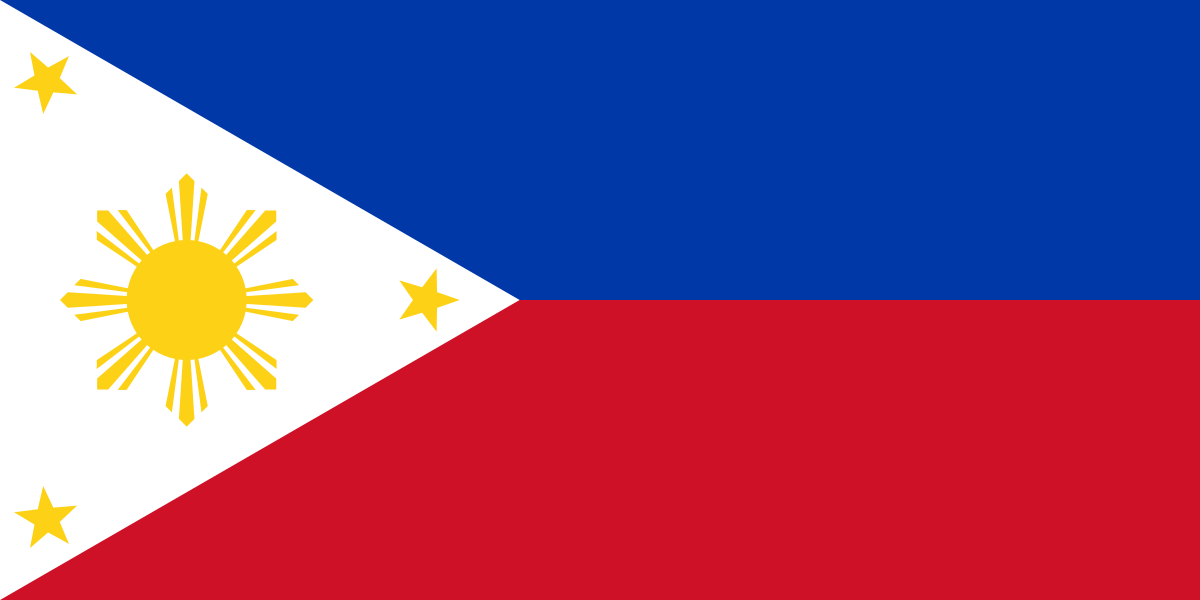
The Philippines uses a 1:2 national flag with blue and red horizontal fields, a white equilateral hoist triangle, a golden-yellow eight-rayed sun and three five-pointed stars. Blue is uppermost in peacetime. [1] Its origins date to 1898; this specimen represents the current specification. [4] [6]
Specification
Article XVI, section 1 of the 1987 Constitution recognizes the national flag’s red, white and blue, sun and three stars. [2] Republic Act 8491, sections 4 and 27–28, supplies the devices, 1:2 proportions, triangle sides equal to the hoist, and Cable color references below. [1]
Colors
| Color | Statutory Cable number | Specimen screen HEX |
|---|---|---|
| Blue | 80173 | #0038A8 |
| Red | 80108 | #CE1126 |
| White | 80001 | #FFFFFF |
| Golden yellow | 80068 | #FCD116 |
The HEX column reports the downloaded SVG, not a statutory conversion or textile standard. Sections 29–30 require government samples to undergo design, color, craftsmanship and material evaluation. [1] [6]
Symbols
The Philippine Consulate General explains the triangle through liberty, equality and fraternity, blue through peace, and red through patriotism. It associates the sun’s eight rays with the provinces that first revolted in 1896 and the stars with the three principal island groups. [4] The House of Representatives names those groups as Luzon, Visayas and Mindanao. These interpretations describe meaning rather than construction. [5]
Construction notes
For hoist W, the rectangular field is 2W long; the triangle’s altitude is √3W/2, derived from its equal sides. The specimen’s two horizontal fields divide at mid-height.
Executive Order 23 specifies a plain sun disc of diameter D=W/5, eight equally spaced ray groups with horizontal and vertical pairs, and each major beam flanked by two narrower beams. Major-beam length is 5D/9; minor-beam length is four-fifths of that. Each star has outer diameter 5D/9 and inner diameter 2D/9, with one point directed toward its triangle corner. The order specifies corner clearance D/2 and excludes the canvas attachment edge from flag length. Its historical allowance for a shortened fly must be distinguished from the later Act’s fixed 1:2 ratio. [3] [1]
The SVG viewBox is −28 −45 180 90. Its triangle runs from (−28, −45) and (−28, 45) to (49.942, 0), agreeing with an equilateral triangle to coordinate rounding. The sun disc has radius 9; its long-ray tips reach radius 19. Three star copies use rotations of 120° and 240° about (−2.019, 0); their outer and inner radii are approximately 5 and 2. The forward tip is 9 units from the triangle apex. These checks agree with the dimensions above. [6]
The sun center (0, 0) is slightly toward the fly of the triangle centroid (approximately −2.019, 0). Do not infer that they must coincide. The official diagram download could not be retrieved, so this placement and the complete ray-outline angles are recorded as specimen geometry, not independently certified production coordinates. Rounded vector artwork, cloth tolerances, seams and physical color matching require separate production review.
Historical record
The Consulate dates the first unfurling to the Battle of Alapan on 28 May 1898, before the independence proclamation on 12 June. These are distinct milestones. [4] Executive Order 23 of 25 March 1936 addressed inconsistent proportions and standardized the component geometry. [3]
The Senate records approval of Republic Act 8491 on 12 February 1998. [7] Its section 55 makes effectivity dependent on publication; the approval date is not asserted here as the exact effective date. [1] The asset register identifies this color version as 1998–present. Earlier renderings belong to their own periods and should not be illustrated interchangeably with this specimen. [6]
Use and display
The Code covers public and educational display and use aboard Philippine ships. Section 10 prescribes blue above red in peace and red above blue in war; for vertical hanging, blue is at the observer’s left in peace. Sections 16 and 26 address vertical display and Flag Days, 28 May–12 June. [1]
Source trail
- Republic Act 8491: Flag and Heraldic Code of the Philippines — sections 3–4, 9–10, 16, 26–30 and 55; legal text hosted by the Arellano Law Foundation.
- 1987 Constitution, Article XVI, section 1 — constitutional identity.
- Executive Order 23, 25 March 1936 — construction text; Supreme Court E-Library listing. The Embassy-hosted design diagram was indexed but its download was unavailable.
- Philippine Consulate General in San Francisco: The Philippines — first unfurling, proclamation and symbolism.
- House of Representatives: For Students — island-group interpretation, inspected in indexed text.
- Wikimedia Commons: Flag of the Philippines.svg — period, contributors and public-domain declaration; downloaded SVG; local inspection and provenance.
- Senate Legislative Reference Bureau: Republic Act 8491 — approval date and gazette reference.

Reviewed 13 September 2026. The unresolved limits are the exact publication-based effective date and independent verification of the full official emblem diagram.
Related records: Malaysia and Indonesia. Browse national flags or the Flag Index.