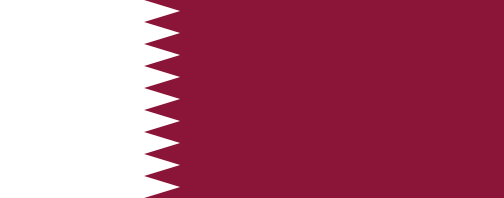
Qatar’s national flag has a maroon field and a white hoist band with nine triangular points facing the fly. The Amiri Diwan dates its present shape to 1960. The long 11:28 specimen represents the outdoor format used within Qatar; the indoor standard has a 1:2 hoist-to-fly ratio. [1] [3]
Specification
The Foreign Ministry describes a horizontal rectangle in white and Al Adam (maroon). White adjoins the staff; the maroon edge flies free. Nine isosceles white triangles project into the maroon field. It identifies the maroon reference as Pantone 1955 C. [2]
Annex 1, parts I and II, section 3/4/1, distinguishes outdoor and indoor proportions within Qatar. Section 3/4/2 allows proportions corresponding to local standards abroad, subject to the annex’s construction figures. These are authorized use formats, not successive historical flags. Outdoor dimensions exclude the heading attached to the staff. The plain second-grade flag is for general use; the embroidered first-grade version is reserved for the Amir. [3]
Colors and physical manufacture
| Color | Government reference | Local SVG value |
|---|---|---|
| Maroon / Al Adaam | Pantone 1955 C | #8A1538 |
| White | White | #FFFFFF (SVG white) |
The hexadecimal values describe this digital specimen, not a legal RGB specification or a certified textile match. [2] [8] Older FOTW notes cite Pantone 222 C; its later account reports the 2012 standard’s 1955 C. The current government reference takes priority. [6]
Construction notes
The local SVG transcribes the code sample published on the Commons description page. Its viewBox is 0 0 504 198, giving exactly 11:28. A maroon rectangle fills the canvas. The white polygon has a vertical root line at x=144 and nine tips at x=180, with tip heights y=11, 33, 55, 77, 99, 121, 143, 165, and 187. Each triangle has a 22-unit base and a 36-unit depth. These are measurements of this artwork, not independently verified legal construction dimensions. [8]
The geometry matches the government’s nine-point isosceles description and the outdoor ratio. However, the annex’s dimensioned drawings could not be retrieved; their exact agreement with this code sample is unresolved. The Government Communications Office summarizes the white and maroon portions as one-third and two-thirds. That overview does not locate serration roots or tips and is not used here to invent a construction grid. [2] [3] [7]
Use the annex’s applicable size, material, stitching, and performance schedules for physical production. Resizing this screen specimen alone does not demonstrate compliance. [3]
Historical record
The National Day Organizing Committee describes a 1932 design containing diamonds and the word “Qatar.” It dates their removal to 1960 under Sheikh Ali bin Abdullah Al Thani, leaving the white and maroon design. The Amiri Diwan independently gives 1960 for the present shape. Earlier inscribed specimens therefore belong to separate historical records. [5] [1]
FOTW lists 9 July 1971 as an adoption date, alongside older chronology that places the basic design in 1949. No primary proclamation supporting either date was retrieved. This entry follows the two Qatari institutions for the basic form’s period, without assigning an exact 1960 adoption day or claiming all present manufacturing details were fixed then. The committee records the flag’s display at the United Nations in 1971. [6] [5]
Law No. 14 was issued on 16 December 2012. Al Meezan lists it as in force and records publication in Official Gazette No. 5 on 1 April 2013. Article 14 makes publication the commencement point; Article 1 refers the flag’s specifications to Annex 1. These legal milestones concern an existing national design. [4]
Meaning and use
The National Day Organizing Committee relates Al Adaam to Qatar’s maroon textile heritage and interprets the nine points through Qatar’s place in the Gulf treaty system. This is an attributed historical explanation, separate from geometric requirements. No sole designer of the present flag is established by the sources consulted. [5]
The flag represents the state in public and official display. Articles 3–7 require dignified treatment, exclude damaged or faded flags from display, prohibit added words or designs and advertising use, and refer flag protocol to Annex 2. Military salutes are specified for flag ceremonies and parades. [4]
Source trail
- Amiri Diwan: State of Qatar, Qatar’s Flag ↗ — current identity and 1960 present-shape dating.
- Ministry of Foreign Affairs: National Flag ↗ — nine isosceles points, orientation, and Pantone 1955 C.
- Al Meezan: Law 14/2012, Annex 1 (Arabic text) ↗ — indexed text inspected, parts I and II, especially 2/2 and 3/4; direct retrieval and dimensioned images unavailable.
- Al Meezan: Law No. 14 of 2012 Concerning the Qatari Flag ↗ — legal status, issue/publication dates, and articles 1–14.
- Qatar National Day Organizing Committee: Qatar Flag History ↗ — 1932 and 1960 changes, 1971 UN display, and historical interpretation.
- Flags of the World: Qatar ↗ — differing historical dates and older color references; secondary evidence.
- Government Communications Office: Facts about Qatar ↗ — broad color-area description, not a dimensioned drawing.
- Specimen provenance and rights → — Commons code sample, inspection notes, and checksum.
Sources checked 14 September 2026. Unresolved: exact conformity to the annex drawings and primary evidence for the competing adoption dates. The specimen is an editorial reference, not an official manufacturing master.
Related records: United Arab Emirates and Jordan. Browse national flags or the Flag Index.