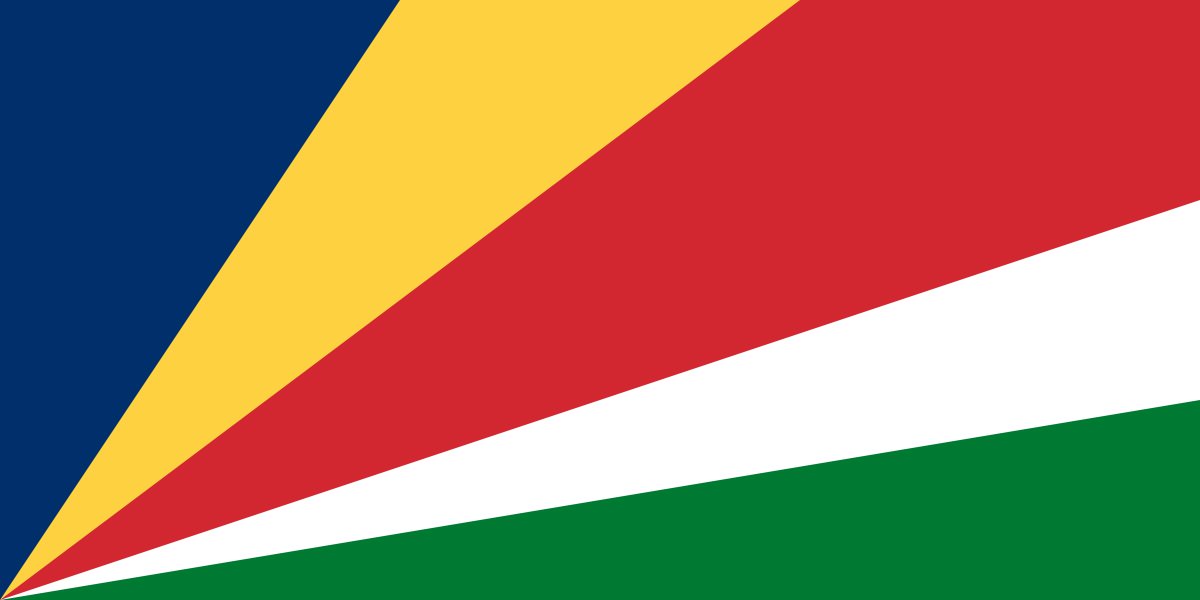
Seychelles uses a 1:2 national flag with blue, yellow, red, white and green rays meeting at the lower hoist. The current design entered use on 18 June 1996. [3] [4]
Specification
Article 3 of the Constitution leaves the national symbols to legislation. [6] The National Symbols Act, Act 3 of 1996, establishes the flag through section 3 and Schedule Part I. The schedule provides an illustration and color indicators, rather than a detailed prose blazon. [1] [3]
The edge divisions agree in the ministry’s guidance and the Flags of the World account of the legal drawing. [2] [3]
Official color indicators
The ministry reproduces these indicators from the Act. It gives no coated/uncoated suffix or textile tolerance here; none is added. The ink percentages below are the listed components, not an inferred full CMYK profile. [2]
| Color | Listed ink components | Pantone reference |
|---|---|---|
| Blue | Magenta 70%, cyan 100% | 294 |
| Yellow | Magenta 20%, yellow 100% | 122 |
| Red | Magenta 100%, yellow 100% | 1795 |
| Green | Cyan 100%, yellow 100% | 356 |
| White | No separate ink formula listed | Not listed |
Specimen screen colors
The inspected SVG uses the fills below. They are not certified Pantone conversions or substitutes for physical production standards. [5]
#002F6C / asset screen value#FED141 / asset screen value#D22730 / asset screen value#FFFFFF / asset screen value#007A33 / asset screen valueConstruction notes
In the specimen’s 0 0 6 3 viewBox, (0, 0) is the upper hoist and (0, 3) the shared origin. Boundaries run from that origin to (2, 0), (4, 0), (6, 1) and (6, 2). Thus each top segment is 2 units and each fly segment is 1 unit. Red wraps around the upper fly corner. These are normalized coordinates derived from the published thirds construction, not prescribed manufacturing dimensions. [3]
The source vector stacks five filled paths. The red base covers the rectangle; white and green overlays establish the lower rays; yellow and blue establish the upper rays. Filled paths close implicitly. Overlap beneath visible fields does not change their boundaries. The unchanged artwork matches the ministry’s textual proportions; this is a reference specimen, not an official production master. [5]
Historical record
The ministry credits Philippe Uzice and a national competition in 1996. [7] SeyLII records commencement on 18 June 1996, and State House’s 18 June 2021 account marks 25 years since the five-color flag was first unfurled. [1] [4]
Commons metadata instead labels 8 January 1996 as adoption. Flags of the World identifies that date as publication of the proposed National Symbols Bill, with effect on 18 June. This record uses the latter date for the period of use; bill publication and commencement are distinct events. The original January gazette was not independently retrieved. [5] [3]
The ministry identifies this as the third national flag since independence in 1976. Earlier designs are separate historical flags, not alternate specimens of this record. [7]
Symbolism
Government guidance associates blue with sea and sky, yellow with sunlight, red with the people’s united effort, white with justice and harmony, and green with land and nature. The rays suggest forward movement. [2]
Usage
The ministry supplies flags for public premises, private homes, vessels and table display. [7] Follow its display guidance for orientation and handling. [2] Public-domain artwork rights are separate from national-symbol use rules.
Source trail
- SeyLII: National Symbols Act, Act 3 of 1996 ↗ — commencement and legislative history; 2012 consolidation ↗. Indexed schedule text was available; the original drawing could not be visually checked. SeyLII flags unapplied 2022 amendments; this entry does not restate current penalties.
- Foreign Affairs Department: Guidelines on Specifications and Correct Usage of the Seychelles’ National Symbols (2021) ↗ — sections 2.2–2.5, printed pages 7–8; section 2.7 for display.
- Flags of the World: Seychelles ↗ — ratio, schedule construction, and distinction between the January bill and June commencement.
- State House: Constitution Day, 18 June 2021 ↗ — first-unfurling anniversary.
- Wikimedia Commons: SVG code, contributors and rights ↗; local provenance register ↗.
- Constitution of the Republic of Seychelles, 2010 edition, via FAOLEX ↗ — article 3.
- Foreign Affairs: Seychelles National Flags ↗ — current identity, designer, competition and uses. Its reference to a 1993 Symbols Act differs from the 1996 Act identified by the official manual and SeyLII.

Sources checked 14 September 2026. Related records: Tanzania and Maldives. Browse national flags or the Flag Index.