
Quick answer
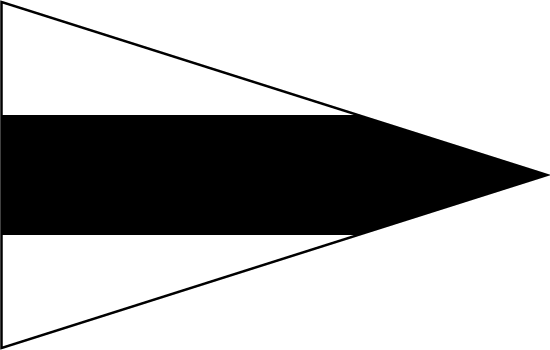
The Third Substitute is a white pennant with a black horizontal band. It repeats the third signal flag, counted from the top within the class—alphabetical flags or numeral pennants—that immediately precedes the substitute. Source: International Code of Signals.
| Item | Description |
|---|---|
| Code designation | 3rd Substitute |
| Appearance | White pennant with a black horizontal band. |
| Function | Repeats the third signal flag of the relevant class in the group. |
| Dimensions | Exact hoist-to-fly ratio, band width and construction tolerances are not established here. |
| Colours | White and black are identification colours; no physical colour standard or official digital values are established here. |
Using the substitute
Substitutes permit repeated letters or numerals when only one flag set is carried. A particular substitute may appear only once in a group. Ignore an answering pennant used as a decimal point when determining the substitute.
The Code’s example for 1100, read from top to bottom, is: numeral 1, First Substitute, numeral 0, Third Substitute. Source: flag signaling, paragraph 6.
Construction and evidence limits
The identification description is not a dimensioned manufacturing specification. Do not derive exact geometry or proportions by measuring a chart illustration. No common manufacturing ratio has been verified for this proposal. Screen colour approximations and editorial reconstructions must be identified as such rather than presented as official specifications.
Historical scope
The cited government publication documents the flag and its procedural role. This review does not establish the design’s first adoption date or a sequence of earlier designs; no historical date range is assigned.
Related flags
See the First Substitute and Second Substitute.