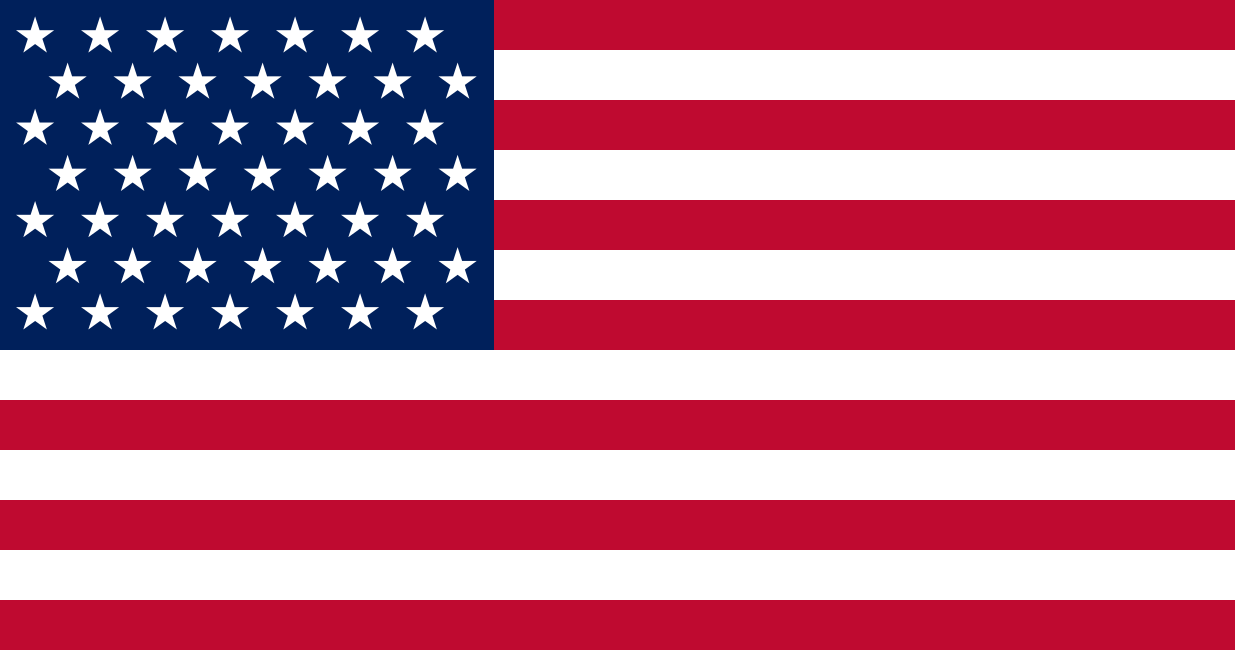
The 49-star flag marked Alaska’s admission and was official for one year. Its blue union arranged 49 stars in seven slightly staggered rows of seven.
Specification
The design retained the established thirteen stripes and overall government proportions. Its distinguishing feature was a seven-by-seven field whose rows were staggered to avoid a rigid square appearance.
A one-year flag
President Dwight D. Eisenhower selected the design and issued Executive Order 10798 on 3 January 1959. It became official on the Fourth of July following Alaska’s admission. Hawaii joined the Union later that year, so the current 50-star replacement took effect on 4 July 1960.
Record boundaries
This record covers the official star-count period, not every surviving manufactured example. Government and civilian flags can vary in stitching, exact color, and physical size.
Source trail
National Archives: 49-star design and Executive Order history ↗
National Archives: Executive Order 10834 and transition date ↗
Understanding the specification
The blue union contains 49 stars in seven staggered rows of seven. The flag has thirteen stripes, and the union is seven stripes high. Hoist means the flag’s height; fly means its length. The qualified 10:19 government standard therefore means 10 units high by 19 units long. Executive Order 10798, section 1 specifies these proportions for executive agencies.
These historical design proportions are distinct from the manufacture of individual flags. As the imported record notes, government and civilian examples can vary in stitching, exact color and physical size. The displayed digital illustration helps explain the arrangement; it should not be treated as a color standard or a statement of manufacturing tolerances.
Frequently Asked Questions
Was the 49-star flag adopted in January or July 1959?
The dates mark different steps. President Eisenhower issued Executive Order 10798 on 3 January 1959, prescribing the design. Official use began on 4 July 1959. The National Archives design history explains the January order and the rule that a new star took effect on the Fourth of July following a state’s admission.
Why was the 49-star flag official for only one year?
The 49th star followed Alaska’s admission. Hawaii became a state later in 1959, bringing another star the following July. The official 49-star period ran from 4 July 1959 through 3 July 1960; the 50-star replacement became official on 4 July 1960, as specified in Executive Order 10834, section 31. This describes the official design period, not the lifespan of every manufactured flag.
Which reference supports which claim?
- National Archives design history: supports the seven staggered rows of seven stars, Eisenhower’s 3 January 1959 order, and the Alaska–Hawaii sequence behind the successive designs.
- National Archives, Executive Order 10834: section 31 establishes the transition to the 50-star flag on 4 July 1960; the preamble explains Hawaii’s admission and the following-July rule. This is the replacement order, not the original 49-star specification.
- Executive Order 10798, reproduced by The American Presidency Project: section 1 supports the 49-star government proportions and union height; section 6 specifies 4 July 1959 as the start of official use.