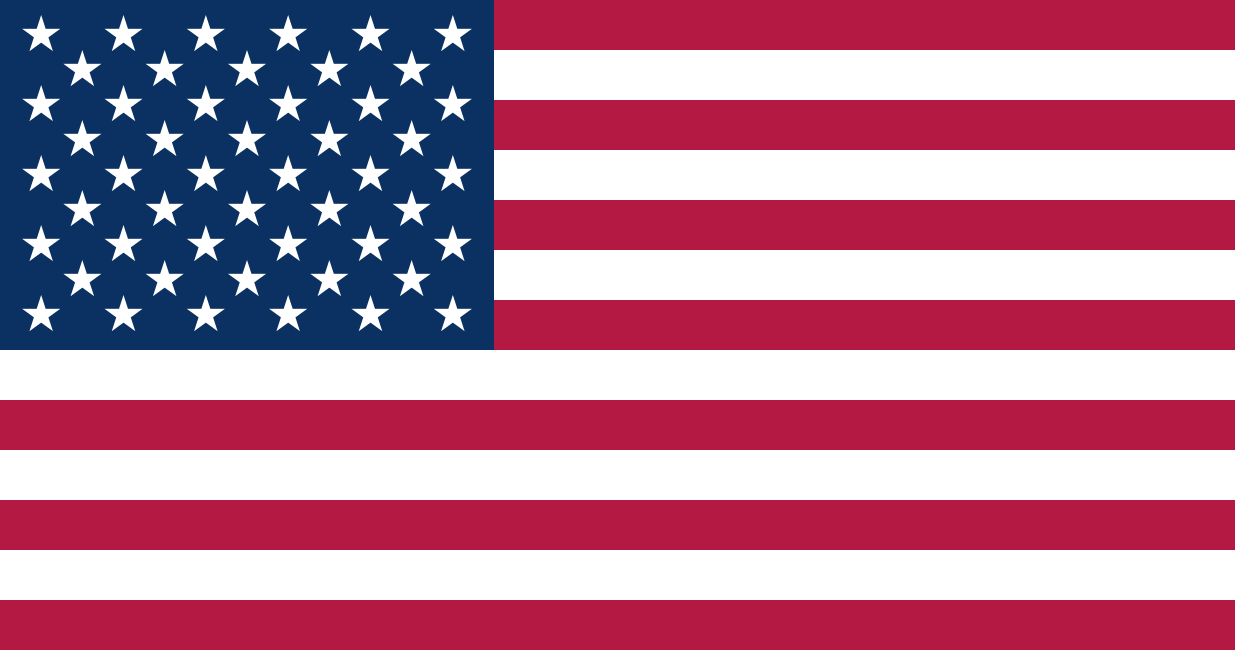
The current United States flag has thirteen equal horizontal stripes, seven red and six white, and fifty white stars on a blue upper-hoist union. It became official on 4 July 1960. The standard drawing has a 10:19 hoist-to-fly ratio and nine star rows alternating six and five.
Specification
Executive Order 10834, signed by President Dwight D. Eisenhower on 21 August 1959, prescribes the striped field and star-bearing blue union, incorporates a construction drawing, and sets the effective date. Read 4 U.S.C. §§1–2 together: the older forty-eight-star wording in §1 is supplemented by §2’s rule adding a star on the Fourth of July following a state’s admission. It does not make the 48-star design current. Federal source trail ↓
Colors and symbols
The legal description names red, white and blue. The stripes represent the original thirteen colonies and the stars the fifty states, as explained by USAGov. The familiar color meanings now given by USAGov are interpretive symbolism; the congressional booklet Our Flag distinguishes the Great Seal’s 1782 color meanings from the original 1777 flag resolution.
Specimen only: #B31942 / RGB 179, 25, 66Specimen only: #FFFFFF / RGB 255, 255, 255Specimen only: #0A3161 / RGB 10, 49, 97These values are read from the displayed SVG. They are not a universal statutory color conversion or a substitute for physical textile samples, material requirements and the applicable procurement specification. No Pantone or other manufacturing equivalence is asserted here.
Construction notes
Take the hoist as 1. The official attachment supplies the following decimal dimensions. Red occupies the top and bottom stripes; the blue union reaches the bottom of the seventh stripe. All stars have one point upward.
| Component | Relative to hoist | Interpretation |
|---|---|---|
| Fly | 1.9 | Overall length |
| Union depth / length | 0.5385 / 0.76 | Depth corresponds to seven stripes; length is 40% of fly |
| Stripe depth | 0.0769 | Rounded decimal for one-thirteenth of hoist |
| Vertical star-grid interval | 0.0538 | Between successive rows and from union edge to first or last row |
| Horizontal half-step | 0.0633 | Stagger between rows; same-row spacing is twice this |
| Star diameter | 0.0616 | Diameter of the circle through the five outer points |
The specimen’s viewBox is 7410 × 3900, with 300-unit stripes and a 2964 × 2100 union. Star centers use horizontal half-steps of 247 and vertical steps of 210. Its 240-unit star diameter is about 0.061538 of the hoist, slightly below the attachment’s 0.0616. Equal subdivisions likewise differ slightly from the printed rounded decimals. This is a documented reference rendering, not a certified cutting or sewing pattern. The public-domain artwork and modifications are recorded in the asset register.
Part II of the order authorizes government sizes including 3 × 4 feet and 7 × 11 feet, and §24 permits specified procurement adjustments. Thus 10:19 describes the standard drawing, not every authorized physical flag. A manufactured flag with other proportions should not automatically be treated as a different historical design.
Historical record
The Continental Congress adopted the first Stars and Stripes resolution on 14 June 1777. The 1818 legislation restored thirteen stripes and provided for a star for each state. These are milestones in the flag’s history, not adoption dates for the present fifty-star arrangement.
Hawaii entered the Union on 21 August 1959. Eisenhower prescribed the new design that day; it took effect on 4 July 1960, succeeding the 49-star flag of 1959–1960. The Eisenhower Library documents the committee recommendation and presidential selection, and the official raising at Fort McHenry on 4 July 1960. This record makes no exclusive individual-designer attribution.
The 48-star flag and 15-star flag have separate historical records. Executive Order 10834 allowed existing government stocks to be used until unserviceable, so an object’s manufacture or display date need not coincide with its design’s official period.
Usage
This is the national flag used in public, civic and government display. The Flag Code addresses display and respect; USAGov links official display guidance and explains half-staff observances. The construction record does not replace those instructions or a purchaser’s material and workmanship requirements.
Source trail
National Archives: Executive Order 10834 ↗ — legal design, authorized sizes, procurement exceptions, stock transition and effective date; 24 FR 6865.
Eisenhower Library: original construction attachment, 21 August 1959 ↗ — arrangement and proportion schedule.
Eisenhower Library: design of the 49- and 50-star flags ↗ — committee process, order dates and official raising.
U.S. Congress: Our Flag, House Document 108-97 ↗ — history, federal flag provisions and construction, especially printed pages 1, 4–5, 9 and 41. For construction, use the original attachment; the booklet’s extracted stripe decimal is inconsistent with thirteen equal stripes.
USAGov: American flag and national symbols ↗ — current fifty-star identity, symbols and display guidance. Hawaii’s admission was in 1959; the 1960 date refers to the flag change.
Wikimedia Commons: SVG code, contributors and public-domain declaration ↗ — specimen provenance and rights; not the legislative authority.
