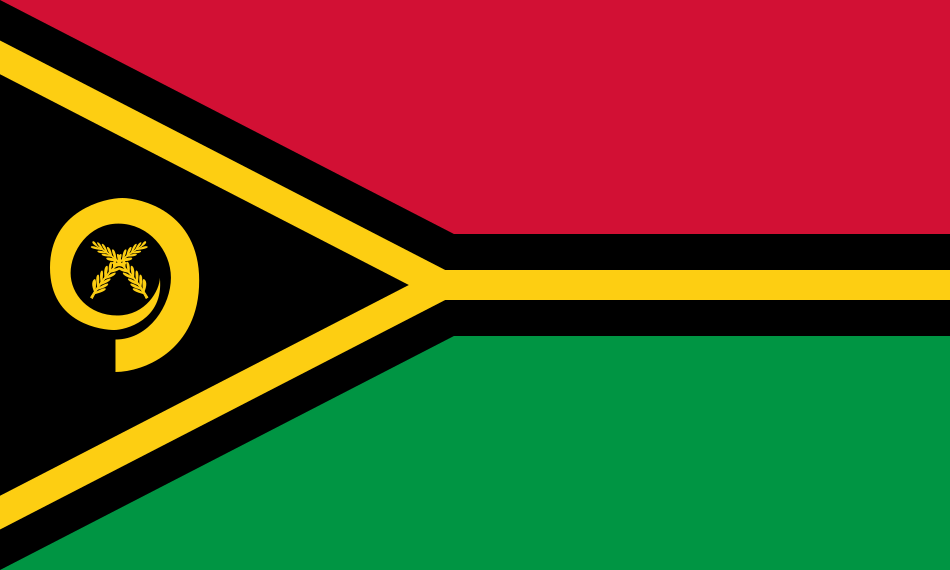
Vanuatu’s current national flag has red above green, a black-edged yellow Y and a black hoist triangle containing a yellow boar’s tusk and crossed namele leaves. The UN’s flag reference dates adoption to 18 February 1980. This record displays a 3:5 reference specimen; the consulted sources do not establish one uncontested legal ratio.
Specification
The design places the tusk and leaves inside the hoist triangle. The yellow Y branches toward the two hoist corners and continues horizontally to the fly. Red occupies the upper field and green the lower field. This describes the inspected reference artwork; it is not a quoted legal blazon.
Legal description and proportions
The Vanuatu Trade Portal lists the State Flag and Armorial Bearings Act under the Ministry of Internal Affairs, with a date of 30 July 1980. This register entry confirms the legislative framework, but supplies no usable dimensioned drawing.
The Commons construction-sheet author reports that the State Flag and Armorial Bearings Public Declaration of 19 March 1980 defines the symbols through an unlabelled schedule image, interpreted there as approximately 2:3. That sheet is a later measured reconstruction, not a government construction standard. The linked PacLII original could not be retrieved during this check, so its date and image measurements are attributed rather than independently certified here.
.svg)
Flags of the World instead reports 19:36 from a premier’s-bureau dimension document and describes the legal annex as 3:5; it also records 11:18 in an older reference. The bureau document was not independently obtained. These accounts conflict; this record does not declare any of them superseded or legally interchangeable.
Colors
The London 2012 flags manual gives PMS 186 red, PMS 116 yellow, PMS 347 green and PMS Black for its event-production context. These are not established here as Vanuatu’s binding textile standards.
#D21034 / specimen only#009543 / specimen only#FDCE12 / specimen only#000000 / specimen onlyThese HEX values were read from the SVG, including its default black fill. No certified conversion to Pantone, RAL reference or physical color tolerance is claimed. Screen approximations do not replace physical production specifications.
Construction notes
The local SVG follows the 3:5 reference variant identified on the Commons source page. It is not the separate Commons file labelled “official,” which now uses 2:3. Drawing paths have been retained without stretching or redrawing the emblem.
| Part | SVG measurement | Interpretation |
|---|---|---|
| Canvas | viewBox 0 0 950 570 | Hoist : fly = 570:950 = 3:5 |
| Horizontal bands at fly | 234, 36, 30, 36, 234 units | Red, black, yellow, black, green; 39:6:5:6:39 |
| Outer black triangle path | (0,0), (552.813,285), (0,570) | Overlaid by the horizontal black band |
| Yellow triangle path | (0,40.502), (474.251,285), (0,529.496) | Joins a 30-unit yellow horizontal bar at y=270–300 |
| Inner black triangle | (0,74.255), (408.782,285), (0,495.745) | Contains the emblem |
| Crossed leaves | One path group plus an internal reflected copy | Reflection uses x′=238.5−x; the tusk is a separate asymmetric path |
The measured band scheme matches the Commons reference description. The yellow triangle’s upper and lower hoist offsets differ by 0.002 SVG unit because of source coordinate rounding; no legal tolerance is implied. Leaflets are stylized: this artwork is not evidence for an exact statutory leaflet count. A manufacturer would need an authenticated current master and shade standard to resolve these limits.
Symbols and use
Flags of the World associates the tusk with prosperity, the crossed namele leaves with peace and the Y with the island chain. Its cited accounts connect green with the islands’ richness, red with blood, black with the Melanesian people and yellow with sunshine or Christianity. These are explanatory interpretations, not numerical construction rules.
The flag represents Vanuatu in national display and international protocol. The Ministry of Internal Affairs’ 45th independence programme includes raising the National Flag. The Trade Portal separately identifies controls on goods bearing state symbols; the artwork’s copyright status does not establish permission for every commercial use.
Historical record
The UN Office at Vienna’s protocol flag reference records adoption on 18 February 1980. This precedes the reported March declaration and independence on 30 July 1980, the latter confirmed by Malampa Provincial Government. These dates describe different events.
The Ministry of Justice and Community Services’ memorial report credits Kalontas Malon as the flag’s designer. This government attribution does not establish authorship of every later vector drawing. This entry covers the current national design from 1980 onward.
Source trail
UN Vienna: flag reference, PDF page 47 ↗ — entity name and adoption date.
Government Trade Portal: regulations ↗ — Act, responsible ministry, date and controlled goods. PacLII: Public Declaration ↗ — original source identified by Commons; retrieval unavailable in this check.
Commons: measured reconstruction and account of the schedule ↗ — secondary evidence for the reported March declaration and approximate 2:3 image, not an official numerical standard.
Flags of the World: Vanuatu ↗ — competing proportion references and symbol interpretations.
London 2012 flags manual, US Department of Defense copy ↗ — event-specific Pantone guidance.
Ministry of Justice: designer memorial ↗ — government attribution; indexed text consulted, full-page retrieval timed out. Ministry of Internal Affairs: independence programme ↗ — national ceremonial use.
Commons: 3:5 artwork and rights ↗ · Retrieved Commons-derived SVG ↗ · Local provenance and checksum →

