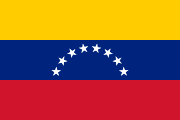
Venezuela’s current national flag has equal yellow, blue and red horizontal bands, with eight white five-pointed stars arched across blue. This specimen shows the civil and merchant form without arms, using the reference ratio 2:3.
Specification
Article 3 of the 2006 national-symbols law prescribes equal joined horizontal bands in that order, with eight white five-pointed stars in the blue band, following a circular arc convex upward. It supplies no numerical ratio, star radius or angular spacing.
Flags of the World records 2:3 for the civil form. The Foreign Ministry’s 12 February 2026 overview confirms the current eight-star design and explicitly notes variation in overall proportions, detailed arc geometry and exact colors.
Specimen colors
SVG #FFCC00 / screen approximationSVG #00247D / screen approximationSVG #CF142B / screen approximationSVG #FFFFFFThese are fills in the retrieved SVG, whose palette differs from the current Commons file. They are not official HEX values or conversions from a verified textile standard. No Pantone, RAL or manufacturing tolerance is asserted.
Construction notes
For hoist H, each band is H/3 high. A 2:3 reference rectangle has fly 3H/2. The specimen has a 180 × 120 viewBox: overlapping red, blue and yellow paths end at y=120, 80 and 40, producing three equal 40-unit visible bands.
Its star centers follow a 36-unit radius about (90, 84), at rotations −70°, −50°, −30°, −10°, 10°, 30°, 50° and 70° from the upward radius. Each repeated five-point star has outer radius 5 and rotates with its position on the arc. All eight sit within blue. These coordinates describe the downloaded artwork; the law does not prescribe this particular spacing, radius or orientation.
The Commons-derived vector was retrieved through country-flags. Paths, transforms and fills are preserved; accessible metadata was added. It matches the legally described equal bands, star count, color order and upward arc, but is a reference rendering rather than an official construction master.
Historical record
The law was signed by the Assembly on 7 March 2006 and entered into force on publication in Gaceta Oficial No. 38.394, 9 March 2006. This record dates the current arrangement to that legal change. Reference summaries also give 12 March; it is not the law’s publication date.
The Culture Ministry traces the tricolor’s arrival on Venezuelan soil to Francisco de Miranda at La Vela de Coro on 3 August 1806 and dates the current modification to 9 March 2006. That earlier tricolor is an antecedent, not the specimen catalogued here. No individual designer attribution is made for the complete current arrangement.
Symbols and interpretation
The Education Ministry’s March chronology associates the first seven stars with the provinces that declared independence and the eighth with the historical province of Guayana. This is a historical explanation of the stars, not a construction rule. The law specifies the colors without assigning symbolic meanings to them.
Usage and status
Article 3 specifies the arms near the hoist in yellow for the Presidency, armed forces and public buildings; merchant shipping uses the stars without arms. The civil form shown here therefore cannot substitute for every official-use version. Articles 4–6 address prescribed display occasions and permit daily public use.
For nearby reference records, compare Colombia’s unequal bands and Brazil’s statutory celestial construction.
Source trail
Checked 15 September 2026. Spanish material is paraphrased in English.
- Gaceta Oficial No. 38.394 / URBE archive — publication issue, 9 March 2006.
- National Assembly / 2006 national-symbols law, Justia copy — article 3, articles 4–6, final provision and Assembly date.
- Foreign Ministry / national flag, 12 February 2026 — current design and specification limitations.
- Culture Ministry / Flag Day — 1806 antecedent and 2006 modification.
- Education Ministry / March chronology — historical star interpretation.
- Flags of the World / Venezuela — 2:3 reference format; differing date and color references.
- Retrieved SVG · repository provenance · Commons contributors and public-domain declaration · local asset audit.

