
Quick answer
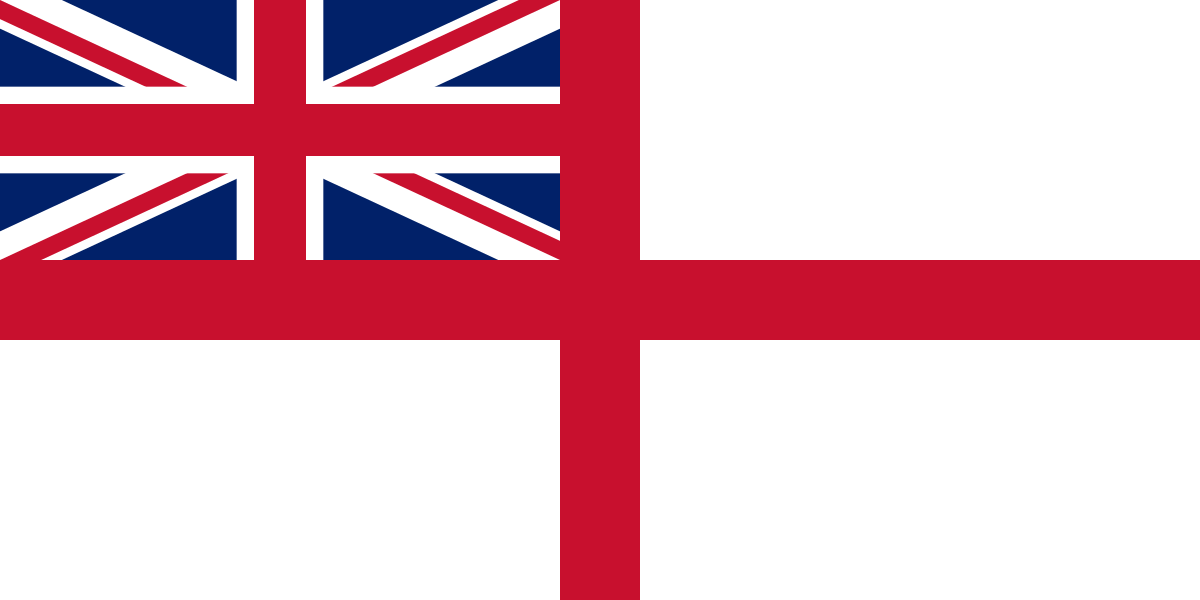
The United Kingdom’s White Ensign identifies the Royal Navy. Its design combines a white field, a red St George’s cross and the Union Flag in the upper corner next to the hoist. Modern British ensigns are customarily made in 1:2 hoist:fly proportions. The Flag Institute’s guide illustrates the ensign and describes customary proportions.
The Royal Navy’s regulations also provide for its display at naval shore locations and certain specifically authorised civil locations.
| Feature | Description | Evidence qualification |
|---|---|---|
| Field and cross | White field with a red St George’s cross. | Identification of the illustrated design; no exact cross width is asserted. |
| Canton | Union Flag at the upper hoist. | Exact canton dimensions and internal construction are not established here. |
| Proportions | Customarily 1:2 hoist:fly. | The Flag Institute describes customary ensign manufacture; this is not presented as a statutory dimension or a rule for all historical flags. |
| Colours | White and red, with blue also present in the Union canton. | No verified textile colour standard, Pantone reference or mandatory digital colour values are supplied. |
| Official use | Royal Navy service and specified authorised settings ashore. | BRd 2, effective October 2025, provides operational and ceremonial rules; it is not used here as a complete manufacturing specification. |
Construction notes and evidence limits
For a customary 1:2 outline, the fly is twice the hoist. This arithmetic does not establish the width of the cross, the dimensions of the canton or the arrangement of the Union Flag within it. The proportion is supported by Flag Institute guidance, rather than a manufacturing drawing verified for this record.
Official specification, common manufacture and digital illustration should remain distinct. No complete official construction drawing or textile colour specification was verified for this proposal. Screen colours would be approximations; an editorial reconstruction would need to be labelled accordingly. Neither exact geometry nor colour values should be inferred by measuring an illustration.
Historical objects also require separate treatment. Royal Museums Greenwich’s specimen AAA0667 is catalogued as machine-sewn wool bunting, dated only ‘after 1801’, and measures 1320.8 × 2667 mm. These are measurements of that surviving object, not prescribed manufacturing dimensions.
Historical context
The White Ensign existed before its general allocation to the Royal Navy in 1864. Royal Museums Greenwich dates the abolition of the squadronal system to an order of 9 July 1864 and explains the subsequent abandonment of red and blue ensigns in ordinary Royal Navy use. This is a change in allocation, not the first appearance of a white naval ensign.
Earlier specimens must not automatically be treated as identical to the current design. The museum’s AAA0703, described as an after-1801-pattern naval ensign and dated to the early nineteenth century, specifically lacks the overall red cross. That catalogue description concerns a particular historical object and does not redefine the current White Ensign.
Current use and related flags
BRd 2, article 9148 identifies naval shore locations for the White Ensign, including commissioned shore establishments, naval bases and Royal Marines establishments. It separately lists exceptional civil locations with naval connections. These provisions support qualified descriptions of authorised use rather than a claim that every display occurs aboard a warship.
Compare the Red Ensign of the United Kingdom and the Union Flag. The Union Flag forms the canton of the White Ensign; it is a separate flag.
Sources
- Royal Navy — BRd 2, effective October 2025, chapter 91: official flag-use rules.
- Flag Institute — UK flag protocol, illustrated ensigns and Appendix C: customary proportions.
- Royal Museums Greenwich — White Ensign, AAA0668: the 1864 change in naval allocation.
- Royal Museums Greenwich — White Ensign, AAA0667: historical materials, qualified dating and specimen dimensions.
- Royal Museums Greenwich — White Ensign, AAA0703: a historical specimen without the overall cross.