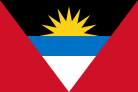
Antigua and Barbuda’s national flag places a golden rising sun above blue and white within red sides forming a V. Adopted on 27 February 1967, it remains the national flag. [1] The specimen uses reference proportions of two units high to three long. [2]
Specification
The government calls the emblem the National Flag and describes a seven-point golden sun, red, blue, black and white, and a V associated with victory. [1] The specimen has red side triangles surrounding an inverted triangle with black above blue above white. [3]
Legal description: no original adoption instrument, separate proclamation date or statutory blazon was verified during this research. Government recognition establishes the identity documented here; the reference grid below is not presented as legislation.
Colors
Government names gold, rather than prescribing a numerical yellow shade. [1] FOTW reports differing Album and Olympic color recommendations; neither is established here as a domestic manufacturing standard. [2] These fills are read from the downloaded SVG. They are screen approximations, not official HEX values or certified textile colors. [3]
#CE1126 / specimen screen value#000000 / specimen screen value#FCD116 / specimen screen value#0072C6 / specimen screen value#FFFFFF / specimen screen valueConstruction notes
The inspected SVG viewBox is 0 0 138 92, exactly 2:3. The red overlay leaves a central triangle joining (0,0), (138,0) and (69,92). Its horizontal color boundaries are y=36 and y=56, giving black, blue and white vertical extents of 36:20:36 along the centerline, equivalent to 18:10:18. The bands narrow within the triangle; these numbers describe heights, not areas. [3]
The sun is centered at (69,36). A gold triangle from (−30,0) to (0,−5.742) to (0,5.742), in local coordinates, is repeated at 22.5-degree intervals from 0 to 180 degrees. The blue band masks its lower portion, leaving seven complete upward rays and two horizontal half-rays at the horizon. The top ray reaches y=6. The layout is symmetric about x=69. These are inspected artwork measurements, not official sun dimensions. [3]
FOTW attributes 18:10:18 band heights to the Album, but explicitly identifies its sun dimensions as an approximation and records another unsourced construction. This specimen agrees with the band proportions and government ray count; its sun outline remains reference artwork. [2]
Symbols and usage
Government associates the sun with a new era; red with ancestral sacrifice and the people’s energy; blue with hope; and black with the soil and African heritage. Gold, blue and white evoke sun, sea and sand, while the V expresses victory. [1]
FOTW identifies national use on land and civil use at sea, and separately records a Coast Guard ensign. This national specimen does not represent that service flag. The exact commencement of maritime use was not independently verified. [2]
Historical record
Government dates Samuel’s design to 1966 and adoption to 27 February 1967. [1] Adoption marked associated statehood; independence followed on 1 November 1981. The design continued in use. FOTW reproduces a museum account reporting a 1994 clarification that seven full sun points should appear after inconsistent renderings; no primary instrument for that clarification was retrieved. It is not assigned a replacement-flag date here. [2]
Source trail
- Government Information Service: National Symbols ↗ — official designation, current recognition, 1966 designer attribution, adoption date, colors and meanings.
- Flags of the World: Antigua and Barbuda ↗ — specialist reference; Album-derived proportions, explicitly approximate sun construction, competing color guidance, usage and historical reports. Museum account consulted through this transcription; its original link now serves unrelated tourism content.
- Retrieved SVG: country-flags ↗; repository provenance and public-domain declaration ↗; Commons contributor history and rights ↗; local asset register →.


Sources checked 15 September 2026. Related records: Barbados and The Bahamas. Browse national flags or the Flag Index.