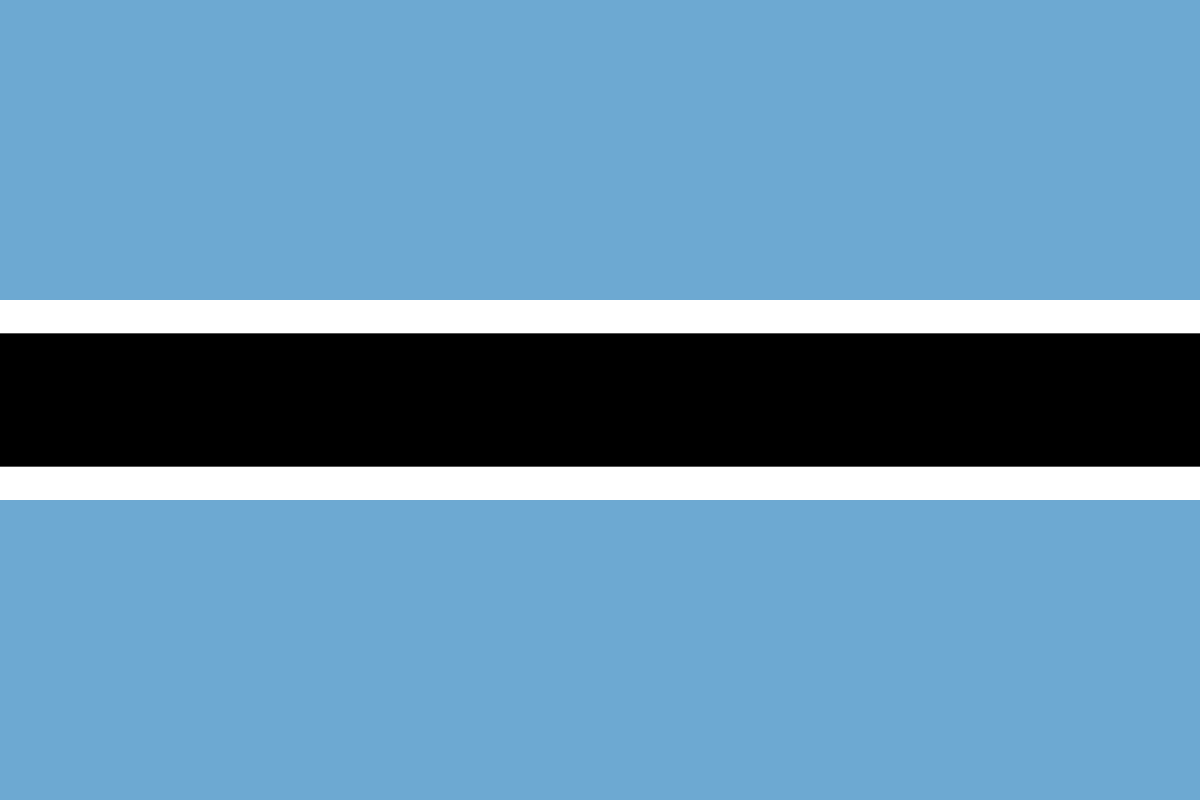
Botswana’s current national flag has a light-blue field crossed by a central black band with narrow white borders. It was adopted on 30 September 1966. Its established hoist-to-fly ratio is 2:3. [3] [5]
Specification
Section 4 of the Botswana Emblems Law, No. 25 of 1966, establishes the flag described in Part II of its Schedule. The five stripes run horizontally. The 2004 amendment replaces “azure blue” throughout the Schedule with “Botswana blue”; white, black and the stripe dimensions remain unchanged. [1] [2]
| Position, top to bottom | Current legal color name | Height / total hoist |
|---|---|---|
| 1 / upper field | Botswana blue | 9/24 |
| 2 / upper border | White | 1/24 |
| 3 / center | Black | 4/24 |
| 4 / lower border | White | 1/24 |
| 5 / lower field | Botswana blue | 9/24 |
Colors and production standards
The Botswana Bureau of Standards lists BOS 207:2015, National Flag – Specification, covering materials, design and manufacture of four flag types. Its full text was not obtained. [4] Flags of the World reports Pantone 15-4225 TCX for its blue, whereas older Olympic guidance used PMS 277 and Album references use 2915 C. These are different references, not interchangeable conversions. The TCX value is reported second-hand here, not independently certified. [5]
#6DA9D2 / asset screen value#FFFFFF / asset screen value#000000 / asset screen valueThese inspected SVG fills are display approximations. The Commons file history attributes its blue update to the 2015 standard, but that does not establish a certified screen-to-textile match. For physical manufacture, consult BOBS for the applicable standard, sizes, materials and tolerances. [8]
Construction notes
The original legal schedule specifies stripe heights but no overall hoist-to-fly ratio. The 2:3 rectangle follows the recognized Flags of the World construction: 24 units high and 36 long. [1] [5]
The inspected SVG has viewBox 0 0 36 24 and intrinsic size 1200 × 800. A full blue rectangle is overlaid with white from y=9 to y=15 and black from y=10 to y=14, leaving visible heights 9, 1, 4, 1 and 9. Each shape spans the full 36-unit fly. This produces equal upper and lower fields and borders, with the black band centered at y=12. These coordinate checks describe the retrieved artwork; they add no manufacturing tolerance. [8]
Historical record
The original law records passage on 23 August 1966, assent on 7 September, and commencement on 30 September. Brand Botswana dates adoption to 30 September 1966, the day of independence. Legislative passage, assent and adoption are separate events. [1] [3]
Act 36 of 2004 commenced on 31 December 2004 and updated the legal blue terminology. The current specimen illustrates today’s flag; its digital palette is not evidence of the exact shade of a flag manufactured in 1966. [2]
Flags of the World reproduces George Winstanley’s account in Under Two Flags in Africa (2000), pages 235–236, in which he credits himself with designing the flag after a competition. This is a published memoir attribution, not an attribution in the flag law. [5]
Symbolism
Botswana’s mission in Geneva associates blue with sky and water, and the white-black-white combination with racial harmony and the nation’s plural composition. Brand Botswana likewise explains blue as water and the central bands as harmony and pluralism. These are official interpretations; no emblem is drawn on the national flag. [6] [3]
Usage
This is the national flag representing Botswana. The government’s Use of National Emblems service provides a formal application route for companies, organizations and independent enterprises outside government, addressed to the Permanent Secretary to the President with details and samples of the proposed use. That guidance concerns organizational use; it is not evidence that every private display requires the same application. Artwork copyright status and permission to use a national emblem are separate matters. [7]
Source trail
- Botswana Statute Law 1966, No. 25: Botswana Emblems Law ↗ — UNODC-hosted scan, printed pages 177–179 (PDF pages 214–216); sections 1–4 and Schedule Part II; original dates and band geometry.
- Botswana Emblems (Amendment) Act, No. 36 of 2004 ↗ — scanned Act, section 2(b), blue-name replacement and commencement. Consolidated Act listing ↗ identifies both Acts; full consolidated text is subscription-only.
- Brand Botswana / Botswana Investment and Trade Centre: About Botswana ↗ — page 16, adoption and symbolism; page 6, independence.
- Botswana Bureau of Standards: BOS 207:2015 ed.1 ↗ — catalogue scope; full production standard not inspected.
- Flags of the World: Botswana ↗ — 2:3 construction, differing color references, reported BOBS TCX specification, and Winstanley memoir extract.
- Embassy of Botswana in Switzerland and UN Mission, Geneva: National Symbols ↗ — current national identity and official symbolism.
- Government of Botswana: Use of National Emblems ↗ — organizational application procedure.
- Wikimedia Commons: SVG, contributor history and public-domain declarations ↗; retrieved original SVG ↗; local asset register.


Sources checked 15 September 2026. Related records: Tanzania and Mauritius. Browse national flags or the Flag Index.