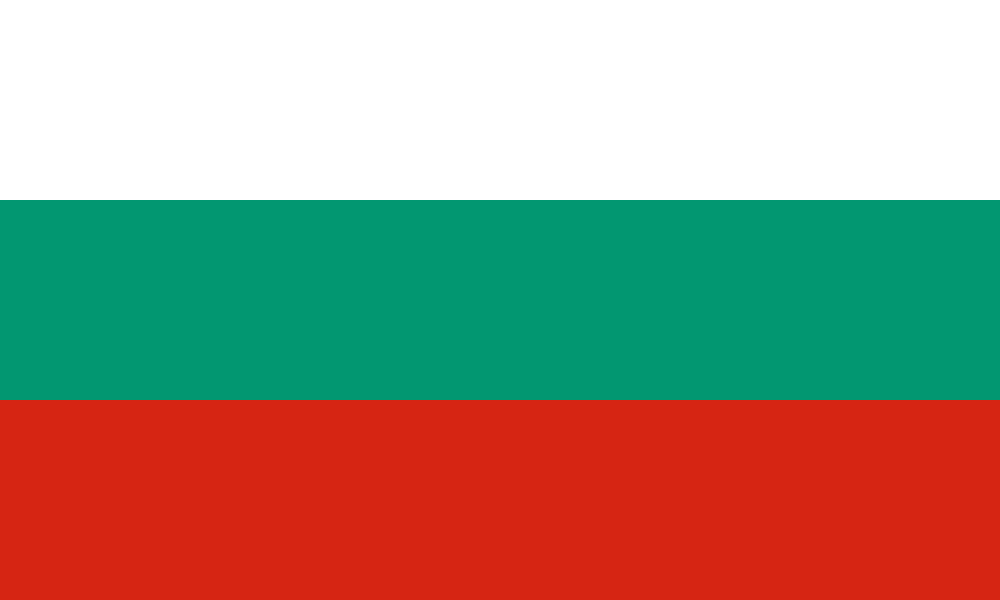
Bulgaria’s current national flag has equal white, green, and red horizontal bands, read from top to bottom. The standard rectangle is three units high and five units long. Council of Ministers ↗
Specification
Article 166 of the Constitution fixes the horizontal color sequence. The Council of Ministers describes the flag as expressing the state’s independence and sovereignty. Its design consists of the three color fields, with no emblem. No separate legal meaning for each color is assigned here.
Physical color references
Annex 2, §1.3 specifies textile green Pantone 17-5936 TC and red 18-1664 TC, with white at least 80% whiteness. Its paper-event flags use 347 U and 032 U respectively. These paper references are sometimes described as digital colors; the annex explicitly scopes them to paper. Flag law, Annex 2 ↗
Specimen screen colors
HEX #FFFFFF / asset screen valueHEX #00966E / asset screen valueHEX #D62612 / asset screen valueThese fills reproduce the Commons SVG. They are screen approximations, not certified conversions of the textile references or manufacturing targets.
Construction notes
On a 5-by-3 drawing grid, place boundaries at y=1 and y=2. Each visible band occupies one third of the area. The local SVG uses overlapping rectangles whose exposed areas reproduce those exact thirds; its 1000-by-600 intrinsic size preserves 3:5. This drawing grid is an explanation of the specimen, not a cutting or stitching schedule.
The annex’s decimal labels 1.66 and 0.33 are rounded; the explicit 3:5 and equal-band rules govern this specimen. It permits extended vertical hanging forms; the government gives white, green, red from the viewer’s left for vertical display.
Maritime scope
Annex 2 separately states 2:3 for maritime and river flags, but lists 124 × 210 cm for vessels over 5,000 deadweight tonnes, which does not match that ratio. This inconsistency remains unresolved. The displayed asset represents the standard national rectangle. Annex 2, §§1.1–1.2 ↗
Use
Articles 16, 18 and 19 cover public buildings and schools, registered vessels, and diplomatic missions. The statutory annex also regulates materials and manufacture; this specimen does not certify physical compliance. Flag law ↗
Historical record
Flags of the World dates the tricolor’s first constitutional adoption to 16 April 1879 and the current plain design’s readoption to 27 November 1990. The 1991 Constitution carries the color sequence in Article 166. These dates identify different milestones; the current period is not presented as uninterrupted use since 1879. FOTW historical constitutional account ↗
The flag law was adopted on 9 April 1998, promulgated on 24 April, and took effect on 25 May. That legislation supplies the detailed production framework. Law heading and final provisions ↗
Source trail
Reviewed 14 September 2026. The National Assembly pages were indexed but their full text was not retrievable during this review; the consolidated statute was inspected through Lex.bg.
- National Assembly: Constitution ↗; Ministry of Justice English PDF ↗, Article 166 (older consolidation).
- Council of Ministers: national flag ↗ — current status, geometry, and vertical orientation.
- National Assembly: flag law and specification ↗; Lex.bg: consolidated statutory text ↗ — Chapter II and Annex 2.
- Flags of the World: Bulgaria ↗ — adoption chronology and comparison of color references; the statute takes precedence over secondary palette descriptions.
- Commons: SVG code, contributors and public-domain declaration ↗; local provenance and geometry checks →.
