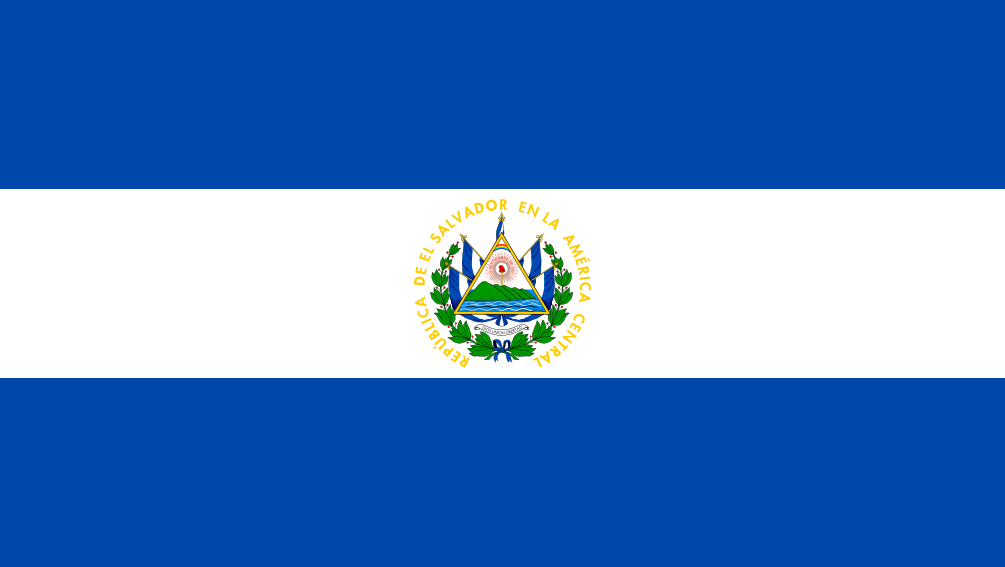
El Salvador’s flag has equal blue, white and blue horizontal bands. The specimen shows the armorial national form associated with the bandera magna. Official motto-bearing forms have their own dimensions and uses; one ratio does not describe every authorized flag.
Specification
The Ley de Símbolos Patrios, articles 5–12, distinguishes these forms. Ratios below are arithmetic reductions of the named hoist and fly dimensions, not separately published construction formulas.
| Official form | Hoist × fly | Device and use |
|---|---|---|
| Magna / article 7 | 1.89 × 3.35 m / 189:335 | Complete arms; joint occasions involving the three branches of government and patriotic celebrations |
| Public buildings and offices / article 9 | 0.60 × 1 m / 3:5 | DIOS UNION LIBERTAD in the middle band |
| Parades / article 11 | 0.90 × 1.45 m / 18:29 | Gold motto; prescribed staff and ribbons |
Articles 7 and 9 permit larger dimensions in the circumstances they describe. Article 12 gives official delegations abroad the buildings-and-offices form with complete arms. Reduced flags may carry arms, motto or only the bands under article 13. Maritime use is referred to separate instruments by article 14.
Conflicting published dimensions
The Presidency’s symbols page says 3.25 × 1.89 m. The judiciary-hosted consolidated statute spells out 3.35 × 1.89 m in article 7. This record follows that statutory text for the magna specimen; it does not silently treat 189:325 as equivalent. The Presidency’s simplified account of who uses arms or motto also differs from the law’s form-specific provisions; the legal distinctions above take precedence.
Colors and symbols
The law names blue and white, without numerical color coordinates in the inspected provisions. The file’s #0047AB blue and #FFFFFF white are screen fills, not certified textile matches. No Pantone, RAL or manufacturing tolerance is asserted.
Article 2 describes a gold equilateral triangle containing five green volcanoes descending from left to right, two seas, a rainbow and a radiant liberty cap on a gold staff. The independence date may be written in full or with the month abbreviated. Gold lettering surrounds the triangle; five national flags and laurel branches complete the arms. The law ties the laurel divisions to the number of departments. The specimen uses outlined lettering and an abbreviated date; no modern font is presented as legally prescribed.
Construction notes
The inspected Commons SVG has a 1005 × 567 canvas. A white field and blue paths covering y=0–189 and y=378–567 produce three equal 189-unit bands. The resulting 567:1005 ratio reduces exactly to 189:335. A matching viewBox was added for responsive display; paths, colors and emblem transform were retained.
The emblem group uses scale 0.295 and translation (414,199.28192). Its conventional illustration sits within the white band. These are artwork coordinates, not official emblem size or placement tolerances. Article 2 supplies the heraldic description, but the inspected law does not supply a numerical emblem grid or exact color system. The specimen was rendered and visually checked for its inscriptions and principal devices; it is a reference drawing, not an authorized manufacturing master. There are no scripts, fonts, raster images or external resource loads.
Historical record
The Presidency dates legislative adoption to 17 May 1912 and the first ceremonial raising by President Manuel Enrique Araujo to 15 September that year. The current design family recalls the Central American federation. Its 1912 date does not imply that every detail of the modern vector file was fixed then.
The law’s preamble records publication of the 1912 decree on 30 May and additions to the arms in March 1916. Decree 115 consolidated the rules in 1972 and repealed the earlier decree and its reforms. A later official reform confirms publication on 14 September 1972 in Diario Oficial 171, volume 236. The commencement clause specifies eight days after publication. The reviewed consolidation includes amendments through July 2021. Earlier national designs are separate historical flags, not substitutes for this current specimen.
Meaning and use
The Presidency associates blue with the Pacific and Atlantic oceans bordering Central America and white with peace. Its interpretive account links the liberty cap to liberation and the laurel divisions to the fourteen departments. These explanations are attributed symbolism, not extra geometry. It credits Rafael Barraza Rodríguez with the arms; that attribution is not extended to authorship of the entire flag.
Choose the official form for the occasion using the statutory distinctions above. The magna specimen should not be passed off as the public-office motto flag or as a separately verified naval construction. Small digital reproductions also cannot settle physical production requirements.
Source trail
Reviewed 15 September 2026. Spanish legal descriptions are paraphrased. The judiciary’s consolidated text was accessible; Assembly PDF endpoints returned access errors. The 3.35/3.25 m discrepancy, emblem construction and physical colors remain explicitly qualified.
- Judicial Documentation Centre / Decree 115, consolidated Ley de Símbolos Patrios — articles 1–14, historical preamble, commencement and amendment list.
- Judicial Documentation Centre / 1991 reform — original 1972 publication reference.
- Presidency / Símbolos Patrios — current status, 1912 dates, attributed meaning and conflicting summary dimensions.
- Wikimedia Commons / Flag of El Salvador.svg — retrieved artwork, contributors and public-domain declaration; local inspection and rights record.

Related records: Guatemala · Honduras · National flags.