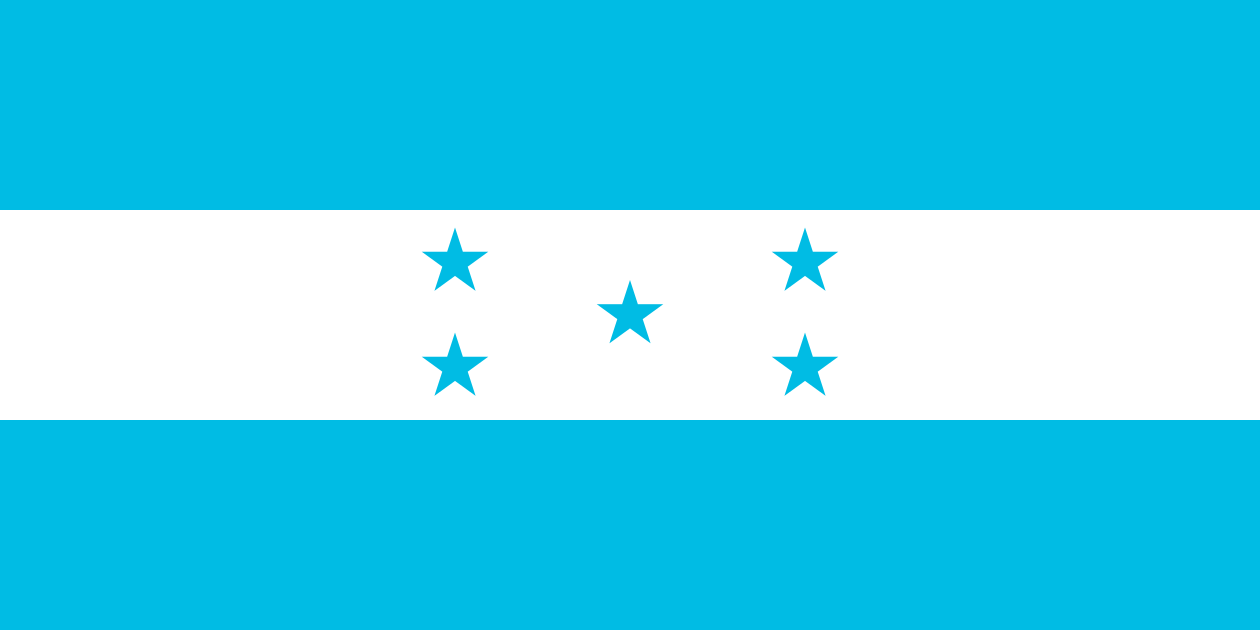
Honduras’s national flag has three equal horizontal bands and five blue stars on white. The legal description names turquoise blue for the outer bands. This specimen illustrates that description; darker flags reported in public use in 2026 are a distinct color practice, not proof of a replacement statute.
Specification
Decree 29 reforms the 1866 flag decree. It places four five-pointed stars at the corners of a rectangle parallel to the bands and the fifth at its center. The fly is twice the combined band height.
| Element | Legal description | Specimen treatment |
|---|---|---|
| Outer bands and stars | Turquoise blue; same blue for both | #00BCE4 / institutional screen reference |
| Middle band | White | #FFFFFF / screen white |
| Star arrangement | Four corners and central fifth star | Conventional vector geometry |
UNAH’s September 2022 account publishes #00BCE4 for its own use pending national chromatic regulation. That institutional reference is used here without claiming a statutory HEX value. Its article contains inconsistent date references and malformed RGB percentage notation; those fields are not converted into a production standard. FOTW reports Pantone 3105 in a 2022 government communication to the Mexican Senate, differing from its other listed color references. The linked letter could not be retrieved, so its scope and continuing force were not independently verified. No single nationally binding Pantone, RAL, textile tolerance or certified physical match is asserted here.
Construction notes
The inspected SVG has a 1260 × 630 viewBox. A full blue field and a white overlay from y=210 to y=420 produce three equal 210-unit bands. The middle star’s top tip is (630,280); the other four are copies translated by x=−175 or +175 and y=−52.465 or +52.534. They form a rectangle approximately 350 × 105 units. Each star is an upright, filled five-pointed path approximately 66.573 units across and 63.315 high.
These numbers describe the retrieved artwork, including its small rounding offsets. They are not legal star sizes or spacing. The cited decree text supplies no numerical star construction or orientation rule. FOTW also describes a wider star arrangement in a later reproduced construction figure; that figure was not obtained. This specimen follows the retrieved SVG, not a claimed official construction sheet. The source paths and resulting positions were retained, with nested star references flattened for renderer compatibility; its dark blue #0D3B99 was replaced by #00BCE4, with accessible metadata added. No scripts, fonts, raster images or external resource loads are present. Use this as a reference illustration, not a certified manufacturing master.
Historical record
The 1949 decree identifies its predecessor as No. 7 of 16 February 1866. That date anchors this record’s five-star design family. FOTW’s heading instead gives 9 January 1866; the decree’s explicit reference takes precedence here. Its preamble describes the earlier blue bands and impractical dimensions; the reform supplies turquoise blue and proportional sizing. The signed reform is dated 18 January 1949 and takes effect ten days after publication. The original Gazette issue was not inspected, so an exact commencement day is not asserted here.
Color in law and in use
UNAH’s 2022 account documents renewed institutional use of turquoise and the absence of a nationally fixed chromatic code. El Heraldo’s report of 23 January 2026 documents darker-blue presentation at Congress and plans for its renewed use. Its later fact-check distinguishes the unqualified blue of 1866 from the explicit turquoise wording introduced in 1949.
No superseding color law was verified in this review. This record therefore retains the documented legal description while identifying the displayed SVG as an interpretation of it. It does not label the turquoise screen file an exact picture of every current government flag, or treat dark and turquoise specimens as interchangeable historical images.
Meaning and use
UNAH’s historical explanation connects the five stars with Central American unity and white with peace. The five countries conventionally represented are Honduras, Guatemala, El Salvador, Nicaragua and Costa Rica, as identified by Flags of the World. These are attributed interpretations, not additional construction clauses.
The reformed decree prohibits inscriptions on the national merchant flag. It separately refers the war flag to military rules and authorizes executive regulation of use; the plain five-star specimen is not an illustration of that separate military form. The Tribunal Superior de Cuentas documents official ceremonial display and observance of Flag Day on 1 September.
Source trail
Reviewed 15 September 2026. Spanish sources are paraphrased in English. The legal text was checked in an archived periodical reproduction and against a government account; it is not represented as a retrieved original Gazette master.
- UNAH archive / Revista de Educación Primaria, July 1955, printed page 30 — reproduction of Decree 29, preamble, reformed articles 1–4, signature and commencement clause.
- Tribunal Superior de Cuentas / Flag Day, 1 September 2024 — government confirmation of the legal description, dates and ceremonial use.
- UNAH / Bandera Nacional, 1 September 2022 — institutional screen reference, distinction from national regulation and attributed meaning.
- Flags of the World / Honduras — five-country symbolism, conflicting dates and construction accounts, and reported color references. Its linked 2022 government letter returned an access error during review.
- El Heraldo / 23 January 2026 report — observed darker-blue presentation and announced practice; not used as legislative authority.
- El Heraldo / 28 January 2026 fact-check — distinction between the two decrees’ color wording.
- country-flags / retrieved SVG — adapted public-domain specimen; rights and geometry record.

Related records: Guatemala · Costa Rica · National flags.