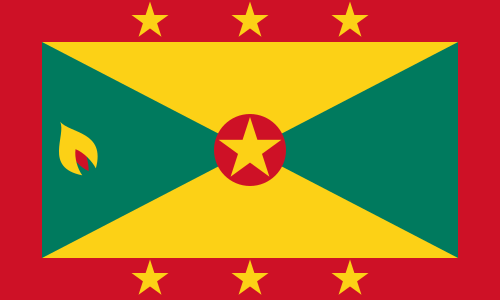
Grenada’s national flag combines a red border, seven gold stars, gold and green triangular fields, and a nutmeg symbol. Adopted at independence on 7 February 1974, it uses a 3:5 hoist-to-fly ratio on land; government guidance gives 1:2 at sea. [2] [3]
Specification
The Second Schedule to the National Emblems and National Anthem of Grenada (Regulation) Act describes a rectangle with a red border, three gold stars along each horizontal edge, four inner triangles, a western nutmeg and a central gold star on red. It calls the gold triangles “equilateral” and the green triangles “isosceles”; see the geometry discrepancy below. [1]
The government publishes these proportions as length-to-height 5:3 and 2:1; this record reverses the notation to hoist:fly. The displayed land specimen must not be stretched and treated as a verified sea construction. [2]
Colors
Official descriptions use red, gold and green; the embassy also calls gold yellow. [2] [3] No physical color standard was verified from legislation. FOTW reports different Pantone sets in Olympic manuals and the French naval Album des Pavillons; these are reference recommendations, not a single established Grenadian standard. [5]
These fills were read from the SVG. They are screen approximations, not official HEX values or certified textile conversions.
#CE1126 / specimen screen value#FCD116 / specimen screen value#007A5E / specimen screen valueConstruction notes
The inspected SVG has a 0 0 500 300 viewBox. Its red border is 42 units wide; the inner rectangle runs from (42, 42) to (458, 258). Diagonals meet at (250, 150), under a red disc of radius 36. Border-star centers lie at x=150, 250 and 350, y=21 and 279, with outer radius 19.5. The central star has outer radius 33. All seven five-pointed stars have one tip upward. The hoist nutmeg uses separate red and gold curved paths. These are artwork measurements, not statutory dimensions. [7]
The dimensions match Vexilla Mundi’s reference grid at half scale: border 84, inner rectangle 832 × 432, and disc radius 72. FOTW instead reports a national-flag border of 2/15 of the hoist; this SVG uses 42/300, or 14%. The difference is retained openly. [6] [5]
Statutory wording discrepancy. The SVG’s upper and lower gold triangles each have a 416-unit base and 108-unit altitude. Their equal sloping sides are approximately 234.37 units, so they are isosceles, not equilateral. The schedule’s direction and facing terminology also does not provide an unambiguous coordinate drawing. The specimen follows the familiar arrangement described by Vexilla Mundi, rather than claiming literal compliance with every geometric word in the Act. No official dimensioned master resolving this conflict was verified. [1] [6]
Symbols and usage
The embassy associates red with courage and vitality, yellow with wisdom and warmth, and green with vegetation and agriculture. Nutmeg represents the spice economy. It assigns the six border stars to the six parishes and the central star to Saint George’s. The government symbols page instead describes seven parish stars collectively; these explanations are recorded as differing accounts, without inventing a seventh parish. [3] [2]
Government etiquette provides for display on government and municipal buildings and respectful handling. [2] Sections 3–7 of the Act address Crown copyright, licensing of specified uses and treatment of emblems. The source artwork’s public-domain declaration does not settle those provisions; the asset register preserves the rights conflict. [1] Asset rights →
Historical record
The embassy credits Anthony C. George of Soubise, Saint Andrew, and dates adoption to independence on 7 February 1974. [3] The National Museum identifies its archive photograph as the first flag raising at midnight that day. [4]
The regulation Act commenced on 23 July 1999; that is not the flag’s adoption date. [1] FOTW reports an earlier selection date through a secondary video account, but no primary selection instrument or separate proclamation was verified here. The record therefore uses the official independence adoption date. [5]
Source trail
- Parliament: Chapter 203A, Act 17 of 1999 ↗ — sections 2–7 and 10; Second Schedule, PDF pages 4–5.
- Government of Grenada: National Symbols ↗ — land and sea dimensions, adoption, symbolism and etiquette; indexed text consulted, direct page retrieval was intermittent.
- Embassy of Grenada in China: About Grenada ↗ — entity, adoption, designer and star interpretation.
- Grenada National Museum: Independence Story ↗ — first-raising photograph and date.
- Flags of the World: Grenada ↗ — attributed reports of alternative construction, colors and selection history; underlying manuals and video not independently verified.
- Vexilla Mundi: Grenada ↗ — reference arrangement and construction values, not legislation.
- Retrieved SVG: country-flags ↗; Commons contributors and rights declarations ↗; local provenance and rights caveat →.


Sources checked 15 September 2026. Related records: Saint Lucia and Trinidad and Tobago. Browse national flags or the Flag Index.