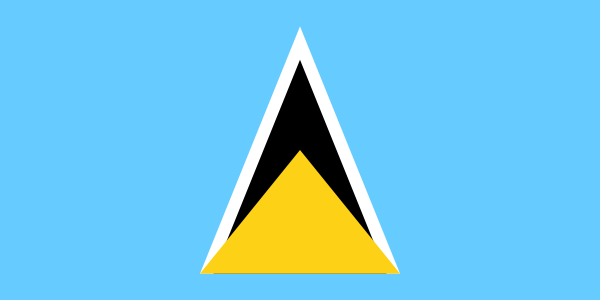
Saint Lucia’s current flag has a blue field, a white-edged black triangle and a gold triangle in front. Its proportions are 1:2. The design originated in 1967; this specimen represents the lighter-blue version reported around 2002. [1] [3]
Specification
The government publishes the designer’s description and a display code. These are official guidance, not a verified statutory construction schedule. The triangular layers run white, black, then gold from back to front. [1]
The Department of Information Services’ notice of 25 October 2003 specifies white borders of 1½ inches, a four-inch separation between the white and black peaks, and a common base one-third of the fly. It lists pole, hand, desk and casket flags as 6 × 3 feet, 9 × 4½ inches, 6 × 3 inches and 11 × 5½ feet respectively: all hoist : fly 1:2. [2]
*The specimen applies these measurements to the six-foot pole flag; that association is an interpretation.
Colors
The notice names cerulean blue, with Process Cyan 100% in parentheses, light chrome yellow, black and white. It supplies no Pantone, RAL or digital color values. [2] The retained SVG fills below are screen approximations, not certified conversions or physical manufacture standards.
#66CCFF / specimen screen value#FCD116 / specimen screen value#000000 / specimen screen value#FFFFFF / specimen screen valueConstruction notes
The public-domain country-flags SVG was adapted to refine its rounded coordinates. The viewBox remains 0 0 600 300; its fills are unchanged. The 200-unit base extends from x=200 to x=400. Applying the inch measurements to a 72-inch fly gives a 12.5-unit perpendicular border and a 33⅓-unit vertical peak gap. These yield an outer triangle height of approximately 247.206616 units. The triangle is centered vertically, with apex y≈26.396692 and base y≈273.603308; the black apex is y≈59.730025. The gold apex is (300,150).
Those coordinates are editorial deductions, not government dimensions. They assume parallel sloping edges, perpendicular border measurement, vertical centering and a gold apex at the flag center. The gold layer masks the lower part of the black triangle. FOTW records competing reconstructions, including a shorter outer triangle, and questions the completeness of the original specifications. No definitive measured government drawing resolving these choices was verified. [3] [6]
Symbols and usage
The official explanation associates blue with fidelity, sky and surrounding waters; gold with sunshine and prosperity; and black and white with African and European cultural influences living together. The triangles evoke the Pitons and national aspirations. Its etiquette code gives the flag precedence and calls for sound, unfaded flags. [1]
Maritime use is also explicit in the port regulations: regulation 34 requires arriving ships from foreign places to display Saint Lucia’s national flag during the stated daytime hours. [7] The 2003 notice addresses permission for importing flag-bearing souvenirs under the Customs Act; that usage rule is separate from this vector’s copyright status. [2]
Historical record
The government’s historical timeline records the first raising on the night of 28 February 1967. Associated statehood began on 1 March, explaining the next-day date used for original adoption. Independence followed on 22 February 1979. [4] [5]
FOTW distinguishes a 1967 version with a lower gold triangle and an approximately 5:8 ratio, a 1979 version, and the later light-blue rendering. A contributor’s reported correspondence with Saint Lucia’s UN office places the latter change between December 2001 and March 2002. The often-suggested 22 February 2002 date is not confirmed there. This record therefore uses “circa 2002,” without treating the current specimen as an exact illustration of earlier versions. [3]
Source trail
- Government of Saint Lucia: Flag of Saint Lucia ↗ — current description, designer, symbolism and etiquette.
- Department of Information Services: Saint Lucia Nationwide, No. 29, 25 October 2003, page 8 ↗ — official notice: measurements, colors, sizes and souvenir-import provisions.
- Flags of the World: Saint Lucia ↗ — historical variants, reported color-change interval and competing contributor constructions; distinguished from official standards.
- Government archive: Our Timeline ↗ — 1967 first raising and 1979 independence ceremony.
- Government: Constitutional Development ↗ — dates of associated statehood and independence.
- Retrieved SVG: country-flags ↗; Commons contributors and public-domain declaration ↗; local asset register and adaptation details →.
- Attorney General: port regulations under the Saint Lucia Air and Sea Ports Authority Act ↗ — regulation 34, ships’ signals on entering; usage evidence, not a geometric specification.


Sources checked 15 September 2026. Related records: Barbados and The Bahamas. Browse national flags or the Flag Index.