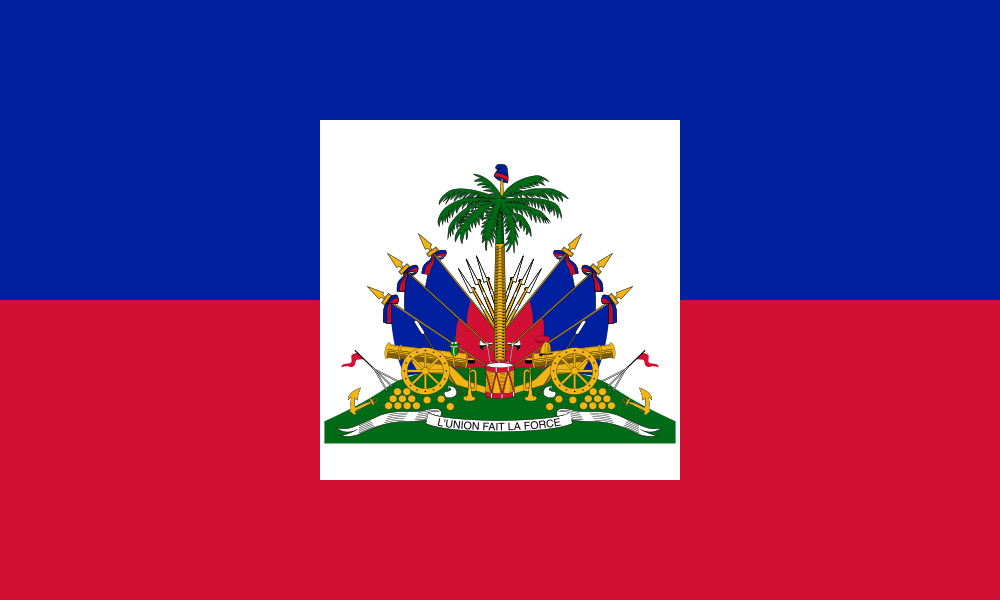
Haiti’s national flag has equal horizontal blue and red bands, blue above red, with the national arms at the center. Article 3 calls for a white square behind the arms. This specimen follows that wording; familiar wider rectangular panels are a documented rendering difference, not the shape prescribed by the Constitution. [1] [3]
Specification
Articles 2–3 name the national colors and describe the flag as the nation’s emblem. The arms comprise a palm topped by a liberty cap, sheltering a trophy of arms, with the legend L’Union fait la Force (“Union makes strength”). Article 4 separately gives the national motto as Liberté – Égalité – Fraternité; the two inscriptions should not be confused. [1]
| Element | Authority or evidence | Specimen |
|---|---|---|
| Field | Equal horizontal bands; blue above red | 1000 × 600; each band 300 high |
| Overall ratio | 3:5 in Flags of the World; Constitution gives none | 3:5 hoist : fly |
| White panel | Centered square in Article 3; size unstated | 360 × 360; editorial size |
| Arms | Constitutional verbal description | Adapted Commons reference artwork |
Colors
The SVG field uses #00209F blue and #D21034 red; the white square uses #FFFFFF. These are inspected file values, not legal HEX specifications. The arms add green, yellow, black and other detail colors. No authoritative national textile color schedule or tolerances were verified. Specialist and sporting references report differing palettes; none is promoted here as a Haitian statutory standard. Screen colors cannot replace physical production specifications. [3]
Construction notes
The local viewBox is 0 0 1000 600. A full red path is overlaid by blue from y=0 to y=300. The editorial white square extends from x=320 to x=680 and y=120 to y=480, centered at (500,300). Its side is 3/5 of the hoist solely as a layout choice; Article 3 supplies no such fraction.
The downloaded SVG had no viewBox and used a transformed white rectangular path. That panel measured approximately 351.24 × 286.44 units after its parent transformation, centered approximately at (500,300). We replaced only that background with the square, added a viewBox and accessible provenance metadata, and removed editor view settings. Armorial paths, their transformations and colors remain as supplied. This preserves the source’s rendering without treating its detailed proportions as legally measured.
Flags of the World reports ministry correspondence giving a 2.90 × 1.74 m flag and a 0.55 × 0.45 m panel, and traces those figures to 1949 legislation. The underlying letter and gazette were not independently inspected. These secondary measurements support the 3:5 reference ratio but cannot override the Constitution’s square wording. The same reference documents variation in panel size. [3]
The arms contain lettering and asymmetric details; do not obtain a reverse-side master merely by mirroring this SVG. Neither the square reconstruction nor the downloaded rectangular rendering is presented as a certified sewing or embroidery master.
Symbols and use
The specimen visibly includes six small flags, two cannons, a drum, anchors and cannonballs beneath the palm, with the legend on a ribbon. These observations describe the drawing; they are not an additional statutory inventory. The liberty cap and the union inscription connect liberty and collective strength within the constitutional emblem.
The Embassy presents the armorial design as Haiti’s national flag. [2] Flags of the World also records national and state use at sea. Its contributors disagree over the continuing status of the plain bicolor as a separate civil flag or ensign. This record covers the constitutional form with arms and does not present the plain version as interchangeable. [3]
Historical record
The Embassy’s historical account places the blue-and-red flag’s origin at Arcahaie on 18 May 1803, associates its colors with unity in the independence struggle, and credits Catherine Flon with sewing the bands. That account concerns the early flag, not authorship of today’s vector artwork. The modern specimen must not be used as an exact 1803 reconstruction. [2]
The Embassy dates restoration to 17 February 1986 and constitutional confirmation to 29 March 1987. [2] A reproduced National Council of Government message instead distinguishes a decree dated 11 February from a ceremonial return scheduled for 25 February. This is a transcription on an independent history site, not a gazette original inspected here. [4] Accordingly, the record’s restoration field uses February 1986, with these events kept separate. The present period begins in 1986; earlier uses of related designs are not described as uninterrupted use of this specimen.
Source trail
Reviewed 15 September 2026. French material is paraphrased in English.
- Organization of American States / Constitution de la République d’Haïti, 1987 — PDF page 2, articles 1–4: entity, designation, colors, square panel, arms and separate national motto.
- Embassy of Haiti in Washington / Flag and Coat of Arms — government presentation of Article 3 and accounts of 1803 and 1986–1987.
- Flags of the World / Haiti — specialist reference: 3:5, panel variation, reported ministry measurements, use and differing color references. Historical correspondence and legislation are consulted through this secondary account.
- Haïtianaute / reproduced National Council of Government message, February 1986 — indexed transcription distinguishes the 11 February decree and planned 25 February ceremony; full-page retrieval was unavailable at review, so not treated as independently verified legislation.
- Wikimedia Commons / Flag of Haiti.svg — public-domain declarations, contributors and rectangular source panel; downloaded SVG. Arms credited to Lokal_Profil and Myriam Thyes; further vector contributors on the file page. Local adaptation and rights audit.


Related records: Dominican Republic · Jamaica · National flags.