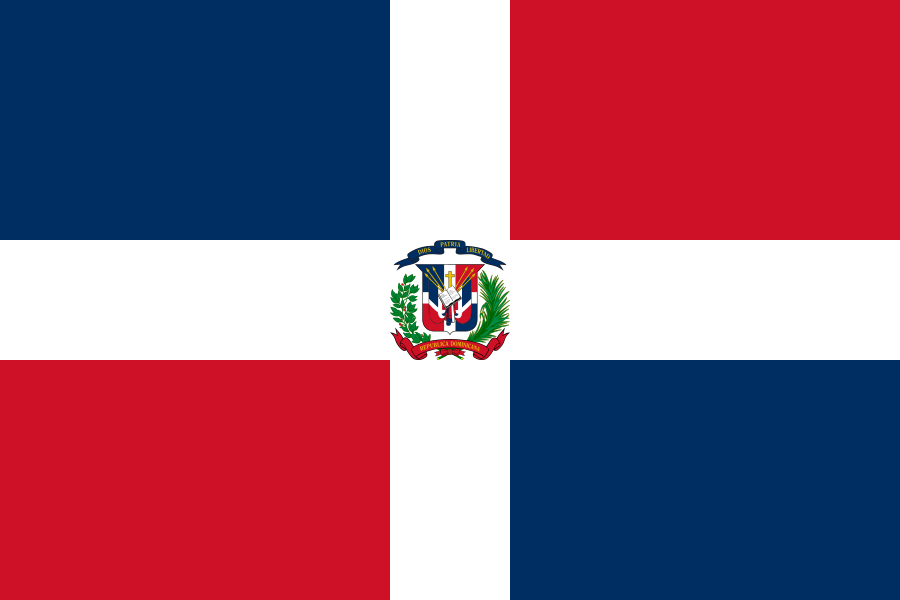
The Dominican Republic’s national flag has alternating blue and red quarters separated by a white cross, with the national arms in the center. Blue occupies the upper hoist and lower fly. The specimen is 2:3; the exact sizes printed in the current law are recorded separately below.
Specification
Article 31 of the 2024 Constitution names ultramarine blue and vermilion red. The white cross has a width equal to half a quarter’s height. The arms are mandatory in this national form; the constitutionally distinct merchant flag omits them.
Ratio and official sizes
The Presidency gives 2:3. Law 210-19, article 4, prints these dimensions and permits other sizes preserving its proportions:
| Official size | Hoist / height | Fly / length |
|---|---|---|
| Small | 1.218 m | 1.829 m |
| Medium | 1.442 m | 2.164 m |
| Large | 1.666 m | 2.500 m |
These three pairs are neither exactly 2:3 nor exactly proportional to one another. They are reproduced without correction. The SVG follows the Presidency’s exact ratio; it does not resolve the statute’s millimetric discrepancies.
Colors
| Constitutional color | Specimen fill only |
|---|---|
| Ultramarine blue / azul ultramar | #002D62 |
| Vermilion red / rojo bermellón | #CE1126 |
| White / blanco | #FFFFFF |
These HEX values are inspected SVG fills, not statutory color codes. No authoritative Pantone, RAL, RGB schedule or textile tolerances were verified. The arms contain additional rendering colors. Screen appearance cannot replace a physical production specification.
Construction notes
Let the quarter height be q and the cross width q/2. Total height H = 2q + q/2, so q = 2H/5 and cross width = H/5. On this 900 × 600 viewBox, the cross is 120 units wide; each colored rectangle is 390 × 240. The vertical white band spans x=390–510 and the horizontal band y=240–360. This is a calculation from the legal cross rule using the Presidency’s 2:3 ratio.
The source SVG has a white full-field path and four colored rectangle paths, followed by the arms. Its paths, internal reusable shapes and fills are retained unchanged; only accessible title and provenance metadata were added. The central artwork was visually inspected, including its Bible, cross, flags, lances, branches and lettered ribbons.
No measured official arms-to-flag scale or complete vector construction master was verified. The source’s emblem size, letterforms, curves and minor details are a reference interpretation. This specimen is not a certified sewing master.
Arms and symbols
Article 32 specifies the Bible open at John 8:32 beneath a cross, two lances, four plain national flags, laurel at the left and palm at the right. Blue and red ribbons carry the national motto and country name. The shield has projecting upper corners, rounded lower corners and a pointed base, with a square construction condition above the lower curves.
The Foreign Ministry and Presidency summaries say three lances; the current constitutional PDF says two, which this record follows. The SVG ribbon reads Dios Patria Libertad; the constitutional wording includes y before Libertad. The retained artwork is therefore identified as a reference rendering, not a letter-for-letter statutory master.
The Presidency associates red with sacrifice for independence, blue with the sky, divine protection and progress, and white with peace and unity. These are official explanatory interpretations, separate from construction requirements.
Historical record
The Presidency attributes the original conception to Juan Pablo Duarte and records approval by the Trinitarios on 16 July 1838. It dates the first raising to 27 February 1844, but describes that earlier flag with blue above red. It dates adoption of alternating quarters to the first Constitution, 6 November 1844. The modern specimen must not be used as a reconstruction of that first raising.
The Ministry of Youth’s historical account records annexation beginning on 18 March 1861 and the national flag’s raising at Capotillo on 16 August 1863 during the restoration struggle. Accordingly, an unqualified continuous “1844–present” use period would conceal an interruption.
The Presidency dates standardization of the modern arms to a decree of 6 February 1913 and credits the accompanying drawing to Casimiro Nemesio de Moya. The Commons file page instead labels its flag “21 March 1908–present”; no corresponding adoption instrument was verified. This record uses 1844 for the quartered design’s origin and distinguishes the later arms, without adopting that asset-page date.
Law 210-19 was promulgated on 12 July 2019. Article 51 repeals Law 360 of 1943, still cited by the Presidency’s older protocol summary. Current use here follows the 2019 text.
Use
Law 210-19, article 5, requires listed public institutions, schools, universities and diplomatic posts to raise the flag on working days from 08:00 to 17:30; monuments, plazas and public buildings may retain it around the clock. Article 7 permits small flags for civic, school and sporting use with the arms. Articles 10–12 keep the upper blue hoist quarter at the viewer’s upper left for frontal or wall display. The plain merchant form is a separate flag and does not replace this national specimen.
Source trail
Reviewed 15 September 2026. Spanish sources are paraphrased in English.
- Tribunal Constitucional / Constitution proclaimed 27 October 2024 — articles 1, 30–32 and 36; printed pages 4 and 11–12.
- Tribunal Constitucional / Leyes sobre Símbolos Patrios, Law 210-19 — printed pages 16–19, 31–33: sizes, use, repeal and promulgation. Follow the enacted text; the introductory essay contains a transposed law number.
- Presidency / Símbolos patrios — 2:3 ratio, design history, 1913 arms and color interpretations; older protocol and discrepant lance count qualified above.
- Ministry of Foreign Affairs / Símbolos Patrios y Banda Presidencial — corroborating flag description, official size list and merchant distinction; discrepant arms transcription noted above.
- Ministry of Youth / El Rostro Joven de la Historia — 1861 annexation and 1863 flag raising.
- country-flags / retrieved SVG, repository provenance and Commons file history and public-domain declarations — local asset audit.


Related records: Panama · Costa Rica · National flags.