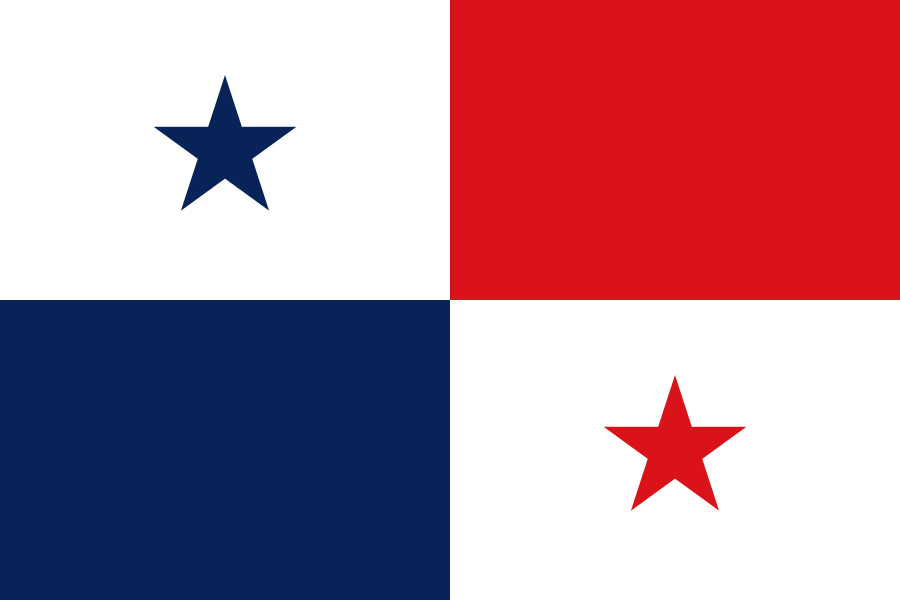
Panama’s national flag is a 2:3 rectangle divided into four equal quarters. At the upper hoist is a white quarter with a blue five-pointed star; the upper fly is red, the lower hoist blue, and the lower fly white with a red five-pointed star. Both stars are centered and point upward.
Specification
Articles 4–5 of the consolidated symbols law prescribe the arrangement, upright stars and one unit of height to one and a half of length. The star measure is one quarter of the flag’s height, equivalently one sixth of its length. The 2017 manual, Gazette pages 22–23, confirms equal quarters and heraldic stars.
| Color | Official digital guidance | Official offset-print references |
|---|---|---|
| Blue | RGB 7, 35, 87 / #072357 | Pantone 295C coated; 296U uncoated |
| White | RGB 255, 255, 255 / #FFFFFF | Pure white, matte or glossy |
| Red | RGB 218, 18, 26 / #DA121A | Pantone 187C coated; 186U uncoated |
These are the manual’s supplied values, not calculated conversions. The SVG uses its digital colors. A screen rendering does not certify textile shades or reproduce a physical print standard.
Construction notes
For height H, the fly is 1.5H; divide at half the height and half the fly. The 900 × 600 specimen therefore has 450 × 300 quarters and star centers at (225,150) and (675,450).
The cited wording gives the star measure as H/4 without explicitly naming its endpoints. This specimen interprets it as the outer-circle diameter, 150 units, and uses regular five-pointed stars of radius 75. The inner contour is calculated as a regular pentagram. That diameter interpretation and contour are editorial rendering choices, not separately verified statutory dimensions; this file is not a certified sewing master.
The MIT-licensed source icon had a 640 × 480 viewBox, uneven quarters, irregular star coordinates and two different reds. All five path coordinates were replaced to implement this reference construction, and fills were replaced with the manual’s digital values. No border, arms or fringe is added.
Historical record
The national design originated in 1903. Article 4 credits Manuel E. Amador T.; the National Assembly’s historical account credits María de la Ossa de Amador with sewing it. Early objects are not interchangeable with this modern specimen: the Ministry of Culture describes a surviving 1903 flag with the colors reversed.
Law 64 of 4 June 1904 adopted the flag provisionally. Law 48 of 10 March 1925 adopted it definitively; its archive metadata records publication in Gazette 4601 on 25 March. The dates distinguish enactment from publication. An education portal summary calls the 1925 law “4”; this record follows the legislative archive and Assembly account, both of which identify Law 48.
Law 34 of 15 December 1949 provided the later symbols framework. Its consolidated text includes the reforms of Law 2 of 23 January 2012. Decree 337 of 22 December 2017 approved the design and usage manual, published on 26 December. The current specimen reflects that modern guidance, not an exact reconstruction of a 1903 cloth flag.
Meaning and use
The Ministry of Government associates blue and red with the historic Conservative and Liberal parties, and white with peace. The blue star signifies purity and honesty; the red star, authority and law.
The ministry describes daily display on public buildings and Panamanian-registered vessels, with respectful private display permitted under the law. For flat horizontal or vertical display, the white quarter with the blue star stays at the observer’s upper left. The manual gives separate vertical artwork; simply rotating this horizontal SVG is not equivalent. Physical color-reference flags are maintained in designated state offices and the history museum.
Source trail
Reviewed 14 September 2026. Spanish sources are paraphrased in English.
- Ministry of Government / consolidated Law 34 of 1949, with 2012 reforms — legal name, attribution, description and ratio, especially articles 4–5.
- Official Gazette 28432-A / Decree 337 and manual, 26 December 2017 — pages 22–23: color schedule and construction; page 27: flat display.
- Ministry of Government / Bandera Nacional — current description, interpretation, reference specimens and usage.
- National Assembly / Revista Debate 16, page 137 — authorship and definitive adoption. LEGISPAN archive copy of Law 48, hosted by Justia — law number, enactment and Gazette publication metadata.
- Educa Panamá / Panamá, Tesoros de mi Patria — provisional adoption date; discrepant 1925 law number discussed above.
- Ministry of Culture / conservation of the Bandera Herida, 2 May 2025 — distinct 1903 historical object.
- flag-icons / source SVG and MIT licence — adapted artwork; local provenance.

Related records: Costa Rica · Chile · National flags.