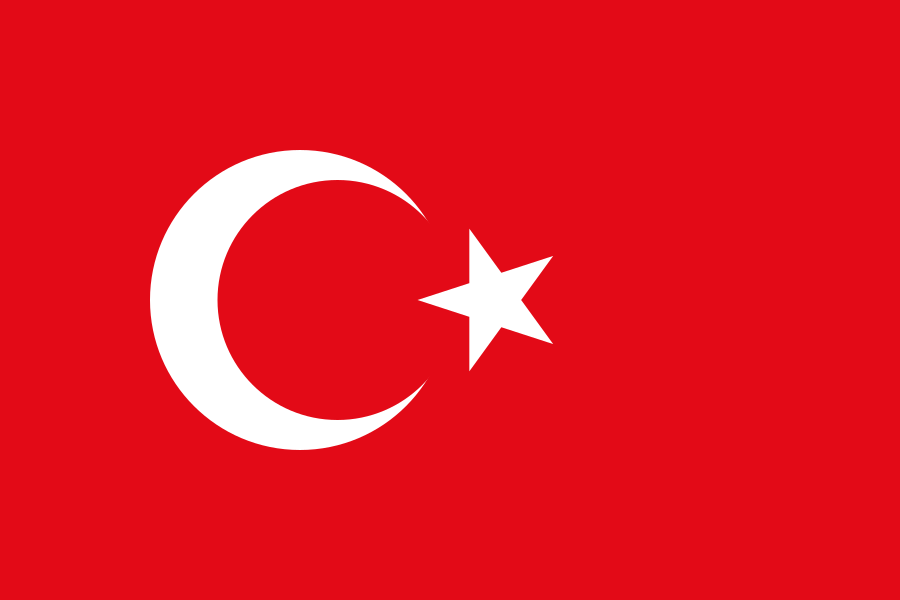
Turkey’s current national flag is red with a white crescent and five-pointed star. Its official Turkish name is Türk Bayrağı. Constitution Article 3 establishes the colors and devices; the flag law supplies the form and proportions. [1] [2]
Specification
Law No. 2893, adopted on 22 September 1983 and published on 24 September in Official Gazette No. 18171, specifies a white crescent and star on red, subject to its attached schedule. This is the national flag of the republic, rather than a separate ceremonial standard. [2]
Physical and screen colors
Regulation Article 3 specifies red coordinates 27.5 (brightness), 44.8 (red–green), 15.6 (yellow–blue), with maximum difference 3 NBS; white has a wavelength-based reflectance test. These are physical requirements, not RGB values. [3]
#E30A17 / RGB 227, 10, 23#FFFFFF / RGB 255, 255, 255The screen fills follow the Commons source-code specimen. No verified HEX, Pantone or RAL equivalence to the physical standard is claimed. [5]
Construction notes
For hoist H, Article 4 gives fly 1.5H. Circle centers share the horizontal axis. The outer crescent radius is H/4, centered H/2 from the sleeve’s inner edge; the cutout radius is H/5, displaced H/16 toward the fly. The star circle has diameter H/4; the sleeve width is H/30. [3]
The law’s schedule gives E = H/3 between the inner crescent circle and star circle. [2] The display uses the hoist-side axial intersections: on its 900 × 600 viewBox the circles are (300,300), r150 and (337.5,300), r120; the star’s left tip is (417.5,300), its center (492.5,300), and radius 75. This calculation replaces the Commons code’s rounded curves and star vertices with circles and recalculated vertices. [5]
Limits of the display construction
Article 2 measures fly from the sleeve’s outer edge, while Article 4 locates the crescent from its inner edge. Article 4(G)’s wording also places a star tip on the crescent-tip line, which does not exactly agree with the E construction. [3] The specimen follows the scheduled E distance and customary sleeve-free red-field display. It does not resolve those textual tensions into a production tolerance. Manufacture requires the applicable Turkish standard and official construction sheet.
Historical record
The 29 May 1936 law already described the red flag with a white crescent and star. Published on 5 June 1936, it provided for commencement one year later. The 1983 law repealed it and provided for commencement six months after publication. Those dates mark legislation, not the invention of the device. [4]
The construction regulation was approved on 25 January 1985 and published on 17 March 1985, taking effect on publication. [3] This record covers the current national flag; the superseded law remains a historical source, not an alternative current specification.
Symbols and attribution
The constitution identifies the crescent and star without assigning meanings to either. [1] No designer or single original adoption event is established by the legal sources used here; neither is assigned in this record.
Usage
The flag law regulates public display, saluting during raising and lowering, ceremonial uses and respectful handling. It includes half-mast observance on 10 November. [2] Consult the competent authority’s current protocol for a particular display; this entry is a reference to the flag’s identity and construction.
Source trail
Reviewed 6 September 2026. The Foreign Ministry confirms current identity; its linked law PDF returned 404. Legal text was checked through the official publications below. The regulation copy includes amendments through 2012; a current TSE manufacturing standard was not obtained.
- Grand National Assembly: Constitution Article 3 ↗; Foreign Ministry: Türk Bayrağı ↗ — constitutional description and current identity.
- Presidency for Turks Abroad: Turkish Flag Law No. 2893 ↗; Turkish Historical Society: law and dimension schedule ↗ — designation, dates, dimensions and usage. These reproductions retain older administrative wording.
- Turkish Flag Regulation No. 85/9034, Ministry of Education hosted copy ↗ — Articles 2–4, Article 40 and Annex 1; physical colors, geometry, sleeve definitions and commencement.
- Turkish Historical Society: 1936 and 1983 laws ↗ — legislative continuity, repeal and commencement clauses.
- Commons: source-code block, contributors and public-domain declaration ↗; local provenance and modifications ↗ — inspect the recorded local adaptation, not an assumed identical raw download.

Related records: Greece and Pakistan. Browse national flags or the Flag Index.
Understanding the measurements
In the hoist-to-fly ratio, hoist means the flag’s height and fly means its horizontal length. A ratio of 2:3 means two units high by three units long. The sleeve is the attachment portion discussed in the construction notes. The regulation measures fly from the sleeve’s outer edge, while locating the crescent from its inner edge. The displayed specimen omits the sleeve and uses a 2:3 red field, following the customary sleeve-free display convention. Keep that display convention distinct from sleeve-inclusive measurements and the official requirements for manufacture.
Frequently Asked Questions
Is 1983 the flag design’s original adoption date?
No. In this record, 1983 identifies Flag Law No. 2893, rather than the origin of the crescent-and-star design. The earlier 1936 law already described a white crescent and star on red. The cited legal sources do not establish a single original adoption event. The period “1983 law–present; design predates this law” and the editorial catalogue code TR-NAT-1983 should be read with that qualification.
Is #E30A17 an official manufacturing color?
The record does not establish #E30A17 as an official manufacturing color. It is the red used for the screen specimen, following the Commons source-code specimen. Regulation Article 3 gives physical color requirements rather than RGB or HEX values. No verified HEX, Pantone or RAL equivalence to those physical requirements is claimed. The local artwork is a display adaptation, not a certified manufacturing pattern; its provenance and modifications remain documented in Flag Asset Sources.