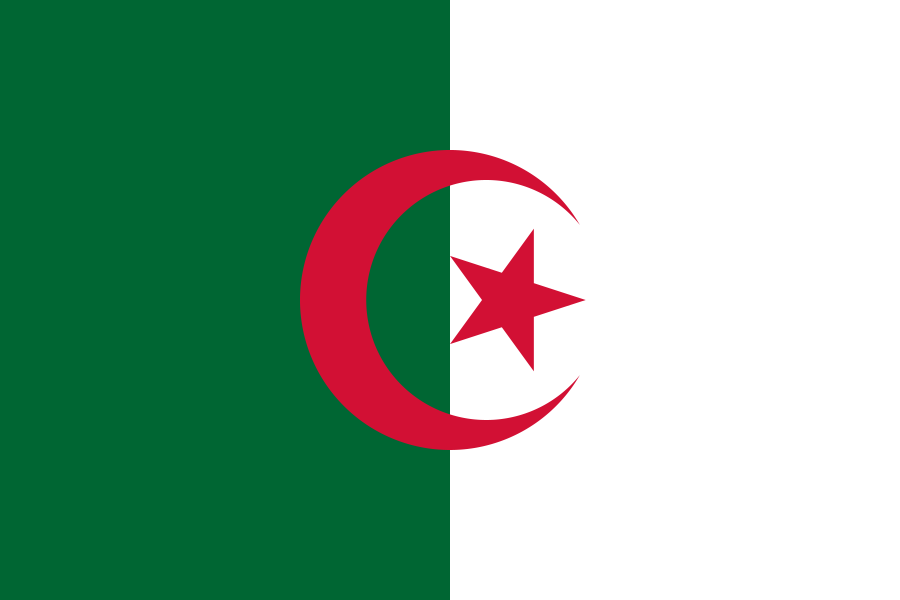
Algeria’s current national flag has green and white vertical halves with a red crescent and five-pointed star. Article 6 of the 2020 Constitution preserves the national emblem’s identity. [1] Its hoist-to-fly ratio is 2:3. [2]
Specification
The 1963 annex places green against the staff and white toward the fly. The star lies in the white half, two tips touching the vertical division and one pointing along the horizontal midline. The crescent’s outer circle is centered on the flag; its surviving outer arc spans 300°. [2]
Physical and screen colors
The annex describes green as equal yellow and blue, citing Rood’s contrast diagram, wavelength notation 5.411 and spectrum position 600. Red is primary, without blue or yellow, with notation 6.562 and position 285. [2] These historical references are not converted here into modern color coordinates.
#006633 / RGB 0, 102, 51#FFFFFF / RGB 255, 255, 255#D21034 / RGB 210, 16, 52These fills were read from the SVG. They are screen approximations, not certified textile colors. [6] Flags of the World reports differing publication and event palettes; none is treated here as a replacement for the law. [4]
Construction notes
The inspected vector has a 900 × 600 canvas, now with an explicit matching viewBox. Its green panel ends at x=450. The red path uses circular arcs of radii 150 and 120 with common endpoints approximately (579.903811,225) and (579.903811,375). The star’s five outer vertices lie approximately on a radius-75 circle centered at (510.676275,300); two tips are at x=450 and the rightward tip is at (585.676275,300). These measurements match the annex’s construction to coordinate rounding. [6]
Calculated from those arc endpoints, the outer circle center is approximately (450,300), and the inner circle center approximately (486.228841,300). The star is a filled pentagram path; its crossing segments produce the solid five-point silhouette. One star tip differs radially from an exact radius-75 circle by about 0.000191 SVG unit. This is a measured vector discrepancy, not an official manufacturing tolerance.
Conflicting summaries
The Astana embassy page calls the halves horizontal in one sentence and gives only a one-fifth-hoist crescent radius. Its ratio is 2:3. [5] This record follows the gazette’s vertical arrangement and separate inner and outer radii. The embassy also describes Decree 22-249 as an amendment; the decree itself regulates manufacture and inspection, rather than supplying a replacement construction. [3]
Historical record
Flags of the World reports adoption on 3 July 1962. This entry retains that as a secondary date; an original adopting instrument for that day was not obtained. [4] The 1963 law formally defines an already existing emblem; its date is not the design’s first appearance. [2] Article 6 of the 2020 Constitution describes the flag as an inherited national symbol and declares it immutable. [1] No individual designer is assigned here.
Symbols
The embassy associates white with peace, love and goodness; green with hope and progress; red with work toward prosperity; and the crescent and star with Islam. These are official explanatory interpretations, separate from the construction requirements. [5]
Usage
This specimen represents the ordinary national flag. Flags of the World records civil, state and military use on land and civil and state use at sea; the naval ensign is a distinct design. [4] Executive Decree 22-249 of 30 June 2022 regulates manufacture, including authorization by the competent wali and inspection of makers and users. It cites the 1963 specification law and the 1997 usage decree. [3] This reference SVG is not a manufacturing approval.
Source trail
Reviewed 13 September 2026. The 1963 French gazette page, including the construction drawing, was rendered and read visually. The constitutional wording was checked in the Constitutional Court’s indexed text; its article page did not load directly. Arabic originals were not independently compared.
- Constitutional Court: Constitution revised in 2020, Article 6 ↗ — current constitutional identity.
- Official Gazette No. 26, 30 April 1963, page 394 ↗ — Law 63-145 of 25 April 1963, Articles 1–3 and annex with construction drawing.
- Official Gazette No. 47, 11 July 2022, pages 7–11 ↗ — Executive Decree 22-249 of 30 June 2022; manufacture and control.
- Flags of the World: Algeria ↗ — secondary adoption date, use categories and color-reference differences.
- Algerian Embassy in Astana: State symbols ↗ — entity name and explanatory symbolism; dimensional wording discrepancies noted above.
- Commons: SVG history and public-domain declarations ↗; retrieved SVG ↗; local asset register and checksum ↗.


Related records: Tunisia and Morocco. Browse national flags or the Flag Index.