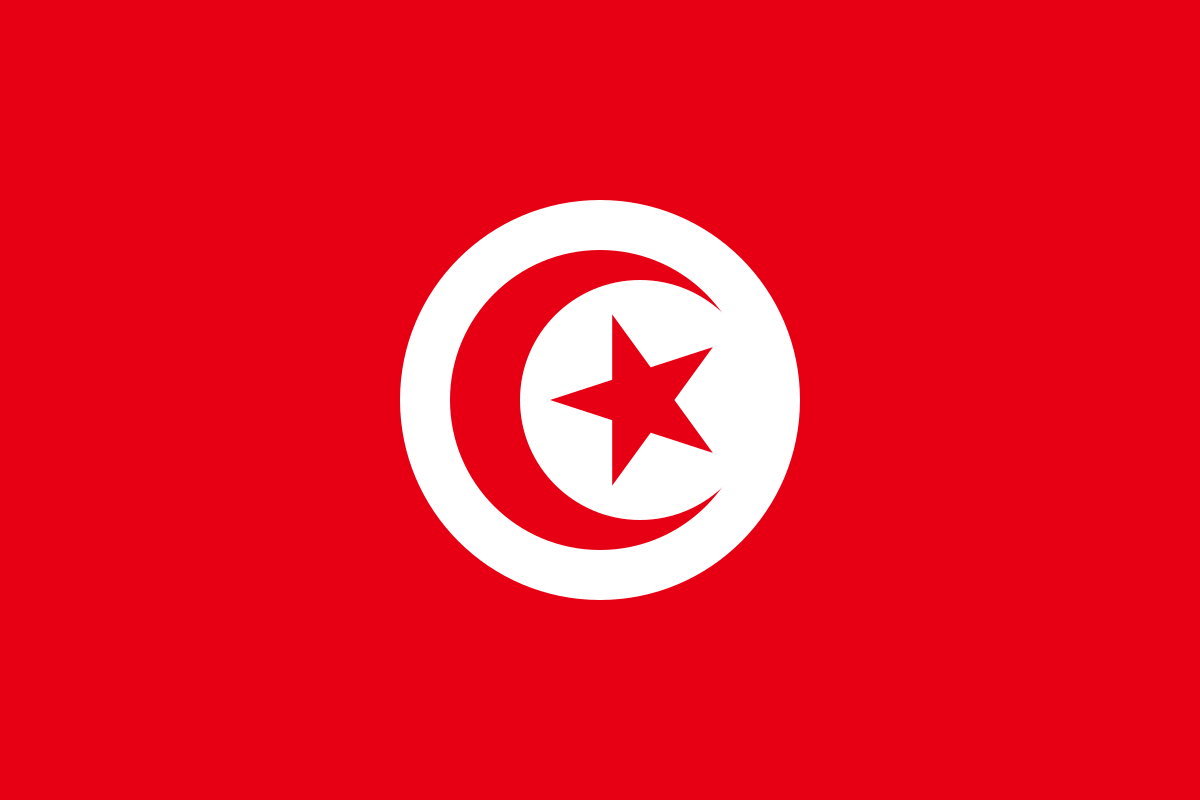
Tunisia’s current national flag is red with a central white disc containing a red crescent and five-pointed star. Article 8 of the 2022 Constitution identifies it as the flag of the Tunisian State; the 1999 law supplies its proportions and construction. [1] [2]
Specification
Articles 1–2 prescribe a red rectangle attached along its left hoist. The disc is centered at the intersection of the diagonals. The star lies toward the fly within the disc, with one tip pointing horizontally toward the hoist; the crescent surrounds it on the hoist side. [2]
Physical and screen colors
The printed articles name red and white. Article 4 refers to an attached technical dossier containing the model, drawing instructions and technical color specifications. That dossier was not obtained, so no official numeric color standard is established here. [2]
#E70013 / RGB 231, 0, 19#FFFFFF / RGB 255, 255, 255These values come from the inspected SVG, not a fabric standard. [5] Vexillological references report differing event and publication palettes; none is substituted for the missing dossier. [4]
Construction notes
For fly L, hoist is 2L/3. The outer crescent circle shares the disc’s center and has diameter L/4. The inner circle shares the star’s center, L/30 toward the fly on the horizontal midline, and has diameter L/5. The five star tips are equally spaced on their circumscribing circle. [2]
The unmodified SVG uses viewBox -60 -40 120 80. Its white disc is at (0,0), radius 20; the red outer circle is at (0,0), radius 15; the white cutout is at (4,0), radius 12. The star is centered approximately at (4,0), radius 9, with its hoistward tip at (-5,0). These match the legal dimensions at L=120. [5]
Specimen limits
The star is a filled, self-intersecting pentagram path with rounded coordinates. Its other tips differ from an exact regular construction by less than 0.002 unit on this viewBox. This is measured SVG rounding, not an official tolerance. The legal prose specifies tip placement but the technical drawing was not inspected; the vector’s straight pentagram edges are a display interpretation. This record is not a manufacturing certificate or a substitute for the technical dossier.
Historical record
The flag’s design family dates to the nineteenth century. Flags of the World records competing 1831 and 1835 adoption accounts associated with the Beylical period. Without the original adoption instrument, this entry does not assign an exact first-adoption date or a graphic designer. [4]
Article 4 of the Constitution promulgated on 1 June 1959 already described the red flag with its white circle, star and crescent. That is constitutional recognition of an existing flag, not its creation. [3]
The 1999 gazette records parliamentary adoption on 29 June, promulgation on 30 June, and publication on 6 July. These primary dates take precedence over the 3 July date repeated in some secondary accounts. [2] [4] Earlier construction drawings use different crescent geometry and are not interchangeable with the current specimen. [6]
Symbols
The crescent and star are commonly understood as Islamic symbols in vexillological accounts. [4] The constitutional description assigns no allegorical meanings to the colors or devices; none is presented here as legally prescribed. [1]
Usage
This entry covers the national flag representing the Tunisian State. [1] Article 3 of the flag law separately describes presidential embellishments in gold and special pole fittings; they do not belong on this ordinary national specimen. [2]
Source trail
Reviewed 13 September 2026. The 1999 French gazette page was rendered and read visually because its text extraction was garbled. The gazette labels its French edition a translation for information; the Arabic original and Article 4 technical dossier were not independently inspected.
- FIPA Tunisia: Constitution of 25 July 2022, Article 8 ↗ — government investment agency’s hosted text; current identity.
- Journal officiel No. 54, 6 July 1999, page 1088, mirrored scan ↗ — Organic Law 99-56, Articles 1–4 and parliamentary footnote; designation, geometry and dates. The mirror is not the issuing authority.
- WIPO Lex: Constitution of 1959, Article 4 ↗ — historical constitutional description; superseded constitution.
- Flags of the World: Tunisia ↗ — competing early dates, symbolism, color recommendations and historical drawings; secondary commentary distinguished from law.
- Wikimedia Commons: source history and public-domain declarations ↗; inspected SVG ↗; local asset register and checksum ↗.
- Flags of the World: construction sheets ↗ — Christopher Southworth’s comparison of the 1999 law with earlier construction.


Related records: Morocco and Turkey. Browse national flags or the Flag Index.