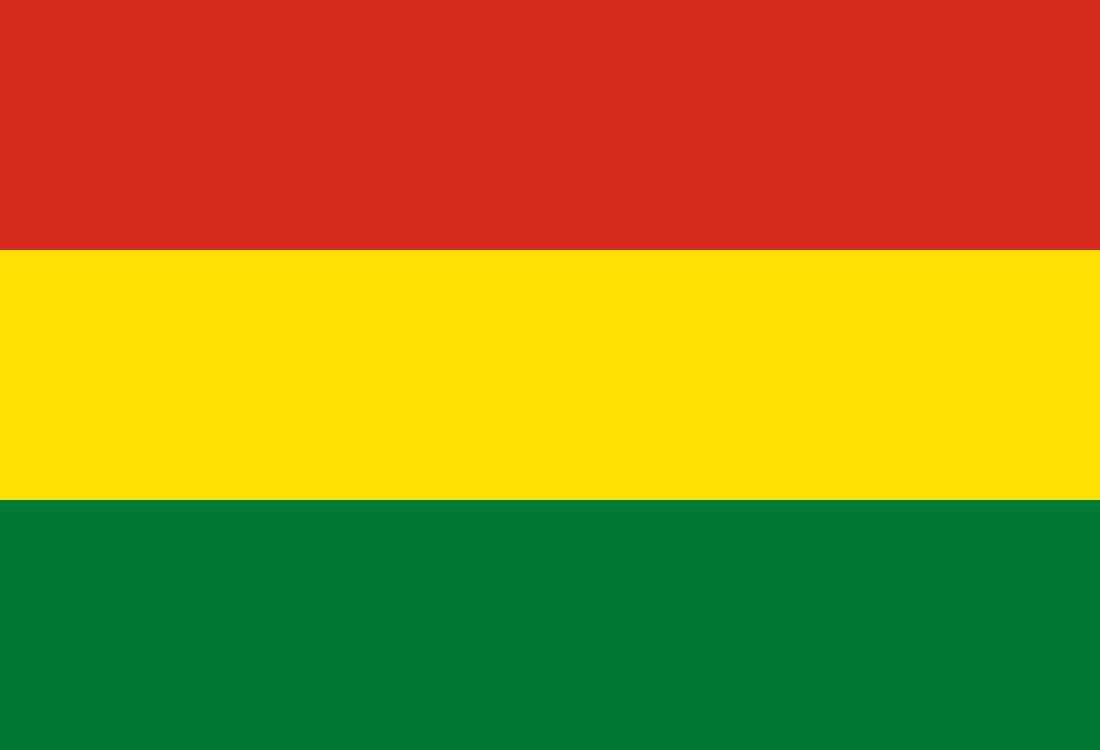
Bolivia’s current plain national flag has equal horizontal red, yellow and green bands. The arrangement dates to 1851. This specimen follows the 15:22 construction in the 2009 decree; institutional flags with arms are distinct variants.
Specification
Constitution article 6(II) recognizes the red, yellow and green tricolor as a state symbol. Supreme Decree 241, articles 5 and 8, specifies equal bands and a rectangle 7.5 C high by 11 C long, each band 2.5 C high. C is a scalable construction unit.
| Provision | Hoist × fly | Interpretation |
|---|---|---|
| Article 8 / general construction | 7.5 C × 11 C | 15:22; specimen used here |
| Article 9(III) / institutional display sizes | 200 × 300 cm; 20 × 30 cm | 2:3; flying and vehicle/desk formats |
The two ratios are not identical. Both occur in the decree; no verified correction resolving their relationship was located. Neither is silently rounded into the other.
Colors
Article 7 refers to a Pantone chart absent from the accessible text transcriptions. Article 23 explicitly names the following for the tricolors within the coat of arms. These contextual references are preserved without claiming independent verification of article 7’s chart.
| Band | Article 23 notation | Local SVG fill |
|---|---|---|
| Red / upper | 485 CVU | #D52B1E |
| Yellow / middle | P-CVU | #FFE000 |
| Green / lower | 356 CVU | #007934 |
The HEX values are retained from the licensed artwork, not certified Pantone conversions. No replacement number for P-CVU, modern suffix, RAL equivalent or textile tolerance is inferred. Article 4(b) calls for approximation to the decree’s tones in textile and other reproduction; this screen specimen cannot serve as a physical color standard.
Construction notes
The SVG has a 1100 × 750 viewBox. Green covers the field, yellow overlays its upper 500 units, and red overlays the upper 250. The visible bands are therefore each 250 units high and span the full fly, with boundaries at y=250 and y=500.
This is an editorial adaptation of flag-icons’ MIT-licensed armorial icon: the three background paths and their fills were retained, coordinates changed to the article 8 ratio, and all armorial paths removed. It is a plain-flag reference rendering, not an official vector master or sewing pattern. It contains no border, script, external resource or raster image.
Historical record
The 1851 law separates two dates: the National Convention approved the measure in Oruro on 31 October; President Manuel Isidoro Belzu ordered its execution on 5 November. Article 1 places red above yellow above green. Those dates identify the adoption of the enduring color arrangement, not the introduction of every detail in the modern specification.
The present specimen should not illustrate earlier Bolivian flags or earlier armorial versions. No individual designer attribution is established by the consulted law. The 2009 Constitution and decree recognize and regulate the continuing tricolor rather than date its creation to 2009.
Meaning and use
Decree article 6 associates red with the sacrifice of national heroes, yellow with mineral and underground wealth, and green with nature and hope. These are statutory meanings, not a claim about the intentions of an identified 1851 designer.
Article 12 addresses civilian display on patriotic and civic occasions. Article 9 prescribes central arms on both faces for the listed public institutions, and additional flanking branches for armed-forces flags. The plain specimen does not depict either armorial form. Articles 10–11 address educational and sporting ceremonies.
Source trail
Reviewed 14 September 2026. Spanish legal text is paraphrased in English; missing charts and dimensional differences remain identified above.
- SENAPI / Constitution of 7 February 2009 — official government text, article 6(II), constitutional status.
- Supreme Decree 241 of 5 August 2009 / LexiVox transcription — articles 4–12 and 23; checked against Infoleyes and Pixi Legal. These are reproductions of legislation, not the official Gazette; the article 7 graphic was unavailable for inspection.
- Law of 5 November 1851 / LexiVox — article 1 and approval/promulgation clauses; the transcription credits the congressional library and historical archive’s legislative compilation.
- Andean Parliament / national-symbols article, 5 August 2026 — contemporary institutional reference to Decree 241 as the governing symbols framework; not a construction standard.
- flag-icons / source SVG and MIT licence — inspected and adapted artwork; local provenance.

Related records: Colombia · Costa Rica · National flags.