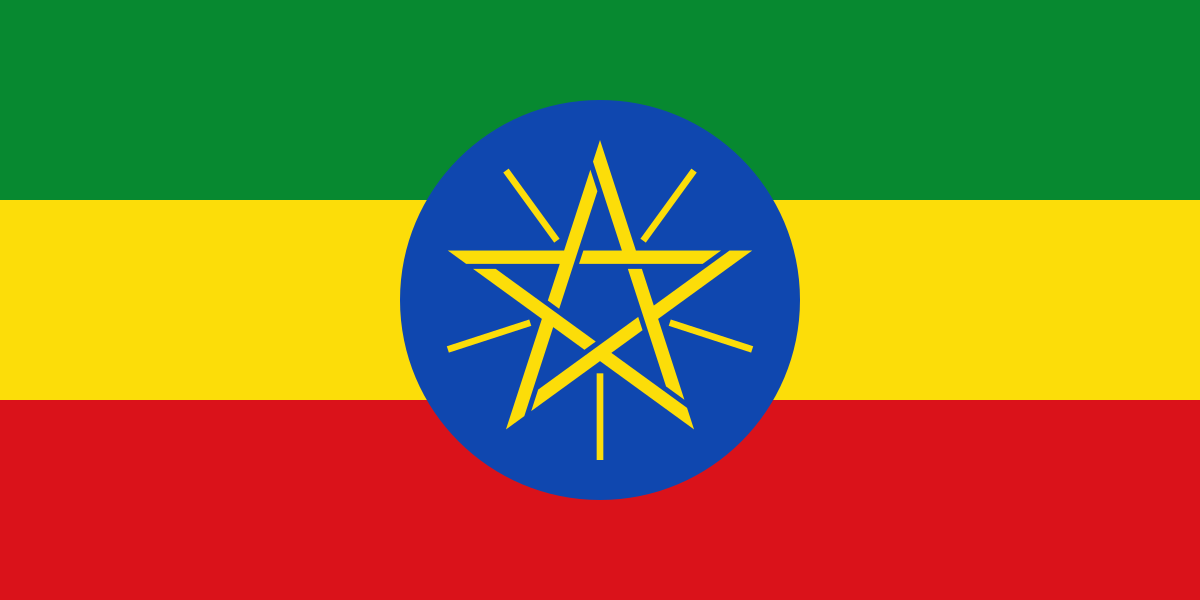
Ethiopia’s current national flag has three equal horizontal bands, green above yellow above red, with a central blue disc containing a yellow five-pointed star and rays. Its legal hoist-to-fly ratio is 1:2. The flag-and-emblem law dates to 6 February 1996; the governing specification used here took effect on 28 August 2009. [2] [3]
Specification
Article 3 of the Constitution requires equal horizontal green, yellow and red bands and a central national emblem. Article 6 of Proclamation 654/2009 fixes the fly at twice the hoist and places the blue disc so that its upper and lower extremes reach the midlines of the green and red bands. The resulting disc diameter is two-thirds of the hoist, a geometric derivation from that wording. [1] [2]
The law describes equal straight yellow lines forming a star and yellow rays radiating from their crossings, on a blue circular background. The Embassy’s current description confirms this design. [2] [5]
Colors
Article 6 calls for bright, basic colors without giving a numeric color system. No official HEX, RGB, Pantone or RAL standard was verified. These fills are read from the inspected SVG and serve only as screen approximations; they do not replace physical production specifications. [2] [6]
#078930 / specimen screen value#FCDD09 / specimen screen value#DA121A / specimen screen value#0F47AF / specimen screen valueConstruction notes
The local SVG has a 1200 × 600 viewBox. Overlapping full-width paths leave three visible bands of 200 units. The disc is centered at (600, 300), with radius approximately 200; its top and bottom are at y = 100 and 500, matching the band-midline rule. The source’s scale factor 1.6666667 introduces only decimal rounding. [2] [6]
A path group repeated at 72° intervals constructs five star points and five rays. In its unscaled coordinates the disc radius is 120, the top star tip is (0, −96), and each ray runs from radius 44 to 96 with stroke width 4. These internal measurements, the apparent breaks at crossings and the exact contours belong to the Commons artwork; they are not dimensions supplied by the legal text. [6]
Evidence limit
The Ministry’s copy of Article 9 has a blank area where the pictorial representation should appear; this was checked in the rendered PDF. The specimen therefore follows Article 6 for the field and disc, and the documented emblem description for its device. It is not a certified manufacturing master. A detailed official emblem drawing and physical color samples remain unverified. [2]
Statutory sizes
Article 10 lists these hoist × fly sizes in centimetres; Article 11 assigns them to different settings. Each retains 1:2. [2]
| Size number | Hoist × fly (cm) |
|---|---|
| 1 | 210 × 420 |
| 2 | 150 × 300 |
| 3 | 135 × 270 |
| 4 | 105 × 210 |
| 5 | 90 × 180 |
| 6 | 21 × 42 |
Historical record
The Constitution took effect on 21 August 1995 and established the flag’s basic layout. The Flag and Emblem Proclamation 16/1996 was published on 6 February 1996. These are separate constitutional and flag-law milestones. [1] [3]
Proclamation 654/2009 took effect on publication, 28 August 2009. Its Article 27 replaces both Proclamation 16/1996 and its amendment 48/1996. The Ministry currently lists the 2009 law as in force. This specimen is catalogued against that later specification; earlier statutory versions are not interchangeable production references. The date does not establish an official change to a particular digital blue value. [2]
Proclamation 863/2014, published on 11 August 2014, changes Flag Day and authority to declare mourning while Parliament is in recess. It does not amend the design clauses. [4]
Symbols and usage
Articles 7–8 associate green with work, fertility and development; yellow with hope, justice and equality; and red with sacrifice and heroism for freedom and equality. Blue signifies peace, the equal lines equality among peoples and religions, the star voluntary unity, and the rays a bright future. These are statutory meanings. [2]
The proclamation covers national display in Ethiopia and use by citizens abroad, diplomatic missions and Ethiopian-registered vessels and aircraft. Its size rules address public squares, government buildings and ceremonial display. The 2014 amendment sets National Flag Day on the first Monday of the Ethiopian month of Tikimit; this is not a fixed Gregorian October date. [2] [4]
Source trail
- Embassy of Ethiopia, Brussels: Constitution, Articles 1 and 3 ↗ — official entity and flag layout; opening proclamation gives commencement on 21 August 1995.
- Federal Negarit Gazeta 58, 28 August 2009: Proclamation 654/2009 ↗ — Articles 5–11 and 27–28; printed pages 4845–4847 and 4855. Article 9’s image area is blank in this copy. Ministry of Justice law record and in-force status ↗.
- Ministry of Justice: Proclamation 16/1996, Gazette 4, 6 February 1996 ↗ — historical flag-and-emblem enactment, superseded by the 2009 law.
- Ministry of Justice: Proclamation 863/2014, Gazette 61, 11 August 2014 ↗ — both scanned pages visually inspected; amendments to Articles 4 and 22.
- Embassy of Ethiopia, Washington: Country Profile ↗ — current official name and flag-and-emblem description.
- Commons: SVG, contributor history and public-domain declarations ↗; local asset provenance and geometry ↗.

Sources checked 15 September 2026. Related records: Kenya and Rwanda. Browse national flags or the Flag Index.