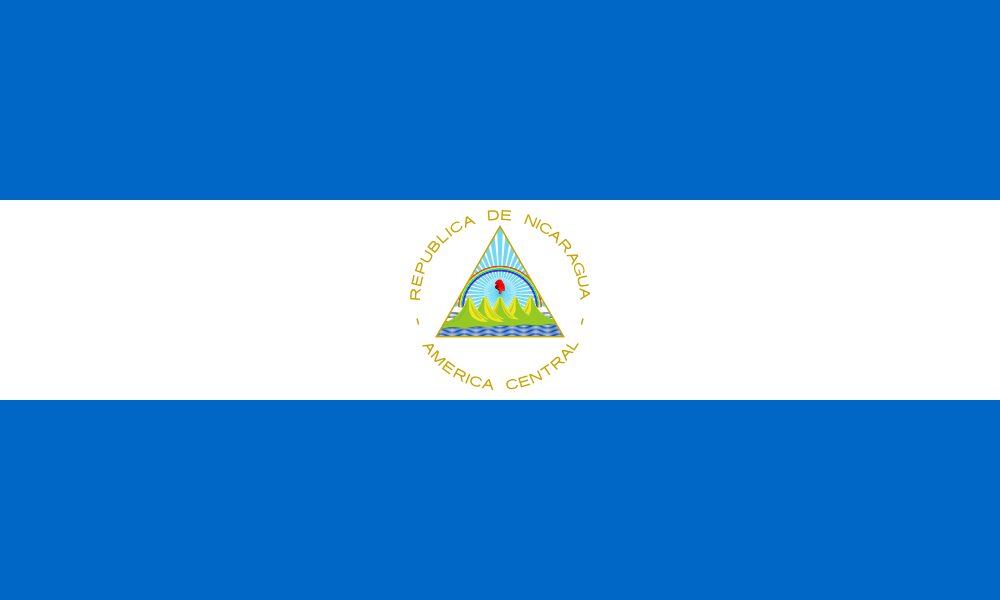
Nicaragua’s current national flag has three equal horizontal bands, cobalt blue above and below white, with the national arms centered on white. Its statutory hoist-to-fly ratio is 3:5. The present design family dates to 1908; detailed rules followed in 1971 and were amended in 2002.
Specification
Article 2 of Decree 1908 supplies the band arrangement, ratio and cobalt-blue name. Articles 42–45 describe and dimension the arms. Read them with Law 432: its amended articles 36 and 46 require the arms, including for festive display on houses and squares.
| Element | Legal specification | Reference treatment |
|---|---|---|
| Field | Three equal horizontal bands; 3:5 overall | 1000 × 600 units; each band 200 high |
| Outer bands | Cobalt blue | SVG #0067C6; screen approximation |
| Middle band | White; national arms in its center | SVG #FFFFFF; centered emblem |
| Arms | Gold-bordered equilateral triangle and circular gold inscriptions | Conventional vector drawing with outlined letters |
The inscriptions read REPUBLICA DE NICARAGUA above and AMERICA CENTRAL below. Inside are an isthmus, five resting volcanoes between two seas, a seven-color rainbow and a radiant liberty cap. Article 43 names yellowish green for the volcanoes, ultramarine seas with white foam, pale-blue sky, white rays and a vermilion cap. No binding HEX, RGB, Pantone or RAL coordinates were verified. The file’s gradients and digital fills illustrate these colors; they do not replace physical standards.
Construction notes
Article 44 uses a 1.50 × 2.50 m flag as its dimensional reference; article 45 requires proportional scaling of the arms. The following are legal measurements, not values inferred from the specimen.
| Feature | Article 44 reference size |
|---|---|
| Outer lettering circle | 45 cm diameter |
| Letters | 2.5 cm high; A 3 cm wide at base; strokes 3.75 mm |
| Triangle | 32.5 cm exterior side; gold border 3.75 mm wide |
| Horizon | 7.5 cm above triangle base |
| Rainbow | 90 mm inner radius; 104 mm outer radius; seven equal bands |
| Liberty cap | 3 cm high; 2.5 cm lower width; 2 cm below rainbow |
| Light rays | 45 rays, each 3° wide, with 5° sky intervals; origin 35 mm above horizon |
The law calls for broad, uniform-stroke sans-serif capitals; it does not name a font. Its isthmus construction divides the lower portions of the triangle’s left and right sides into five and four parts respectively.
What this specimen verifies
The inspected SVG has a 1000 × 600 canvas, with a matching viewBox added locally. A blue background and white path spanning y=200–400 give exact equal bands. The triangle’s exterior base runs from x=435 to x=565, a 130-unit side corresponding to 32.5 cm at this scale; its top is approximately (500,224.874). The surrounding lettering spans approximately a 180-unit circle, corresponding to 45 cm. These principal dimensions agree with the statute.
The retrieved rainbow and ray placement differed from article 44. This local adaptation redraws the rainbow as seven concentric semicircular bands centered at (500,307.459), with inner radius 36 and outer radius 41.6 units: precisely the statutory 90 and 104 mm at this scale. Each band is 0.8 units wide. The ray pattern is repositioned to (500.001,293.459), 14 units or 35 mm above that horizon; its repeated 8° arrangement is retained. Rays are extended beyond the visible sky and clipped by the triangle; the extension is a rendering device, not a new legal dimension.
The field, lettering, triangle, volcanoes, seas and cap paths are retained from the source. Their artistic contours, shading and digital colors are not an approved physical master. The local adaptation follows the measured construction points above without claiming to settle every manufacturing detail. Accessible metadata and a viewBox were also added. All references are internal SVG fragments, with no scripts, fonts, raster images or external resource loads.
Unresolved volcano construction
Law 432 removes the perspective wording from article 42(b) and describes equally high, equidistant volcanoes. It does not amend article 44(e), which still assigns different apparent summit heights to the nearest and farthest volcanoes using perspective. The SVG depicts level summits, consistent with the amended descriptive clause. This record does not claim that this resolves the surviving dimensional conflict. An approved physical pattern would be needed to settle production details.
Historical record
The National Assembly’s 2008 commemorative proceedings reproduce the decree passed on 4 September 1908. Government educational material dates establishment to its executive enactment on 5 September. Those dates describe different stages of the same measure. No designer attribution is asserted.
Decree 1908 is numbered 1908 but dated 25 August 1971: the decree number must not be mistaken for its year. It was published in La Gaceta 194 on 27 August 1971 and took effect on publication. Its article 78 preserves the 1908 legislation; 1971 therefore marks detailed regulation, not the first existence of the flag.
Law 432 was approved on 2 July 2002, published in La Gaceta 135 on 18 July and effective upon publication. It amended emblem description and usage. Earlier unarmorial festive provisions must not be used to describe the current flag as freely interchangeable with a plain triband.
Meaning and use
The Assembly associates blue with justice and loyalty and white with purity and integrity. It interprets the triangle as equality, rainbow as peace, cap as liberty and five volcanoes as the fraternity of the five Central American republics.
The law addresses official buildings, education, household festive display and ceremonial use. Military use is referred to separate rules by article 29. Article 34, as amended, provides for silk reference flags held by public institutions; none of those physical patterns was inspected for this entry. The specimen represents the current armorial national design, without claiming a separately verified naval or military production standard.
Source trail
Reviewed 15 September 2026. Spanish legal sources are paraphrased. The Assembly-hosted texts are official reproductions rather than inspected original Gazette sheets.
- National Assembly / Decree 1908, 1971 — articles 2, 29, 34, 42–46, 78–79; field, arms, measurements and commencement.
- National Assembly / Law 432, 2002 — amendments to the arms, mandatory armorial display and physical reference patterns.
- National Assembly / Símbolos Patrios — current national identity and attributed symbolism.
- National Assembly / 2008 commemorative proceedings — reproduction of the 4 September 1908 legislative decree.
- Ministry of Education / national flag infographic — establishment on 5 September 1908.
- Wikimedia Commons / Flag of Nicaragua.svg — public-domain declaration, C records attribution and subsequent vector contributors; local rights and adaptation audit.

Related records: Honduras · El Salvador · Costa Rica · National flags.