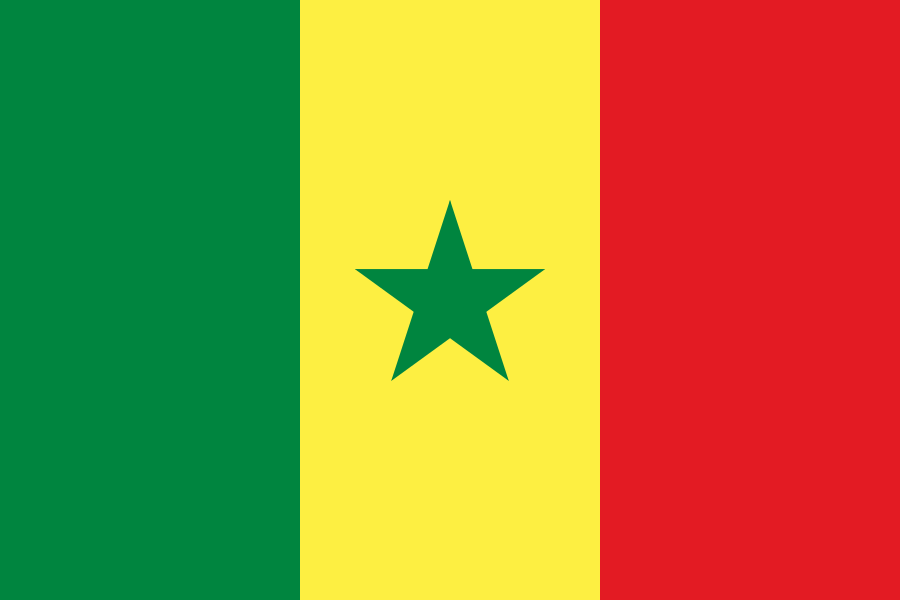
Senegal’s national flag has equal green, gold and red vertical bands, with a green five-pointed star in the center of the gold band. This is the constitutional design and the flag presented by Senegal’s embassy. [1] [2] Its customary hoist-to-fly ratio is 2:3; the current design dates from 1960. [3]
Specification
Article 1 of the Constitution describes three equal vertical bands in green, gold and red and a green star with five points at the center of the gold band. The constitutional name is descriptive: Drapeau de la République du Sénégal. It does not provide numerical proportions, star dimensions or colorimetric values. [1]
Legal wording and reference practice
The specimen places green at the hoist and red at the fly, with one star point upward. Flags of the World reports 2:3 as the usual, potentially de facto ratio and records star diameters ranging from one third to two thirds of a band’s width. Those variations are not a legal tolerance schedule. [3]
Specimen colors
Gold is displayed as yellow. The following fills are read from the SVG and are screen approximations only. No official Pantone, RAL, dye or textile tolerances were verified; these values do not replace a physical production specification. [5]
#00853F / asset screen value#FDEF42 / asset screen value#E31B23 / asset screen valueConstruction notes
The inspected SVG has a 0 0 900 600 viewBox. Three rectangular paths cover x=0–300, 300–600 and 600–900 over the full 600-unit height. Its star is built from mirrored half-points repeated at 72° intervals about (450, 300). The top tip is (450, 200); the outer radius is 100 units, giving a 200-unit circumcircle diameter, two thirds of a band’s width. These measurements describe this vector, not government-approved cutting dimensions. [5]
The star’s circumcenter lies at the flag center; its visible bounding box is not vertically centered because a five-pointed star has one upper tip and two lower tips. Preserve the supplied geometry when scaling. The specimen follows the constitutional arrangement, using one reference choice for details left unspecified in Article 1. It is not a certified manufacturing master. [1]
Historical record
The current design dates to Senegal’s separation from the Mali Federation in 1960. Flags of the World gives 20 August 1960 or September 1960 in its heading, while an older contribution associates the change with 22 August. This record retains the supported year without selecting an unverified proclamation day. [3]
The 22 January 2001 Constitution documents the continuing design; its date is not the flag’s original adoption date. The current embassy description confirms the same arrangement. No designer attribution is made without supporting evidence. [1] [2]
Symbols
The Culture Ministry’s explanation gives green religious associations with the Prophet’s flag, Christian hope and animist fertility. Gold represents wealth earned through work, as well as arts and learning. Red evokes life, sacrifice and determination against underdevelopment. The star expresses openness to five continents and spiritual values; its green conveys the hope of independence. These are government-published interpretations, separate from the constitutional construction wording. [4]
Usage
This entry represents the current national flag identified by Senegal’s embassy. [2] Flags of the World records its use at national ceremonies and celebrations. [3] No additional lettering or arms form part of the constitutional design. [1]
Source trail
- Ministry of Armed Forces: Law 2001-03 of 22 January 2001, Constitution as amended, Article 1 ↗ — legal name and design; no numerical ratio, star grid or colorimetric schedule in the flag clause.
- Senegal Embassy in Brussels: Le Sénégal ↗ — represented entity and current national-flag description.
- Flags of the World: Senegal ↗ — customary ratio, differing star sizes, conflicting adoption dates and ceremonial use.
- Ministry of Culture, Craftsmanship and Tourism: national symbolism ↗ — government interpretation of colors and star.
- Retrieved SVG: country-flags / sn.svg ↗; repository provenance and rights ↗; Commons contributors and public-domain declaration ↗; local asset record ↗.


Sources checked 15 September 2026. Related records: Ghana and Nigeria. Browse national flags or the Flag Index.